Dear Family-Business Owner – your vulnerability is your superpower

Whilst I was drafting this post – a number of stories crossed my newsfeed of owners of family businesses expressing their desire to hold on to their independence and with it financial vulnerability as well as the intense vulnerability experienced whilst leading their organisation. And yes, I believe if we look closely exactly that may be their superpower.

Big corporates always like a best practice to copy. Often they look at the other major players. Maybe it is time to look at the family-owned businesses if we start to shift away from short-term financial profit as the single measure of success and have to build cultures with leadership that creates trust, binds employees, and at the same time enables innovation, disruption, creation.

“We posit that compared to their non-family peers, the likely elevated levels of vulnerability felt by many family firm owners and managers will engender richer and more rewarding social exchanges with those stakeholders”

Hayward M, et. al., Journal of Family Business, 2022 (full source below)

A couple of newly published journal articles in the Journal of Family Business have dug into these topics in family-owned businesses. Here’s what I take-away from them. Family-owned businesses build trust and an excellent attrition of their employees (even binding family members over generations) due to the following:

  • The vulnerability and acute sense of responsibility family-owned business owners feel on a daily basis.
  • Truly caring for their employees and hence offering a safe internal culture that develops along with needs.
  • Their independence from shareholders and the ability to look at the long-term returns versus quarterly balance sheets.

The two papers are different in style – one looking at one family-owned firm as a case study and another looking at a model based on social exchange theory. Yet, their findings support each other, and also support what was shared in the book published by family-business owner Antje von Dewitz, Vaude, which I wrote about here (in German).

“According to employee statements, whether long- established members of the executive team or new employees, they refer to the importance of the family firm’s long-term orientation enabling enduring employment and innovation for generations.”

Rondi E, et al. Journal of Family Business, 2022 (full source below)

This what I take from this research.

As a family-business owner, I can only imagine that intense sense of vulnerability of being in service to the idea, the employees, the customers, the local community. From this research and the work in daring leadership, which explains how vulnerability is our most accurate measure of courage, I invite you to lean in to this discomfort of vulnerability to use it as your superpower – learn all the skills to have courage as well as boundaries, self-compassion as tools to look after yourself.

If I was a startup building my culture – I would be looking at these type of businesses rather than trying to be like the big corporates, the next unicorn. Some really interesting work into this field is being led by the New Mittelstand movement in Germany, which I can only recommend investigating.

And for the big corporates – this only adds another data point to support the need for a change in leadership, culture and strategy. We have to revisit the detachment of business leaders from the pulsing heart of the business. This can only be done if we change our definition of business success away from short-term financial profits, away from strategy based on competitive advantage and succeeding on business metrics to instead looking to provide products, services, solutions that contribute to people, planet and profit.

Source:

One for all, all for one: A mutual gains perspective on HRM and innovation management practices in family firms. Emanuela Rondi, Ruth Überbacher, Leopold von Schlenk-Barnsdorf, Alfredo De Massis and Marcel Hülsbeck. Journal of Family Business Strategy 13 (2022) 100394

How vulnerability enriches family firm relationships: A social exchange perspective. Mathew Hayward, Richard Hunt, Danny Miller. Journal of Family Business Strategy 13 (2022) 100450


Is it getting busier in here? Busyness, uncertainty and the courage to slow down

credit: pixabay

Is it getting busier in here? Busyness, uncertainty and the courage to slow down

Busy. The next meeting – online, offline, over coffee, with lunch, after dinner. Presentations, evaluations, process optimisations, digitalisation, implementations and reorganisations. Emails, instant messages, video calls, meetings. 

You may feel frazzled but isn’t fast a great advantage? In a recent survey McKinsey1 found that speed was associated with better outcomes – the positive effect was seen across all business dimensions, yet particularly in regards to operational resilience and innovation. Yet – here’s the thing – as separately reported McKinsey2 senior business leaders reported feeling busy and overwhelmed whilst getting nothing done and the quality of interactions decreasing.  I remember that feeling well from corporate settings – a constant stream of meetings, project revisions, KPI reporting – being busy with no tangible outcome for the business. 

What is it about the connection here with speed versus busyness with little value added.

When McKinsey talks about an advantage for speed, if you dig into their report, you will find that the barriers reported as getting in the way of speed are silos, slow decision-making and lack of strategic clarity. So, I would argue that the advantage of organisations being ‘faster’ is not about doing more, quicker, and spinning madly. I believe it is about being intentionally focused and calm with a clear strategy, and with a culture that enables employees to take bold business decisions at the right moment and right level,  with the right amount of information and with an appropriate amount of risk. This enables a felt speed – as the right activities and decisions get focused on and delivered upon.

The importance of strategic clarity as seen as one element required for speed – and increased operational resilience and innovation. The research by Leadership Expert Dorie Clark, who focuses on long-term strategic thinking, showed that business executives recognise the importance for long-term strategic thinking yet at the same time report to not have time to do so3. She took her research further to explore why they don’t have time, what is it with the busyness. Here’s the thing, as you will see in her concise Ted Talk4 the perceived busyness is often not about how much you have to do, but is associated with status, uncertainty and numbing (ie avoiding feeling our emotions). That means this busyness achieves the opposite to what would be desired, business leaders are staying busy to avoid decisions, or feeling discomfort and ambiguity. 

So if you want leaders and a corporate culture, where leaders are calm and focused, whilst making courageous decisions based on strategic clarity and collaborating across silos – you want to build the ability to handle discomfort, ambiguity, paradox challenges whilst staying true to agreed upon values and being accountable for mistakes. You want leaders who are able to feel comfortable slowing down in able to speed up.

There are three areas to focus on:

1) At the individual level: Train for skills in courage and handling uncertainty.  Start right at the top of the organisation with this.  You have to slow down to make space, learn about vulnerability, values, trust and resilience. Become brave and kind leaders who pay attention.

2) At the corporate culture level: Create a corporate culture where it is safe for courageous decision-making. And remember, clear is kind.  Culture is defined by a collection of norms, beliefs, values or artifacts. Take a close look at what you are rewarding and what people are held accountable for.

3) At the corporate strategy level: Really focus the corporate strategy to avoid noise, ensure there is alignment with your purpose and values. Understand your stakeholders.

In 2021, the consulting firm Kienbaum did a study5 investigating courage in the workplace – their research led them to define a leader as courageous as being both ‘determined’ and ‘value-driven’ (Entschlossenheit & Werteorientierung). Despite confirming the positive correlation of courage with business performance – they found that only 12% of participants in their study displayed courage as measured by their definition.

The good news is that courage and the ability to handle uncertainty can be developed as leadership skills.  I support leaders develop Daring Leadership, Abundance Mindset and Collaborative Narratives as the cornerstone for courageous and innovative organisations.

Sources: 

  1. https://www.mckinsey.com/business-functions/people-and-organizational-performance/our-insights/the-need-for-speed-in-the-post-covid-19-era-and-how-to-achieve-it
  2. https://www.mckinsey.com/business-functions/people-and-organizational-performance/our-insights/if-were-all-so-busy-why-isnt-anything-getting-done
  3. https://hbr.org/2018/06/if-strategy-is-so-important-why-dont-we-make-time-for-it
  4. https://www.ted.com/talks/dorie_clark_the_real_reason_you_feel_so_busy_and_what_to_do_about_it/transcript?language=en
  5. https://media.kienbaum.com/wp-content/uploads/sites/13/2021/09/Kienbaum_Die-MUTation-der-Arbeitswelt_2021_.pdf
  6. https://brenebrown.com/hubs/dare-to-lead/ 

Longing for divinity – what Bittersweet has to do with our workplaces and daring leadership

During this great resignation employees are leaving workplaces and listing ‘Uncaring leaders’ as their number one reason (source: McKinsey – Gone for now, or gone for good? ). People are desperate for meaning, values, purpose, kindness and leaders who care.

What if we have to go a step further, and consider that employees are desperately seeking both guidance as well as safe story stewardship for their longing for divinity and wholeness. And with no where else to go they are now searching for this in the workplace.

Let’s go a little back in time. Since I read the book “The Gifts of Imperfection” many years ago, I have had an ongoing quest in the back of my mind regarding ‘Faith’ – what is it to me, where do I find it, how do I cultivate it? This came as a result of one of Dr. Brené Brown’s findings in the book that the most wholehearted people cultivate faith in their lives, making her include guidepost #6: Cultivating Intuition and Trusting Faith. This has nothing to do with a religion and Brené Brown offers following definition for faith.

Faith is a place of mystery, where we find the courage to believe in what we cannot see and the strength to let go of our fear of uncertainty.

The Gifts of imperfection, Dr. Brené Brown.

More recently Dr. Jill Bolte Taylor talked in her book Whole Brain Living about how our ‘character 4’ on our right brain side already knows about the deep connection we all share. Also the work by Dr. Martha Beck explores how to let go of culturally-derived values, and follow the longing for warmth and yearnings to stay in our own integrity.

Now with Susan Cain just publishing her newest book “Bittersweet” (published April 2022), I have been provided a further addition to the thinking on our inherent longing for that more beautiful place.

I am an avid fan of the work by Glennon Doyle and how she has cut loose from culturally imposed rules of how things “should” be and writes about it so beautifully in her books (Carry on Warrior, Love Warrior, Untamed). So I was very excited to see that Susan Cain went into a conversation about the findings in her book Bittersweet with Glennon Doyle, Abby Wambach and Amanda Doyle on their podcast We can do hard Things.

It is a beautiful and stirring conversation – do listen to it yourselves – and it resulted in this post. They talk about how that longing or yearning that we feel in those moments of beauty and sadness remind us of the better world that could be, that it ideally makes us stretch together to build such a world even if we never fully reach it. It reminds us that this feeling of longing and bittersweet is a moment that connects us with each other. This really brought for me the point of faith or a longing for divinity together.

Ok – so that’s all great, but what about the workplace?

In the podcast, they also speak about relationships and refer to a finding from Esther Perel to which I went and found this reference in a another article: “In our modern world, we have the unrealistic expectation that our relationships will fill in for the divine, offering wholeness, transcendence and unconditional love”.

So let’s come back to the workplace – I wonder, did the time at home in the pandemic make us realise that we will not find divinity within our relationships? And so now we are off searching for it in our workplace? And that is why if we are not cared for, looked after, if we are made to feel morally compromised, constantly put in competitive situations to go against each other then employees are leaving or burnt-out or certainly not going to be in a best position for healthy striving.

Why is this important? Because we have to have conversations about it – and as it is even more ambiguous and wishy-washy and touchy-feely than even talking about emotions, I fear many organisations will avoid going there. And at the moment business schools are hardly building strong skills and competencies in this area.

For leaders ready to look at this a bit closer, we do have starting points.

The work by Dr. Brené Brown, published in her book Dare to Lead, showed that courageous, wholehearted leaders have in common that they truly care for and connect with their employees. In daring leadership I work to build courageous, wholehearted leaders and work cultures. And I continue to see this as an important first step for leaders – as it teaches what courage is, how to rumble with vulnerability, why values with behaviours are important, what the elements of trust are and how distancing from the stories our minds make up we can gain resilience. So it means skills to sit with uncertainty are built, there is space for the conversations and for being a learner, not a knower.

The Dare to LeadTM program includes how grief gets in the way of LivingBIG, that is the belief every person is doing the best they can, yet it handles the topic of grief with a lot of caution. And I see grief as part of sorrow and bittersweet, about something that is lost and what it may make us yearn for and stretch for with action.

This is where I believe we have to dig deeper and not shy away from conversations around the bittersweet, grief, nostalgia, beauty. These play a critical part of connecting us with our humanity, our longing, our faith and those emotions awe and wonder. It can put us in communion with each other. Taking from Brené Brown’s newest book Atlas of the Heart – we have to become more confident as story stewards to one another.

If you are looking for something concrete to do:

  • Develop your own thoughts, skills and awareness (you can start with books mentioned in this post)
  • Get leaders trained to enable safe workspaces, where vulnerability and uncertainty is allowed (eg. the Dare to LeadTM program)
  • Business schools – do include new programs so leaders come away with empathy and humility
  • Start incorporating and become aware of beauty in your life and workplaces

Although my thoughts here are around the workplace, I believe it is imperative that our education systems and our local governments step up in their responsibilities to engage and enable dialogue on our societies’ values, our moral compass, our desire for communion and connection with each other. As really I am not convinced we want these beautiful, soft issues of humanity to be cared for by large corporate conglomerates.

I leave you with some words from Susan Cain in her conversation with The House of Beautiful Business:

I think it’s possible to admit – not just admit, but embrace – all the bounty of what spiritual longing actually is. That’s completely consistent with deep agnosticism. But we’ve lost sight of that.

House of Beautiful Business. LONGING IS THE SOURCE OF ALL OUR MOONSHOTS, AND ALL OUR LOVE

And if you wonder where I am with my personal quest for faith. I continue to rumble with it, explore, learn and give myself grace whilst doing so. Currently it rests for me around my gratitude practice, the mantra Martha Beck offers “I deserve to live in peace”, my reading of the Tao Te Ching and it’s call to Non-Action, and the Buddhist high virtues of: loving-kindness, compassion, appreciative joy and equanimity.

(Clear is kind: I provide links so you can find my sources and find publications. I have no affiliation with any of these external sites or any return from doing so.)

What if we might have been wrong? … then let’s have the courage to do better now

The Great Attrition triggered surely by our collective recognition of our vulnerability and the finity of our lives has gained significant traction in the US and now in Europe. McKinsey ran a big study and recently shared these numbers, which caught my attention in the blog here.

“More than half of employees who left their job in the past six months did not feel valued by their organization (54 percent) or manager (52 percent), or they lacked a sense of belonging (51 percent). Additionally, 46 percent cited the desire to work with people who trust and care for each other as another reason to quit. Employees want stronger relationships, a sense of connection, and to be seen.”

It’s not about the office, it’s about belonging. McKinsey.com, 13th January 2022. Accessed 19th Jan 2022.

It is good to see our human need for belonging and it’s role in the Great Re-Evaluation, as Arianna Huffington calls it, get the deserved attention.

Small fixes as suggested in this post by McK are a good immediate step.

Yet if we mean the change seriously, I believe this calls for a real re-think of our societal and organisational cultures. Including slowing down, lots of self-awareness work to be able to show up as a courageous and vulnerable leader, and reframing our mindset towards one of abundance and collaboration.

That would include in organisations having to question our productivity and performance measures, including which behaviors and deliverables those measures really create and measure. Or questioning being so occupied with competition, profit, busyness and creating more wealth for the few beneficiaries right at the top of the current structures?

It’s a bumpy path and vulnerability is uncomfortable, we might have to admit some management choices we were part of for example to drive up productivity and consumerism weren’t so great. We have to look at our individual choices – how do we show up towards ourselves and others, what and from whom do we make purchases, what do we have to let go off.

It can also be pretty lonely if you are ready to start down this track, with various shareholders resisting any change and pulling you back when they can.

I am convinced those leading the way with courage will create spaces for people sharing their values in purpose, authenticity and belonging to join them and at some point that magic tipping point for others to follow will happen. In the same way I prefer to believe people are doing their best, I prefer to be part of reimaging a great place that our world is developing towards.

What are the choices you make?

Daring Leadership – it is not about reckless daredevils, but about leaders who courageously show up open to vulnerability and empathy

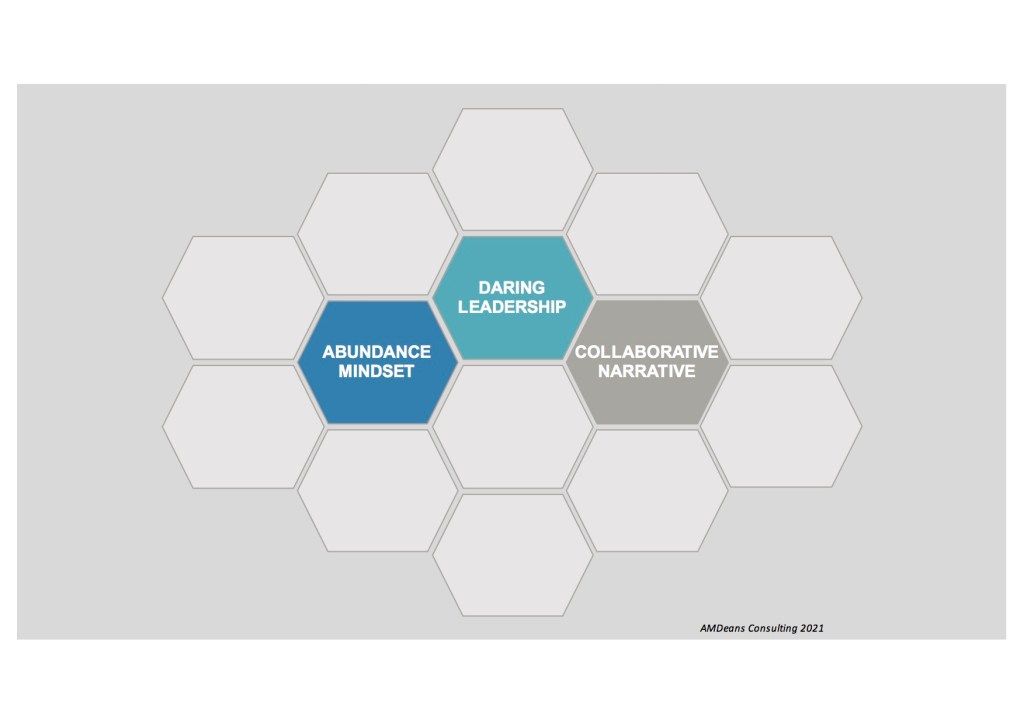
There are three important elements required to reimagine our systems and business models:

  1. Daring Leadership
  2. Abundance Mindset
  3. Collaborative Narrative

In this post I dig in to the term ‘Daring Leadership’ and why I believe it is important at the individual leader level, and also at a cultural level for our societies and organisations.

You are working on a project, your colleague has a great idea for an improvement that is mentioned over a coffee break. However, in the critical meeting no one speaks up. When they do speak up – you notice no genuine interest by those in the room to spend time to dig in to what this change would require. Most of the time in your organisation you seem to be reactively fixing issues, adding a new task force on top of another – rather than taking courageous decisions of stopping projects or blocking a chunk of time to really engage in meaningful dialogue with the experts and take hard decisions.

Time and time again in different organisations I witnessed and participated in similar situations and behaviour – yet I couldn’t quite put words to what was going on. I valued my colleagues individually, yet in our work interactions we seemed to stay in safe places that mid-term felt very dissatisfying regarding the business decisions taken.

Brené Brown opened my eyes and gave me language to explain what is going on in our societies and organisations. By interviewing CEOs and c-level executives Brené Brown collected all the answers to what is required in leaders. The answer she received most often was courage – “We need braver leaders and more courageous cultures”. Did they know how to act with courage and what skills this required? No – was the answer. But then the list, like mine above, started pouring out – behaviours that get in the way of a courageous work culture. This led to a large piece of research by Brené Brown and her group to look closely at the topic of courage and vulnerability in our work cultures.

‘Daring Leadership’ is based on this research by Dr. Brené Brown, Research Professor at the University of Houston, Texas. Other terms that for me relate to Daring Leadership and which are used elsewhere are ‘Servant Leadership’, ‘Courageous Leadership’, ‘The Purposeful Leader’.

If you are a leader living by Daring Leadership principles then you are leaning into vulnerability and staying open to learning, you are caring for and connecting with your stakeholders, you are demonstrating curiosity and empathy and you have the courage to develop the potential in people and processes.

Brené Brown is not alone in her findings of the importance of courage and vulnerability. The best business schools and management consulting firms have started to put major highlight on the importance of trust, vulnerability, empathy and innovation in our workplaces. The recent publication by Hubert Joly “The Heart of Business” is receiving much positive attention for it’s focus on ‘unleashing the human magic’.

Yet, what is significantly harder to find are concrete methodologies that provide you with a way to strengthen your own skill set, provide you with tools and help you recognise when you are on the right path to being a leader and building an organisation with a culture of vulnerability, trust and empathy. Too often it is assumed we are naturally brave or trust is something you just have, or it is easy to come forward with these attributes.

Dare to Lead™ is an empirically based courage building program designed to be facilitated by organisational development professionals. It originated in the publication of Dr. Brené Brown’s research findings in the book Dare to Lead™.

Daring Leadership is unrelated to a companies organisational design. How you draw your organisational chart, whether you like the old-fashioned boxes with dotted and direct lines and classic project management, or you focus on agile methods and new ways of operating, whether you are set up in business and function units or are a process-driven organisation – it really does not matter (and I actually believe overall it does not really matter). Daring Leadership is the cultural and behavioural glue you require for HOW you, your leaders and employees operate within the organisational setting and interact with one another.

So why is Daring Leadership important? In a world that is transforming from shareholder-driven capitalism to a new form of stakeholder capitalism, from individual profit focus to sustainable solutions and with new technological advancements we have to be able to stay curious, foster an environment with diverse thinking, the ability to have tough conversations and dig into uncomfortable decisions. And with all of this we have to care better for each other and our planet.

On an individual level there are steps you can take on your path to Daring Leadership:

First, you become aware of what is happening around you – you observe carefully your own behaviour and that of others around you at the workplace. For example do people come up with and give voice to questions or suggestions, are there ‘meetings-after-the-meetings’ taking place where, what was agreed is altered again and do you feel you are constantly just fire-fighting issues rather than proactively taking the time for hard conversations early when issues start to appear?

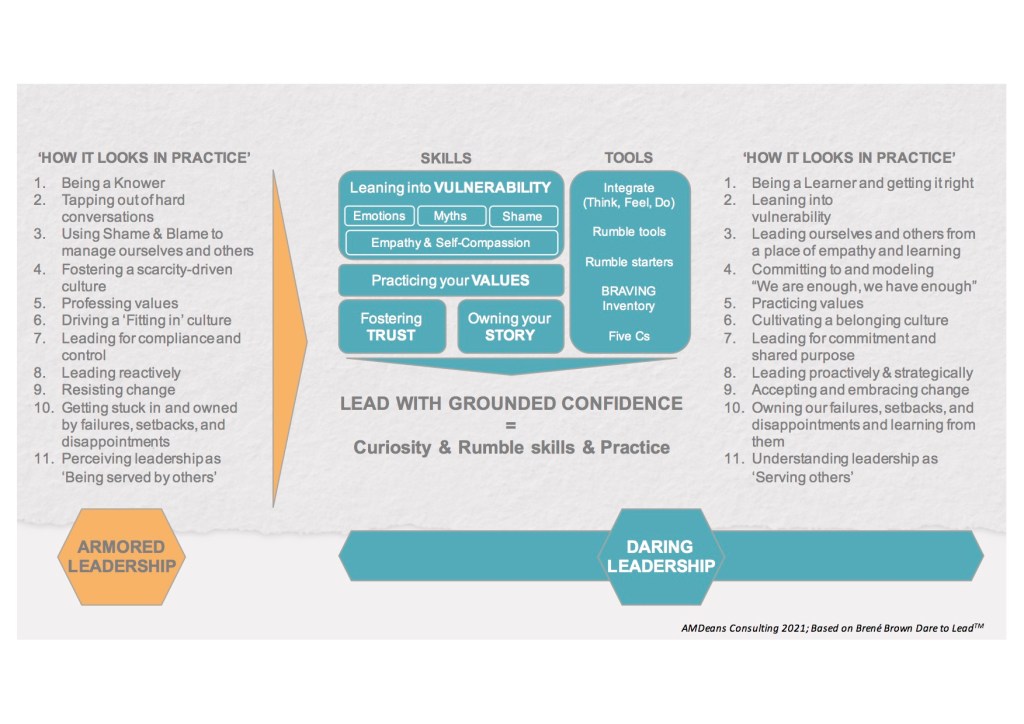
Second, learn the skill sets for courage – by understanding vulnerability, identifying and discovering how to practice your values, understanding the elements required to foster trust and find out how to own and change the stories you develop. To build these skill sets you have amongst others the options depending on your learning preferences to read the book, work with a coach or take part in a Dare to LeadTM facilitated program. The facilitated program is also available to organisations.

Finally, you can develop your practice by integrating tools such as rumble starters into your daily way of working and keep developing the ability to lead with grounded confidence – that is by staying curious, using your rumble skills and practice, practice, practice.

On a societal and business model level we have to focus on building these skill sets in individuals, but also by generating interactions, time and space for meaningful dialogue around our values and also start operating from a notion of an abundance mindset and with new collaborative narratives that define how we measure success.

Summary of the Dare to LeadTM program to develop Daring Leadership, ie leading with Grounded Confidence. Dare to LeadTM is an empirically based courage building program developed by Dr. Brené Brown.
Image by AMDeans Consulting 2021.

Source: You can find more information on the work by Dr. Brené Brown and Dare to LeadTM here.