Active engagement in our local communities – an unachieved priority

What if.. people want to be actively engaged in their community.. and yet are not achieving that?


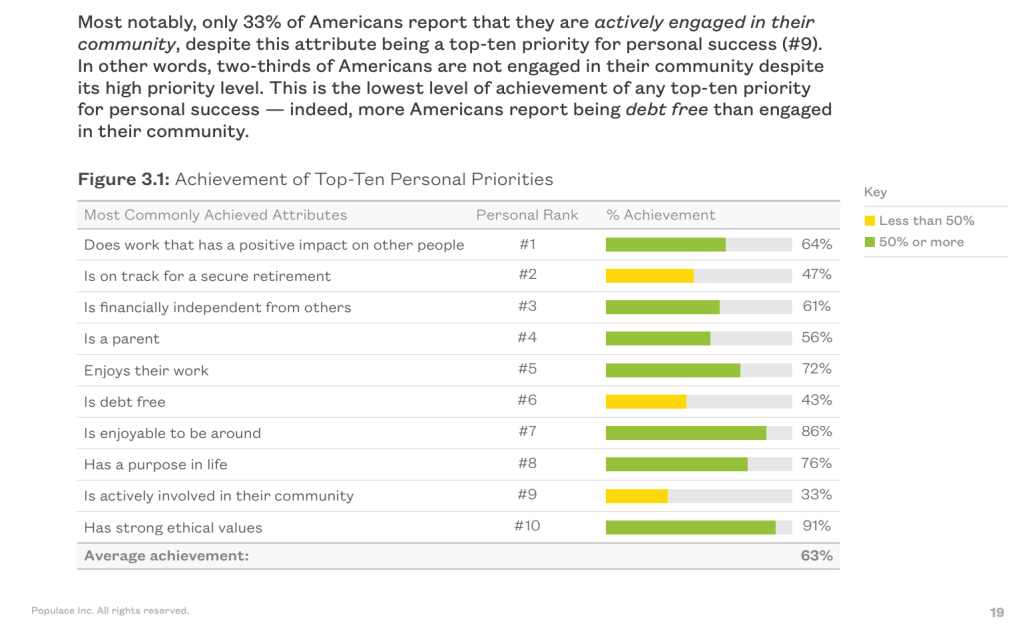
A study in the US that looked at what people privately share as their top personal priorities* and also to what degree do they subjectively feel they achieve against these. Below you see the top 10 results – source Populace, Success Index:
Misunderstanding the American Dream
:

.


Of the individuals reported top 10 priorities – active engagement in their community scores lowest in terms of their feeling if they are achieving it in their lives.

From my other research I know active engagement in our local communities is important for our wellbeing, for building peaceful connections across divides, and for engagement into looking after our local environment. It matters.

My personal experience with community engagement? My observation is for me getting involved in my local community requires space such as small regular chunks of time, free attention to look around myself, and consistency in being present. It’s about familiarity and micro-steps in building trust. It’s quiet, not loud. Sometimes it feels pointless and annoying. The rewards are not what mainstream culture rewards, they are connection, the satisfaction of living into your integrity and fulfilling that priority number 1 of having a positive impact on others in small, hardly noticeable ways.

And maybe it is simply knowing you matter because you feel part of a place. Your community. Where people know you and treat you as part of the community, irrespective of differences you may have.

A shoutout here. This makes me proud to be affiliated with the new initiative PIONIERQUARTIER – which is an amazing team of experts and initiative looking at how to create community spaces with a lower threshold for how to become and stay engaged. 💫

If anything these data are an invitation to question any judgement if people are not engaged because they do not care about their local community, and wonder what if rather there is something in the way of making it happen? What if..?

(*note: these top personal priorities are often not expressed publicly as we self-silence and follow what we believe are societal norms, there is more to this in this study – for example actively engaging in our community is ranked at nr26 for how important supposedly ‘others’ think it is)

Source: If you like reports and data and original sources as much as I do. This is all from the Populace research report on ‘Success index’ (2023) and the conversation by Todd Rose: Populace

Source: I also can highly recommend a listen to Todd Rose talk about his data and the findings in this episode of the Mel Robbins podcast. So much also on belonging, values, trust, and our personal agency.


Getting curious about entitlement – what’s convenience got to do with it?

Entitlement.

A word that’s popped up so frequently in the conversations I’ve had with leaders over the last two years. These are typically conversations about wholehearted daring leadership, courage building, enhancing trust, and all with the goal to achieve the strategic business results with energised, motivated and engaged employees.

Often when entitlement is mentioned there is frustration, uncertainty and armored leadership that comes up with it, hanging in the air like a big question mark. I am sure there is resentment mingling amongst the reactions. 

Here’s the thing I can’t help but get curious about this. What’s the root cause? How do stealth expectations play a role? What is to be done?

First off, as this word entitlement has come up, in German sometimes as ‘Konsumverhalten’, I keep coming back to one thing. Something that surrounds us to such a degree it may easily be overlooked. That is how over the last decades we‘ve been working so hard on making everything as convenient as possible for the individual. 

Examples? Banking, messaging, picture taking and sharing, self-promotion, information accessing, holiday booking, traveling, recruitment etc etc. A latest example that popped up with my software update with an app that will more or less do your journaling for you at the end of your day*. 

So we have basically communicated to people it is important everything is maximally convenient for you. We will trade you convenience for your money and that convenience will validate you are living life well. Yet now we are surprised when we feel our employees display entitlement. Is entitlement not asking for that convenience? For what I deserve?

Second, let’s talk about stealth expectations. These are “A desire or expectation that exists outside our awareness and typically includes a dangerous combination of fear and magical thinking. Stealth expectations almost always lead to disappointment, resentment, and (more) fear.” from Dare to LeadTM.

Both parties – on the ‘non-entitled’ and ‘entitled’ side – are likely harboring stealth expectations. We all do so often throughout our days. On the one side a leader doing their best to build a great work place and on the other side an employee with unexamined messages about being clear on what they deserve. Does reading these two sides already shift something in your thinking? The thing is as Dr. Brené Brown says – stealth expectations if not voiced can lead to disappointment, resentment and fear – that is walls that build up and disconnection from each other.

Finally, what can be done? To not let the uncertainty and resentment build walls, the best first step is to tap into curiosity when the feeling arises. Notice it and get curious about what’s happening. You can always begin with yourself and check about your stealth expectations, were you hoping for a certain reaction? Why? And also include asking questions with your colleagues and within your team to normalise reality-checking of expectations, and their underlying explanations. OK, everyone. Do we think there are any stealth expectations we need to put on the table? What does this mean to you? What is this really about?

I say this as I believe we have to not let the uncertainty lead to walls and instead let curiosity from all sides show where behaviors and reactions are coming from. Not easy but worth striving for. 

Sources: Dare to LeadTM, Dr. Brené Brown and Atlas of the Heart, Dr. Brené Brown

*Side note: This refers to the new Journaling app that has appearred on my iPhone. Not having to reflect whilst journaling may defeat its valuable point, it will surely be a good activity and people tracker if that’s what one seeks. And it’s worth checking the fine print and privacy settings on this new feature, in case you don’t like other people’s phones collecting you having been around them for their journal prompt that eve..


Investing in our aliveness matters

“The wheel is turning, the hamster is dead”

I have chosen a quote from 📚 Michael Bungay Stanier‘s fantastic and funny session on ‘how to work with (almost) everyone’, to sum up what I wish to share from my The_Dream business festival attendance: a quick win, a pay attention, a choice and a permission.

1) Less talking, more doing regarding our inner & outer ecology. It’s time to get the hamsters out of those wheels (alternatively we can use Philosopher Bayo Akomolafe’s reference to not be a Kafkan bug). Ie. how we want to work with each other, how we look after ourselves, how we build skills for wholehearted, courageous leadership. This can be a ‘quick win’ – it is known what can be done. Do it.

2) Speaking the truth – our planetary safety needs degrowth, our geopolitical safety needs growth. That means we have to really drill down into this paradox and align on a global scale to work on solutions. This is taken from Olivia Lazard‘s talk – the speaker who to me stood out most with her bravery, courage to look closely and her ability to grasp and look for solutions around energy transition and global situations. This is about paying attention – don’t look away from hard topics, chose where you want to invest your skill sets, your own behaviour.

3) Every time we invest in technology, we have to also invest in being human – our morality, our ethics, our communities. The messages were clear on how fast technology is moving, I took from it once more confirmation that we cannot expect to ‘teach’ technology ethics, morality if we are not investing similarly into these skills for ourselves and ensuring well grounded, alive human beings, relations and communities. To me this is a choice – let us link tech investment to human investments.

4) Do not mistake dreamers for not also being doers. I met the most amazing people – dreamers AND who have created businesses and institutes and art and graduate schools and new ideas. And who bring new ways of being to their leadership, teaching and interactions. Full of hope, curiosity, passion and desires to develop life-centered businesses. To me this is a permission – please dream, be full of aliveness, that is what our communities and work places need.

Back to that quote and stepping out from the busyness of a turning wheel – only with our aliveness can we tackle all these paradox questions around planetary wellbeing, shaping technological developments and doing so out of a deep care for ourselves and others.

Again, a thanks to the organisers and curators at House of Beautiful Business and all dreamers contributing.

Source: This post is reflecting my experience at The_Dream Business Festival, 2-5 June 2023, Sintra Portugal. Full details of the program is here: https://houseofbeautifulbusiness.com/thedream. I am happy to share more – get in touch.

Dear Family-Business Owner – your vulnerability is your superpower

Whilst I was drafting this post – a number of stories crossed my newsfeed of owners of family businesses expressing their desire to hold on to their independence and with it financial vulnerability as well as the intense vulnerability experienced whilst leading their organisation. And yes, I believe if we look closely exactly that may be their superpower.

Big corporates always like a best practice to copy. Often they look at the other major players. Maybe it is time to look at the family-owned businesses if we start to shift away from short-term financial profit as the single measure of success and have to build cultures with leadership that creates trust, binds employees, and at the same time enables innovation, disruption, creation.

“We posit that compared to their non-family peers, the likely elevated levels of vulnerability felt by many family firm owners and managers will engender richer and more rewarding social exchanges with those stakeholders”

Hayward M, et. al., Journal of Family Business, 2022 (full source below)

A couple of newly published journal articles in the Journal of Family Business have dug into these topics in family-owned businesses. Here’s what I take-away from them. Family-owned businesses build trust and an excellent attrition of their employees (even binding family members over generations) due to the following:

  • The vulnerability and acute sense of responsibility family-owned business owners feel on a daily basis.
  • Truly caring for their employees and hence offering a safe internal culture that develops along with needs.
  • Their independence from shareholders and the ability to look at the long-term returns versus quarterly balance sheets.

The two papers are different in style – one looking at one family-owned firm as a case study and another looking at a model based on social exchange theory. Yet, their findings support each other, and also support what was shared in the book published by family-business owner Antje von Dewitz, Vaude, which I wrote about here (in German).

“According to employee statements, whether long- established members of the executive team or new employees, they refer to the importance of the family firm’s long-term orientation enabling enduring employment and innovation for generations.”

Rondi E, et al. Journal of Family Business, 2022 (full source below)

This what I take from this research.

As a family-business owner, I can only imagine that intense sense of vulnerability of being in service to the idea, the employees, the customers, the local community. From this research and the work in daring leadership, which explains how vulnerability is our most accurate measure of courage, I invite you to lean in to this discomfort of vulnerability to use it as your superpower – learn all the skills to have courage as well as boundaries, self-compassion as tools to look after yourself.

If I was a startup building my culture – I would be looking at these type of businesses rather than trying to be like the big corporates, the next unicorn. Some really interesting work into this field is being led by the New Mittelstand movement in Germany, which I can only recommend investigating.

And for the big corporates – this only adds another data point to support the need for a change in leadership, culture and strategy. We have to revisit the detachment of business leaders from the pulsing heart of the business. This can only be done if we change our definition of business success away from short-term financial profits, away from strategy based on competitive advantage and succeeding on business metrics to instead looking to provide products, services, solutions that contribute to people, planet and profit.

Source:

One for all, all for one: A mutual gains perspective on HRM and innovation management practices in family firms. Emanuela Rondi, Ruth Überbacher, Leopold von Schlenk-Barnsdorf, Alfredo De Massis and Marcel Hülsbeck. Journal of Family Business Strategy 13 (2022) 100394

How vulnerability enriches family firm relationships: A social exchange perspective. Mathew Hayward, Richard Hunt, Danny Miller. Journal of Family Business Strategy 13 (2022) 100450

Is it getting busier in here? Busyness, uncertainty and the courage to slow down

credit: pixabay

Is it getting busier in here? Busyness, uncertainty and the courage to slow down

Busy. The next meeting – online, offline, over coffee, with lunch, after dinner. Presentations, evaluations, process optimisations, digitalisation, implementations and reorganisations. Emails, instant messages, video calls, meetings. 

You may feel frazzled but isn’t fast a great advantage? In a recent survey McKinsey1 found that speed was associated with better outcomes – the positive effect was seen across all business dimensions, yet particularly in regards to operational resilience and innovation. Yet – here’s the thing – as separately reported McKinsey2 senior business leaders reported feeling busy and overwhelmed whilst getting nothing done and the quality of interactions decreasing.  I remember that feeling well from corporate settings – a constant stream of meetings, project revisions, KPI reporting – being busy with no tangible outcome for the business. 

What is it about the connection here with speed versus busyness with little value added.

When McKinsey talks about an advantage for speed, if you dig into their report, you will find that the barriers reported as getting in the way of speed are silos, slow decision-making and lack of strategic clarity. So, I would argue that the advantage of organisations being ‘faster’ is not about doing more, quicker, and spinning madly. I believe it is about being intentionally focused and calm with a clear strategy, and with a culture that enables employees to take bold business decisions at the right moment and right level,  with the right amount of information and with an appropriate amount of risk. This enables a felt speed – as the right activities and decisions get focused on and delivered upon.

The importance of strategic clarity as seen as one element required for speed – and increased operational resilience and innovation. The research by Leadership Expert Dorie Clark, who focuses on long-term strategic thinking, showed that business executives recognise the importance for long-term strategic thinking yet at the same time report to not have time to do so3. She took her research further to explore why they don’t have time, what is it with the busyness. Here’s the thing, as you will see in her concise Ted Talk4 the perceived busyness is often not about how much you have to do, but is associated with status, uncertainty and numbing (ie avoiding feeling our emotions). That means this busyness achieves the opposite to what would be desired, business leaders are staying busy to avoid decisions, or feeling discomfort and ambiguity. 

So if you want leaders and a corporate culture, where leaders are calm and focused, whilst making courageous decisions based on strategic clarity and collaborating across silos – you want to build the ability to handle discomfort, ambiguity, paradox challenges whilst staying true to agreed upon values and being accountable for mistakes. You want leaders who are able to feel comfortable slowing down in able to speed up.

There are three areas to focus on:

1) At the individual level: Train for skills in courage and handling uncertainty.  Start right at the top of the organisation with this.  You have to slow down to make space, learn about vulnerability, values, trust and resilience. Become brave and kind leaders who pay attention.

2) At the corporate culture level: Create a corporate culture where it is safe for courageous decision-making. And remember, clear is kind.  Culture is defined by a collection of norms, beliefs, values or artifacts. Take a close look at what you are rewarding and what people are held accountable for.

3) At the corporate strategy level: Really focus the corporate strategy to avoid noise, ensure there is alignment with your purpose and values. Understand your stakeholders.

In 2021, the consulting firm Kienbaum did a study5 investigating courage in the workplace – their research led them to define a leader as courageous as being both ‘determined’ and ‘value-driven’ (Entschlossenheit & Werteorientierung). Despite confirming the positive correlation of courage with business performance – they found that only 12% of participants in their study displayed courage as measured by their definition.

The good news is that courage and the ability to handle uncertainty can be developed as leadership skills.  I support leaders develop Daring Leadership, Abundance Mindset and Collaborative Narratives as the cornerstone for courageous and innovative organisations.

Sources: 

  1. https://www.mckinsey.com/business-functions/people-and-organizational-performance/our-insights/the-need-for-speed-in-the-post-covid-19-era-and-how-to-achieve-it
  2. https://www.mckinsey.com/business-functions/people-and-organizational-performance/our-insights/if-were-all-so-busy-why-isnt-anything-getting-done
  3. https://hbr.org/2018/06/if-strategy-is-so-important-why-dont-we-make-time-for-it
  4. https://www.ted.com/talks/dorie_clark_the_real_reason_you_feel_so_busy_and_what_to_do_about_it/transcript?language=en
  5. https://media.kienbaum.com/wp-content/uploads/sites/13/2021/09/Kienbaum_Die-MUTation-der-Arbeitswelt_2021_.pdf
  6. https://brenebrown.com/hubs/dare-to-lead/ 

Trust doesn’t need a strategy – it requires common values and skill development.

Up until recently I was responsible for corporate strategy, I remember a project not too long ago together with one of the large management consulting firms looking at best practices in corporate strategy development and strategic planning. We spent hours digging into the details of different models and recommendations. Clearly, I felt it had an important role and I am still convinced particularly by the relevance of strategic thinking.

I also believe in the importance of trust in business and society – today more than ever. Only midway in life, did I learn what trust entails and recognised the importance these skills can have in a business setting.

And at the same time – I do not want to see the two put together for CEOs to create an adaptive trust strategy(1). 

Why?

Strategies are about controlling uncertainty and decision-making, they are done for a business intention and to provide guidance for what to do and more importantly what not to do, to focus attention and priorities so a group of people are working towards common goals. They have been used by big management consultancies in business in relation to scarcity and competition for resources, to ‘speed up’ natural competition and evolution and involve trade-offs. 

Trust on the other hand is not about control. It is not about certainty. It is not a limited resource to be competed for. It is about letting go and being able to let go because of common values, acting reliably and in integrity with defined values, holding accountability, clarity of competencies and boundaries. That is not in an adaptive or planned way – but every time, in every interaction big or small. And when it goes wrong, you make amends and repair with integrity. 

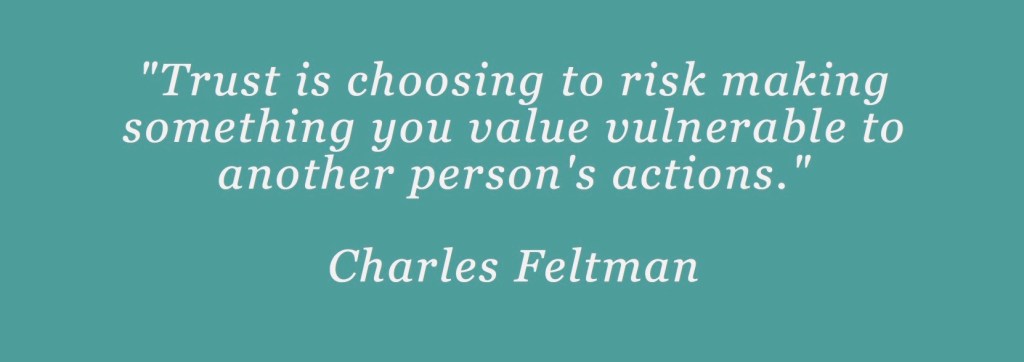
Trust is exactly the glue required to enable interactions when there is uncertainty and ambiguity, when you make something you value vulnerable to another person’s actions, which you have no control over. 

If I do not recommend a strategy, what do I recommend?

The starting point seems to be reminding ourselves of our humanity, our vulnerability and the common values we stand for. As Halla Tomasdottir said so well just the other day:

“Imagine common sense emerging as a governing philosophy. Humanity at the heart of leadership. A future built upon common values.

It’s on each and every one of us to make it so.”

Halla Tomasdottir, LinkedIn 31 May 2022

Further to that, we can move to include skills development around trust in our education systems, executive education and leadership trainings. There are frameworks on the elements of trust, which allow an understanding of what it requires to build and maintain trust.

And to be clear we have to be careful how we integrate product and service delivery within a trust measure as the report I wrote about here does – without reliably delivering a safe product, then even a great leadership team with common values and a great skill set around trust will not make up for the lack of delivery.

In conclusion. Trust is not a finite resource. Not one company has to win or beat others on a devised trustworthiness scale, it has to be inherent to our behaviours and choices as investors, CEOs, leaders and consumers.

(1) Source: The Evolving Role of Today’s CEO: BCG Weekly Brief, May 31 2022

Trust – it has a business value, yet is volatile. Can a new ‘Trust Index’ be the answer for leaders to navigate the topic?

Charles Feltman, The Thin Book of Trust

BCG, the strategy consulting firm, is going deep into the topic of Trust at this year’s WEF in Davos and have published a new report, in which they present a newly developed trust index. You can find the full report here.

Five immediate reflections below to the report, as I find there are interesting details hidden in this big scale research and at the same time it raises questions:

1. Good news for those of us who believe trust is important. They find a strong correlation of their way to assess trust with above-average total shareholder return, better post-crisis performance and higher ESGC scores – so investors will also be paying attention. But oops – a “significant portion of the largest companies received consistently low-trust scores” – plenty to do then! 

2. The overall finding confirms how fickle trust is – slow to build, quick to destroy. It is very variable which firms were in the top 100 list over a time span of 4 years. But those who do stay show strength in looking after their people, good governance, strength in collaboration and innovation. And unsurprisingly they deliver on their products and promises. I’d love to see the list of these 20 companies and look closer at how their leadership team looked within that time span. 

3. A whole report on trust without talking about care, integrity, values. These topics are hidden to a certain degree within BCG’s indicator of ‘Fairness’. Yet is still surprising given how these are weighted in other trust frameworks to not see them get more coverage. I disagree with this being purely ‘systemic trust’. Personally, I believe there needs to be more courage to include these more ambiguous and hard to measure aspects of trust and leadership.

4. Measuring topics has pro’s and con’s. The BRAVING Trust framework from Dare to LeadTM also comes with an assessment. So yes a Trust Index will draw attention to strengths/weaknesses and allow a degree of comparison. Yet if it is handled as primarily a KPI on a dashboard to ‘perform’ against, rather than truly integrate it into leadership behaviour, it may turn into exactly that – a performance. And I would not be surprised if that could send your trust-index score shooting right down.. 

5. Finally – did I miss it? What about looking a little closer at governance and the leaders. Did those with high scores have a stable consistent leadership team, that built and maintained trust by operating with clear values and integrity? How does it match with BCGs diversity score or their innovation rankings?

My work on the topic of ‘Trust’ is based on the research findings by Dr. Brené Brown and the work by Charles Feltman, and I continually integrate additional research and findings. For sure I will be following this ongoing work by BCG closely.

Most importantly – this research confirms the significance and value of investing in trust. Trust is a skill that can be learnt. It has to be maintained with continuous attention to the elements that define trust and addressing what gets in the way of trust in a safe manner. Trust will only be meaningful if leadership from the top truly stands behind their purpose, lives their values with empathy and with humility holds a true stakeholder focus which goes beyond ego, profit and financial returns.

My conclusion? Before adding a new KPI to the dashboard, I would take the money to invest in leadership skills such as those for Daring Leadership, ensure values have clear behaviours to operate by, and have the courage to move from a narrow profit-/performance-based dashboard to a wider collaborative, stakeholder and long-term perspective of success.

Source: What AI Reveals About Trust in the World’s Largest Companies, May 2022, BCG