Investing in our aliveness matters

“The wheel is turning, the hamster is dead”

I have chosen a quote from 📚 Michael Bungay Stanier‘s fantastic and funny session on ‘how to work with (almost) everyone’, to sum up what I wish to share from my The_Dream business festival attendance: a quick win, a pay attention, a choice and a permission.

1) Less talking, more doing regarding our inner & outer ecology. It’s time to get the hamsters out of those wheels (alternatively we can use Philosopher Bayo Akomolafe’s reference to not be a Kafkan bug). Ie. how we want to work with each other, how we look after ourselves, how we build skills for wholehearted, courageous leadership. This can be a ‘quick win’ – it is known what can be done. Do it.

2) Speaking the truth – our planetary safety needs degrowth, our geopolitical safety needs growth. That means we have to really drill down into this paradox and align on a global scale to work on solutions. This is taken from Olivia Lazard‘s talk – the speaker who to me stood out most with her bravery, courage to look closely and her ability to grasp and look for solutions around energy transition and global situations. This is about paying attention – don’t look away from hard topics, chose where you want to invest your skill sets, your own behaviour.

3) Every time we invest in technology, we have to also invest in being human – our morality, our ethics, our communities. The messages were clear on how fast technology is moving, I took from it once more confirmation that we cannot expect to ‘teach’ technology ethics, morality if we are not investing similarly into these skills for ourselves and ensuring well grounded, alive human beings, relations and communities. To me this is a choice – let us link tech investment to human investments.

4) Do not mistake dreamers for not also being doers. I met the most amazing people – dreamers AND who have created businesses and institutes and art and graduate schools and new ideas. And who bring new ways of being to their leadership, teaching and interactions. Full of hope, curiosity, passion and desires to develop life-centered businesses. To me this is a permission – please dream, be full of aliveness, that is what our communities and work places need.

Back to that quote and stepping out from the busyness of a turning wheel – only with our aliveness can we tackle all these paradox questions around planetary wellbeing, shaping technological developments and doing so out of a deep care for ourselves and others.

Again, a thanks to the organisers and curators at House of Beautiful Business and all dreamers contributing.

Source: This post is reflecting my experience at The_Dream Business Festival, 2-5 June 2023, Sintra Portugal. Full details of the program is here: https://houseofbeautifulbusiness.com/thedream. I am happy to share more – get in touch.

Today’s strategic leaders require space more urgently than a neatly orchestrated strategy process

“There are leaders that always have time.
And then there are leaders that never have time.”

Does that ring true to you and your experience? This is what a senior leader recently observed to me and a group of their peers during a recent workshop. Since then, this comment has stuck in my mind. Because all around me I hear of the current busyness in organisations, and not in a ‘this is great there is so much happening’ way but rather in a ‘it’s too much we are all close to burnout’ way.

So what distinguishes those two groups of leaders mentioned above, if of course we all have the same hours in a day and a to-do list, which is never ending?

My hypothesis – we’re back to courage. Courage to make space, take time, be strategic and deliberate in our activities and interactions. Imagine the two groups:

  • A hustle and busyness culture: You stick with a command and control style of leadership, reactively fighting fires and resisting any change.
  • A strategic, deliberate culture: You make the space to invest in delegating power, allow for strategic thought and getting collaborative and curious in the face of change.

Does this mean if you lead with daring leadership everything will get real slow? I doubt it, even if I also believe it may not be the worst thing if there was more focus rather than worrying about speed. Anyway, if you look at it closely, removing the busyness may not be a contradiction to enabling speed. In the last years, McKinsey published work showing that speed can be a business advantage (McKinsey, The need for speed in the post-COVID-19 era—and how to achieve it), yet they also published that leaders report a lot of busyness with little effectiveness (McKinsey, If we’re all so busy why isn’t anything getting done? ).

I don’t have their underlying data, yet when McKinsey talks about an advantage for speed, if you dig into their report, you will find that the barriers reported as getting in the way of speed are silos, slow decision-making and lack of strategic clarity. So, this supports my hypothesis about being intentionally focused and calm with a clear strategy, and with a culture that enables employees to take bold business decisions at the right moment and right level, with the right amount of information and with an appropriate amount of risk. This enables the speed we are looking for – as the right activities and decisions get focused on and delivered upon – or as McKinsey says it themselves in an older 2018 article “Slowing down to speed up”.

What also backs this hypothesis up for me regarding busyness actually getting in the way of strategic work is the work by Business Professor Dorie Clark, who has written and spoken about the fact that busyness is often a mask to avoid facing uncertainty. You can go watch her TED Talk on the topic here.

So this busyness is asking us to have the courage to lean heavily into the discomfort of slowing down. That is making space. Space..

  • … for strategic, deliberate thinking, ideas and reflection, versus rushed firefighting and action bias.
  • … to take the time to align accountability and responsibilities for activities, versus blame and shaming over unclear responsibilities and deliverables.
  • … to allow for providing guidance on work that has been delegated with power to and power with models, versus a quicker ‘power over’ decision or solution,
  • … to respond with empathy to a situation going on with a colleague, versus brushing over it with a sympathetic gesture,
  • … to breath when you notice an emotional hook and get curious, versus letting our eager minds make up a false story.

And for many more examples of showing up with daring leadership behaviours.

As all of you reading this know, leaning into daring leadership is a tough choice, requiring persistence and practice. And yet we can build our courage skills to handle the vulnerability of making that space.

And this is where my activities tie to this work and you are welcome to get in touch with me about:

  1. Providing consulting and facilitation services to build those courage skills within your organisation that enable your leadership team to make and hold space
  2. As an open mindset facilitator certified by OMind support organisations in developing the mindset regarding collaboration
  3. Bringing the dialogue method to you and/or your organisation to create a wide space for strategic thinking and curiosity outside of structured processes and frameworks

I’d love to hear what you do to create and hold space as a leader so we can share and learn from each other around this.  

Image credit: Picture by Adam Thomas on Unsplash

Rethinking strategy or sometimes you have to look backward to move forward

Wrapping up the year 2022, I want to end with a piece of work that is unfinished and at the same time only just beginning. The question whether it is time to rethink the principles underlying business strategy. Does strategy even need a new name?

There are three pillars at the center of my thought-leadership work: leadership, culture and strategy. For me these represent the symbol of integration, that 3-legged stool often used within different concepts – think (strategy), feel (culture), do (leadership). I see the future of these being grounded in daring leadership, an abundance mindset and collaborative narratives.

There is significant awareness how organisational culture is the engine driving success, there is awareness that the main lever shaping the culture is leadership behavior and also which behaviors foster a courageous culture enabling innovation, change and creativity. Yet, strategy – well I see yet little work digging back to the roots of strategy and questioning the engrained concept of strategy being grounded in competition, beating others and winning.

If you go back to the roots of the well-known strategy consultancy, where I had a great experience starting my path into corporate strategy work – the Boston Consulting Group – you will find the classic text by Bruce Henderson on “The origin of strategy”. He was fascinated by the work of Darwin regarding evolution, competitive advantage and survival of the fittest. Bruce Henderson developed a theory to compare natural selection with business, which was grounded in assumptions around having to compete for limited resources. And he saw businesses having the human advantage of adding strategy to the moves they make, “primates possess imagination and the ability to reason logically“. For him using strategy could be revolutionary and faster, versus the slower natural selection of evolution. So far quite interesting..

Yet, this is what I see as complications. Bruce Henderson grounded a lot of his theory into the similarities regarding limited resources. When looking at this for business he talks around the following resources: “The characteristic fundamental resource segments for business are sources of: money, either in capital or in ongoing revenue; suitable skills, abilities and individuals on an ongoing basis; materials, supplies, energy, components not contained within the organization; and knowledge and communication capability with respect to all external resources and factors affecting their availability.

There is no consideration here for planetary limits that all businesses (and species) are bound to. Although he touches upon boundaries at other points in his writing, it is not further considered regarding the competition situation. Is that what may have led us to the situation we are in today?

Bruce Henderson himself adds the following about the observations of natural competition: “Except for the most elementary forms of life, the required resources are other forms of life or activity. This establishes a form of vertical equilibrium. The higher levels prey on the lower levels but cannot live without them. Excessive success is self-defeating.

Excessive success is self-defeating. Yes – so potentially the excessive success of the business principles of the last 30 years have been exactly that: self-defeating, to the point that we are at risk of destroying the basic resources required for all species, including us humans.

Is there an alternative? Can we again look to nature? As clearly despite the ongoing natural competition our planet has been able to be regenerative over a long period of time before humans came along with their ability for strategy.

Yes, I believe we can. If you consider natural selection I can see two differences to think about:

  1. The species are geared towards survival, they are not geared towards ‘winning’ or ‘beating’ other species. That is about mindset, if you like.
  2. Nature often moves to a state of cooperation, which allows the most benefit outcome for the different species and organisations in an ecosystem. Elisabet Sahtouris has written extensively about this and I will be coming back to her work.

So when you are next looking for input on your strategy, looking at the websites of leading business schools on their strategy principles and executive education – pay attention to the language used. Ask yourself is the goal truly to win and beat other companies, organisations and markets? Or is it time to shift up a maturity level also with our strategy principles and re-consider what real success on a people, planetary and profit basis can look like.

Taking one more quote from Bruce Henderson – maybe it is time to go back to his starting point on what makes strategy possible and pay attention the effects of alternative actions.

For strategy to be possible, it is necessary to be able to imagine and evaluate the possible consequences of alternate courses of action. But imagination and reasoning power are not sufficient. There also must be knowledge of competition and the characteristic higher order effects of alternative actions.

Let us be courageous, start changing our mindset, allow for different language in our strategy workshops and consider new definitions of successful outcomes.

Look out for more on this topic in the new year. Share your thoughts with me. And look after yourself – also on an individual level it may be time to let go of having to be more extra-ordinary than the next person. Be you. You are enough. And thanks for your time to read this.

Sources for all quotes in italics are taken from Bruce Henderson and the following two publications:

Bruce Henderson, The Origin of Strategy, Harvard Business Review, 1981

Bruce Henderson, The Concept of Strategy, BCG Publications, 1981

What a Red Queen and a White Queen might tell us about about business

Are you creating the space in your organisation for creativity and anticipation of the future – imagining as many possible scenarios as you can to build a bold new future? Listening to those idealists, visionaries, dreamers, thinkers who share how trends are developing?

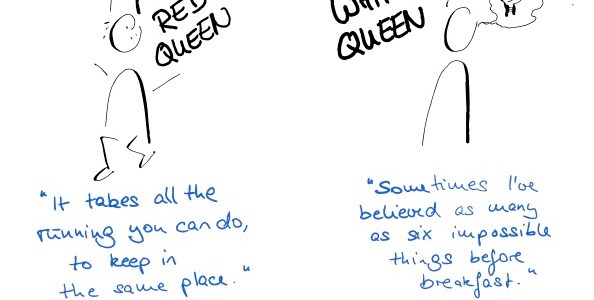
“Now, here, you see, it takes all the running you can do, to keep in the same place. If you want to get somewhere else, you must run at least twice as fast as that!”

Red Queen, Through the Looking-Glass, Lewis Carroll 1871

I remember in my molecular genetics in biotechnology degree many years ago learning about the “Red Queen Hypothesis”. This is used in evolutionary biology to describe how organisms interact in a continuous “arms race” of defence and counter-defence mechanisms. It was called “Red Queen” based on the above quote from the red queen in Lewis Carroll’s book. Now that I have spent 15+ years in business after leaving academic science both on the management consulting side and in the industry – it is very much how business likes to behave. Constant competition both within the organisation (employees, projects, business units, etc) and also outside against other companies (competitors, substitutes, supplier, customers, etc). A lot of running fast to get more efficient and performing in what they already do well, that is known ways of doing business.

Here is the thing though. Today more than ever, we have a good understanding that all this competition against each other is not really going to solve the problems we jointly share – around inequality, climate change, human and planetary wellbeing. Those Dennis Meadows named “Difficult, global problems”. Similarly it leads to a very narrow perspective – the busyness of running to keep still is distracting from real disruptive change. So is it time to shift away from running fast only to keep in the same place?

Sometimes I’ve believed as many as six impossible things before breakfast

White Queen, Through the Looking-Glass, Lewis Carroll 1871

Inspired by the proposition from Eric Muraille in his paper “Diversity Generator Mechanisms Are Essential Components of Biological Systems: The Two Queen Hypothesis” (2018) I would like to extend his thinking around the other queen, the White Queen, towards businesses as a concept.

My reasons for this?

  1. We have difficult, global problems to solve – it requires bold (impossible) thinking
  2. It is time to anticipate how our future can look – have the courage to imagine outside of what we already do
  3. The White Queen is described as child-like – it will require playfulness, curiosity, the right brain

We jointly have one planet. Let us anticipate (at least) six impossible futures that involve courageous, compassionate and collaborative ways of doing business and living.

How to start? Stop running like a Red Queen – make space for long-term thinking, playing, curiosity and reimagining. It might be a little scary to stop running – as there are multiple factors why we tend to stay on that treadmill as I wrote about here – yet there are skills you can learn so you land softly when you bounce of that treadmill and into being.

Sources:

  1. Muraille E (2018) Diversity Generator Mechanisms Are Essential Components of Biological Systems: The Two Queen Hypothesis. Front. Microbiol. 9:223. doi: 10.3389/fmicb.2018.00223
  2. Escaping the Red Queen Effect in Competitive Strategy: Sense-testing Business Models. European Management Journal Vol. 23, No. 1, pp. 37–49, February 2005