“Denken ist handeln” – it’s time to examine our thinking

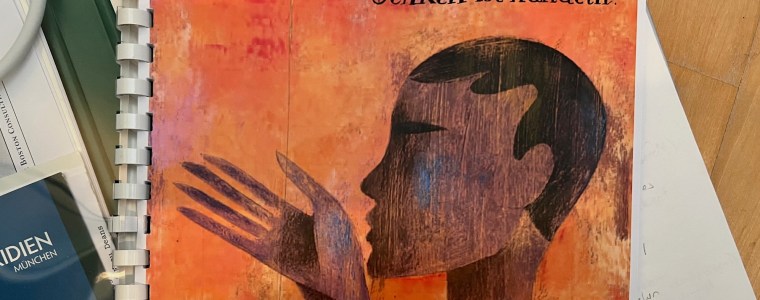
Image: Artist Olaf Hajek 2003. Personal material from the Move On Weekend, Munich 2005, by The Boston Consulting Group.

“Denken ist handeln” takes me back to my first interaction with the large management consultancy I joined after my malaria PhD. That line, “Thinking is for action,” spoke to me. I love ruminating, researching, putting complex bits of information into a digestible big picture, spotting the inconsistencies, the patterns, the messages. I tend to hang out a little longer on the side of thinking than on the side of action.

Yet – today I ask.

What if our thought itself was incorrect?

What if our thought adapted to a world around us and is driven by external messages of “you are not enough until _____” and you fill that blank with an external validation: your school grades, your university, your job titles, your products, your material wealth, your nose shape, your wittiness, your number of likes and followers. A world that we have created and our brains told us this is the only way of doing things.

If there’s one thing that such thought does it keeps us pretty distracted, busy and insecure as our basic desire for worthiness depends on external factors. It turns our opinions into self-identities, as David Bohm writes. It makes conversations into dangerous battle-grounds, as differing opinions are seen as attacks on our inherent internal worthiness and right to belong.

It makes us distracted and complacent.

As I write this, the world is watching atrocities unfold in the Middle East. It feels a little like the final straw on the camels back. I observe we are in pain. Yet, I also sense a discomfort in a sense of how could this happen (again). And a sense of grief for what we realise we are losing. There is also an unsettling silence to not say a wrong thing.

For me this article in the Guardian by Patrick Wintour sums up what I believe is a relevant viewpoint and speaks in a broader sense on other topics such as the loneliness, the anxiety, the questions on how to care for each other and our planet better. His title captures it: “The danger of leaving things be”.

Can we break the cycle of complacency?

Can we channel the regret of what got us here today, into where we put our energy into action tomorrow?

From all the research into the topics of wholehearted, courageous leadership, moving from discussion to dialogue and ways of rethinking strategy and business, I land at these three areas of focus for myself:

  1. Thought: Start with “you are enough”. Full stop. Then get really curious about a lot of other aspects of what we think of as normal and ‘has to be that way’. Ask yourself is it true?
  2. Feeling: Seek out & soak in awe. You can find this witnessing moral beauty in others, music, dance, nature, art. Read words from those that inspire you, watch concert videos, go to an exhibition, dance in the kitchen. Awe connects when the world polarises.
  3. Action: Shift from exploitation to exploration. I hold a deep desire to work with leaders and organisations (exploitation). That rarely allows real disruption and is slow, the logical consequence – it’s time to work with those leaders and organisations at the fringes (exploration).

Now here’s the thing – if we are feeling regret mixed in with all those feelings, according to Dan Pink we have three choices: Delusion, Despair or Action. Let’s choose action.

Sources:

  • David Bohm: On Dialogue.
  • Dan Pink: The power of regret
  • Dacher Keltner: Awe, The transformative power of everyday wonders

Investing in our aliveness matters

“The wheel is turning, the hamster is dead”

I have chosen a quote from 📚 Michael Bungay Stanier‘s fantastic and funny session on ‘how to work with (almost) everyone’, to sum up what I wish to share from my The_Dream business festival attendance: a quick win, a pay attention, a choice and a permission.

1) Less talking, more doing regarding our inner & outer ecology. It’s time to get the hamsters out of those wheels (alternatively we can use Philosopher Bayo Akomolafe’s reference to not be a Kafkan bug). Ie. how we want to work with each other, how we look after ourselves, how we build skills for wholehearted, courageous leadership. This can be a ‘quick win’ – it is known what can be done. Do it.

2) Speaking the truth – our planetary safety needs degrowth, our geopolitical safety needs growth. That means we have to really drill down into this paradox and align on a global scale to work on solutions. This is taken from Olivia Lazard‘s talk – the speaker who to me stood out most with her bravery, courage to look closely and her ability to grasp and look for solutions around energy transition and global situations. This is about paying attention – don’t look away from hard topics, chose where you want to invest your skill sets, your own behaviour.

3) Every time we invest in technology, we have to also invest in being human – our morality, our ethics, our communities. The messages were clear on how fast technology is moving, I took from it once more confirmation that we cannot expect to ‘teach’ technology ethics, morality if we are not investing similarly into these skills for ourselves and ensuring well grounded, alive human beings, relations and communities. To me this is a choice – let us link tech investment to human investments.

4) Do not mistake dreamers for not also being doers. I met the most amazing people – dreamers AND who have created businesses and institutes and art and graduate schools and new ideas. And who bring new ways of being to their leadership, teaching and interactions. Full of hope, curiosity, passion and desires to develop life-centered businesses. To me this is a permission – please dream, be full of aliveness, that is what our communities and work places need.

Back to that quote and stepping out from the busyness of a turning wheel – only with our aliveness can we tackle all these paradox questions around planetary wellbeing, shaping technological developments and doing so out of a deep care for ourselves and others.

Again, a thanks to the organisers and curators at House of Beautiful Business and all dreamers contributing.

Source: This post is reflecting my experience at The_Dream Business Festival, 2-5 June 2023, Sintra Portugal. Full details of the program is here: https://houseofbeautifulbusiness.com/thedream. I am happy to share more – get in touch.

Is it getting busier in here? Busyness, uncertainty and the courage to slow down

credit: pixabay

Is it getting busier in here? Busyness, uncertainty and the courage to slow down

Busy. The next meeting – online, offline, over coffee, with lunch, after dinner. Presentations, evaluations, process optimisations, digitalisation, implementations and reorganisations. Emails, instant messages, video calls, meetings. 

You may feel frazzled but isn’t fast a great advantage? In a recent survey McKinsey1 found that speed was associated with better outcomes – the positive effect was seen across all business dimensions, yet particularly in regards to operational resilience and innovation. Yet – here’s the thing – as separately reported McKinsey2 senior business leaders reported feeling busy and overwhelmed whilst getting nothing done and the quality of interactions decreasing.  I remember that feeling well from corporate settings – a constant stream of meetings, project revisions, KPI reporting – being busy with no tangible outcome for the business. 

What is it about the connection here with speed versus busyness with little value added.

When McKinsey talks about an advantage for speed, if you dig into their report, you will find that the barriers reported as getting in the way of speed are silos, slow decision-making and lack of strategic clarity. So, I would argue that the advantage of organisations being ‘faster’ is not about doing more, quicker, and spinning madly. I believe it is about being intentionally focused and calm with a clear strategy, and with a culture that enables employees to take bold business decisions at the right moment and right level,  with the right amount of information and with an appropriate amount of risk. This enables a felt speed – as the right activities and decisions get focused on and delivered upon.

The importance of strategic clarity as seen as one element required for speed – and increased operational resilience and innovation. The research by Leadership Expert Dorie Clark, who focuses on long-term strategic thinking, showed that business executives recognise the importance for long-term strategic thinking yet at the same time report to not have time to do so3. She took her research further to explore why they don’t have time, what is it with the busyness. Here’s the thing, as you will see in her concise Ted Talk4 the perceived busyness is often not about how much you have to do, but is associated with status, uncertainty and numbing (ie avoiding feeling our emotions). That means this busyness achieves the opposite to what would be desired, business leaders are staying busy to avoid decisions, or feeling discomfort and ambiguity. 

So if you want leaders and a corporate culture, where leaders are calm and focused, whilst making courageous decisions based on strategic clarity and collaborating across silos – you want to build the ability to handle discomfort, ambiguity, paradox challenges whilst staying true to agreed upon values and being accountable for mistakes. You want leaders who are able to feel comfortable slowing down in able to speed up.

There are three areas to focus on:

1) At the individual level: Train for skills in courage and handling uncertainty.  Start right at the top of the organisation with this.  You have to slow down to make space, learn about vulnerability, values, trust and resilience. Become brave and kind leaders who pay attention.

2) At the corporate culture level: Create a corporate culture where it is safe for courageous decision-making. And remember, clear is kind.  Culture is defined by a collection of norms, beliefs, values or artifacts. Take a close look at what you are rewarding and what people are held accountable for.

3) At the corporate strategy level: Really focus the corporate strategy to avoid noise, ensure there is alignment with your purpose and values. Understand your stakeholders.

In 2021, the consulting firm Kienbaum did a study5 investigating courage in the workplace – their research led them to define a leader as courageous as being both ‘determined’ and ‘value-driven’ (Entschlossenheit & Werteorientierung). Despite confirming the positive correlation of courage with business performance – they found that only 12% of participants in their study displayed courage as measured by their definition.

The good news is that courage and the ability to handle uncertainty can be developed as leadership skills.  I support leaders develop Daring Leadership, Abundance Mindset and Collaborative Narratives as the cornerstone for courageous and innovative organisations.

Sources: 

  1. https://www.mckinsey.com/business-functions/people-and-organizational-performance/our-insights/the-need-for-speed-in-the-post-covid-19-era-and-how-to-achieve-it
  2. https://www.mckinsey.com/business-functions/people-and-organizational-performance/our-insights/if-were-all-so-busy-why-isnt-anything-getting-done
  3. https://hbr.org/2018/06/if-strategy-is-so-important-why-dont-we-make-time-for-it
  4. https://www.ted.com/talks/dorie_clark_the_real_reason_you_feel_so_busy_and_what_to_do_about_it/transcript?language=en
  5. https://media.kienbaum.com/wp-content/uploads/sites/13/2021/09/Kienbaum_Die-MUTation-der-Arbeitswelt_2021_.pdf
  6. https://brenebrown.com/hubs/dare-to-lead/ 

Reflections on 50 years ‘The limits of growth’ – let’s invest in the skill sets and mindset to be ‘Courageous. Enough. Together’

I am convinced we require courage and caring; we require the ability to recognise what we have versus being driven by external wants; and we have to seek true collaboration based on our common vulnerability and a common goal to build “The Mature Society” – a term coined by Dennis Meadows.

Professor Dennis Meadows is not a name I was familiar with up until very recently. Also his work was not something I was aware of. That is the “Limits of Growth” research and work published now 50 years ago.

That is although I worked in management consulting advising business leaders on structuring their businesses. The job was not to be concerned with a full view and long-term thinking on people, planet, profit. It was a view on competitive advantage, profit and total shareholder return – that is excluding the occasional non-profit engagements. Dominant topics requested by industry to management consultancies were to cut FTE, benchmark and optimise sales numbers, find reasons to raise prices, perfect patient funnels or customer journeys, and outsource to somewhere (still) cheaper (globalised) where possible. More sales at higher prices, cheaper costs of resources, and consistent growth of the financials was the goal.

So back to Dennis Meadows and the original work in 1972. At the time an international team of researchers at the Massachusetts Institute of Technology began a study looking at the implications of continued worldwide growth. The findings: The earth’s interlocking resources – the global system of nature in which we all live – probably cannot support present rates of economic and population growth much beyond the year 2100, if that long, even with advanced technology. A strong message – that got completely belittled and ignored.

It was the work published by anthropologist James Suzman that brought my attention to this report, as well as how it was received back then. So as my attention on the topic was raised, I grabbed the opportunity on the 7th June 2022, to watch a live transmission of Dennis Meadows presenting to The New Institute Hamburg titled “Reflections on The Limits to Growth at 50 & 80”. ’50’ being the years since his original presentation of The Limits of Growth in 1972 at the Smithsonian Institution and ’80’ being his age in 2022.

I took away three key messages and learnings shared by Dennis Meadows to reflect on:

  1. Ignore your doubts and be persistent with your contributions
  2. The findings of the model were accurate, yet were not addressed as they are “difficult, global problems”
  3. Create a positive alternative and a goal to drive hope

1. Ignore your doubts and be persistent with your contributions. Dennis Meadows shared one of his main thoughts before going on stage back then in 1972. And it was this: “This is completely obvious“. His research and finding seemed to him to be obvious, and that it was not worth him telling the collected group of scientists and journalists. And yet it was not obvious. It was ignored. Did that make him give up on the work? No, he continued and 50 years later is still hopeful for our ability to take action.

2. The findings of the model were accurate, yet were not addressed. Dennis Meadows shared how simple the model was focusing on just five aspects: population increase, agricultural production, nonrenewable resource depletion, industrial output, and pollution generation. Yet from the scenarios the ‘standard run’ represents real-life happenings leading to where we are today 50 years later. He reflects openly on failure “We completely failed to achieve our purpose“. He then linked this failure to our (politics, business, societies) lack of ability to tackle “difficult, global problems” – that is problems, which generate returns in the long-term (vs. short-term) (that is ‘difficult’) and which require global solutions, so cannot be solved with local actions (that is ‘global’).

3. Create a positive alternative and a goal to drive hope. Finally, he talked about what is required for us to work together and find solutions, rather than moving in the direction of “less liberty, in exchange for less chaos” – based on the basic social law. In his perspective it links to first what is required for hope: “It requires a sense of humanity (collective ethics and values) plus tools to give hope“. And second Dennis Meadow explained what he would change “If I were to go back.. we need to offer a positive alternative“. His finish is a proposal for that alternative scenario to stimulate discussion and activity around this: “The mature society”.

I attended a further event on the “50 Years of The Limits of Growth” hosted by the Club of Rome on the 14th June 2022. Prof. Dennis Meadows shared the above learnings once more in his keynote and a panel discussion took place moderated by Sandrine Dixson-Declève, Co-President of the Club of Rome. I noted in particular following thoughts to pursue (I attempt to attribute these to the panel speakers, wording may not be accurate):

  • People are currently affected by the 3 Cs – Covid. Climate. Conflict. (Sandrine Dixson-Declève)
  • GDP is not measuring what is worthwhile measuring. (Tim Jackson)
  • A new business school is required. (Tim Jackson / Sandrine Dixson-Declève)
  • Care for place. Care for community. (Kate Raworth)
  • Have courage of our convictions. (Sandrine Dixson-Declève)
  • Look at positions of power: those who it suits well and do well in it will not change it. (?)

With Sandrine Dixson-Declève wrapping the overall discussion up well – saying let’s make Jane Goodall proud and use our intellect wisely.

Jane Goodall in a book written with Douglas Abrams lays out her reasons for hope: the amazing human intellect, the resilience of nature, the power of young people, the indomitable human spirit. “Let us use the gift of our lives to make this a better world.”

Hope itself is not an emotion – it is a way of thinking and is based on having three things: realistic goals, pathways to get there (not one but multiple) and agency – we believe in ourselves. “Hope is a function of struggle – we develop hope not during the easy or comfortable times, but through adversity and discomfort”.

How can the work on reimaging systems and culture towards the concepts of Daring Leadership, Abundance Mindset and Collaborative Narratives play a part in creating this “The Mature Society”?

These are the opportunities and contributions I see and will continue to work on:

Daring Leadership: Courageous leaders can handle their vulnerability, can lead from the head and heart. They can stay curious and generous, stick with the messy middle of problem identification and solving, and listen with the same passion with which we want to be heard. These are skills to be teaching at school, in business schools and the further development of current leaders.

Abundance Mindset: To slow down our consumption and increase our well-being, we have to move from scarcity-fuelled fears and externally-created wants to recognising what we have (and yes this may not be material wealth and rather go back to the roots of our mental, spiritual, physical wellbeing) as well as understand that we have enough to make a change, that is to give us that sense of agency.

Collaborative Narratives: It is imperative to move from competitive to collaborative thinking to address current challenges and particularly to address the ‘global problems’ described by Dennis Meadow. No one can ‘win’ alone, as then we all lose. An aspect of this is the ability to address paradox challenges and recognise the vulnerability we all have in common with each other and the planet.

In short it is about being Courageous. Enough. Together.

  • Sources:
  • Professor Dennis Meadows, Online Presentation, hosted by: The New Institute, date: Hamburg 7th June 2022.
  • Professor Dennis Meadows, Online Presentation, hosted by: The Club of Rome, date: 14th June 2022.
  • Book: The Book of Hope: A Survival Guide for Trying Times, by Jane Goodall and Douglas Abrams, with Gail Hudson
  • Book: Atlas of the Heart, Brené Brown, 2022
  • Book: Dare to Lead, Brené Brown, 2019.

Trust doesn’t need a strategy – it requires common values and skill development.

Up until recently I was responsible for corporate strategy, I remember a project not too long ago together with one of the large management consulting firms looking at best practices in corporate strategy development and strategic planning. We spent hours digging into the details of different models and recommendations. Clearly, I felt it had an important role and I am still convinced particularly by the relevance of strategic thinking.

I also believe in the importance of trust in business and society – today more than ever. Only midway in life, did I learn what trust entails and recognised the importance these skills can have in a business setting.

And at the same time – I do not want to see the two put together for CEOs to create an adaptive trust strategy(1). 

Why?

Strategies are about controlling uncertainty and decision-making, they are done for a business intention and to provide guidance for what to do and more importantly what not to do, to focus attention and priorities so a group of people are working towards common goals. They have been used by big management consultancies in business in relation to scarcity and competition for resources, to ‘speed up’ natural competition and evolution and involve trade-offs. 

Trust on the other hand is not about control. It is not about certainty. It is not a limited resource to be competed for. It is about letting go and being able to let go because of common values, acting reliably and in integrity with defined values, holding accountability, clarity of competencies and boundaries. That is not in an adaptive or planned way – but every time, in every interaction big or small. And when it goes wrong, you make amends and repair with integrity. 

Trust is exactly the glue required to enable interactions when there is uncertainty and ambiguity, when you make something you value vulnerable to another person’s actions, which you have no control over. 

If I do not recommend a strategy, what do I recommend?

The starting point seems to be reminding ourselves of our humanity, our vulnerability and the common values we stand for. As Halla Tomasdottir said so well just the other day:

“Imagine common sense emerging as a governing philosophy. Humanity at the heart of leadership. A future built upon common values.

It’s on each and every one of us to make it so.”

Halla Tomasdottir, LinkedIn 31 May 2022

Further to that, we can move to include skills development around trust in our education systems, executive education and leadership trainings. There are frameworks on the elements of trust, which allow an understanding of what it requires to build and maintain trust.

And to be clear we have to be careful how we integrate product and service delivery within a trust measure as the report I wrote about here does – without reliably delivering a safe product, then even a great leadership team with common values and a great skill set around trust will not make up for the lack of delivery.

In conclusion. Trust is not a finite resource. Not one company has to win or beat others on a devised trustworthiness scale, it has to be inherent to our behaviours and choices as investors, CEOs, leaders and consumers.

(1) Source: The Evolving Role of Today’s CEO: BCG Weekly Brief, May 31 2022

Mutig voran – die Unternehmerin Antje von Dewitz zeigt auf, wie wir uns mit einer Vision und Vertrauen den Herausforderungen stellen können

In meinem Ansatz geht es um ein Führungsverständnis und eine Kultur, welche auf Mut, Empathie, Werten und Vertrauen basiert (Daring Leadership); mit einer Haltung, das wir genug haben, um die Offenheit für Innovation zu ermöglichen (Abundance Mindset); sowie über die Notwendigkeit von echter Kollaboration, um gemeinsam Lösungen zu ermöglichen (Collaborative Narratives).

Doch gibt es Beispiele, das es möglich ist in einem Unternehmen folgendes zu erreichen: Vertrauensorganisation als Kultur leben, Infrastruktur bereitstellen um Diversität zu fördern, Nachhaltigkeit im gesamten Unternehmen verankern trotz Widerstände, und langfristig zu wirtschaften anstatt kurzfristige Gewinne vorzuziehen? Ja! Und ich kann folgendes Buch sehr empfehlen: “Mut steht uns gut!” von Antje von Dewitz. Bei der Übernahme des Familienunternehmens hat sie nicht auf Trends und externen Druck gewartet, sondern ist als Unternehmerin und Mensch mutig ihrer Vision gefolgt und hat diese umgesetzt.

Ich folge dem gesunden Menschenverstand. Wir haben ein positives Menschenbild. Wir glauben daran, dass die Menschen, die hier arbeiten, gerne hier arbeiten und ihr Bestes einbringen wollen.

Antje von Dewitz, Interview im Manager Magazin 20.10.2020 hier

Bereits in den letzten Jahren wurde ich durch Artikel und Podcasts auf die Arbeit von Antje von Dewitz als Geschäftsführerin des Familienunternehmens Vaude aufmerksam. Doch erst jetzt kam ich dazu ihr Buch zu lesen. Es hat mich tiefst beeindruckt.

In dem Buch teilt Antje von Dewitz was sie als Unternehmerin bzgl. Vision, Vertrauen, Diversität und Nachhaltigkeit bei der Übernahme des von ihrem Vater gegründeten Unternehmen Vaude gemacht hat. Das wichtige dabei – sie hat es gemacht. Sie ist mit ihrem Team und den Mitarbeitern durch die Höhen und Tiefen der Umsetzung einer Vision und neuen Unternehmenskultur gegangen, um wirklich durchgehend nachhaltig zu werden. Im Buch teilt sie was sie auf diesem Weg gelernt hat und warum es sich rentiert. Rollenmodelle wie diese brauchen wir, um Mut und Hoffnung zu schöpfen für andere Unternehmen und die Zukunft.

Als Antje von Dewitz 2009 das Familienunternehmen übernommen hat, hatte sie eine klare Vision – mit Bezug auf starken Produkten, einer Werteorientierung und konsequenter Rücksicht auf Mensch und Natur. Sie hatte sich bereits vor der Übernahme in ihrer Forschung mit der Rolle von Vertrauen und der Motivation von Mitarbeitern auseinandergesetzt. Für mich beschreibt der folgende Auszug ihre Elementare Erkenntnis, die hinter allem steht, um ihre Vision zu erreichen.

Unser nachhaltiger Weg stellt uns (Vaude) immer wieder vor scheinbar unüberwindbare Hindernisse[…]Als Pioniere müssen wir immer wieder kreativ werden und miteinander eine machbare Lösung finden.

Diesen Einsatz, der viel Kraft und Erfindungsgeist erfordert und schwer messbar ist, kann ich nicht von Mitarbeitenden erwarten, die sich fremdbestimmt fühlen und ihr eigenes Leben dem Unternehmen unterordnen müssen. Für diesen Weg brauchen wir den ganzen Menschen mit Herz, Seele und Verstand und seiner ganzen Energie.

Antje von Dewitz, Mut steht uns gut!, 2020 Benevento Verlag

Ich teile diese Einsicht, und bin überzeugt, dass wir mit Blick auf den aktuellen Herausforderungen dringend an der Unternehmenskultur, Werten und Haltung arbeiten müssen, um Kreativität zu ermöglichen und mit kollaborativen Ansätzen Lösungen zu finden.

Antje von Dewitz hatte also eine Vision und wusste auch. “Unser Führungsverständnis und Unternehmenskultur sollte sehr bewusst und durchgängig auf Vertrauen und Wertschätzung aufbauen”. Später hat sie auch die Notwendigkeit, die Werte schriftlich festzuhalten, gesehen um damit die Position des Unternehmens klarzumachen. Für demokratische Werte einstehen, dabei auch die Stimme zu erheben und Haltung zu zeigen.

Sie hat viel investiert, um dieses Führungsverständnis und die Unternehmenskultur über viele Jahre gemeinsam mit den Führungskräften und Mitarbeitern aufzubauen. Das Buch beschreibt gut, nach welchen Ansätzen sie mit externer Unterstützung vorgeht und besonders wichtig, dass es eine Investition ist, welche kontinuierliche Weiterentwicklung und Zeit braucht. Nicht jede Führungsperson konnte/wollte sich mit entwickeln, so gab es auch Abgänge. Es gab zudem natürlich Rückschläge, kritische Meinungen, negative Erfahrungen.

[…]Genau das unvermeidliche Ringen mit Zielkonflikten, Authenzität und eine klare Wertehaltung eine Strahlkraft entwickeln, die anzieht, Hoffnung erzeugt und nicht zuletzt Vertrauen schafft.

Antje von Dewitz, Mut steht uns gut!, 2020 Benevento Verlag

Ein paar Beispiele zu den Änderungen, welche im Buch genannt sind: “Führungskräfte von Richtungsweiser und Entscheider… hinzu Rahmengeber, Vermittler und Begleiter”; “Leistung wird nicht nach Anwesenheit, sondern nach den Ergebnissen gemessen”; “Keine Besprechungen nach siebzehn Uhr angesetzt werden”; “weniger Belastung durch Überstunden” , “Schlichte Erkenntnis, dass wir mit möglichst gemischten Teams am Besten aufgestellt sind für die Zukunft”, “Verschiedene Hintergründe, Erfahrungen, desto unterschiedlichere Blickwinkel und nachhaltigere Lösungsansätze und Strategien”.

Wir lernten, dass schwarz-weisse Sichtweisen und Lösungen uns nicht voranbringen, sondern wir gemeinsam und abteilungsübergreifend um eine pragmatische Lösung ringen mussten.

Antje von Dewitz, Mut steht uns gut!, 2020 Benevento Verlag

Das Fundament des positiven Menschenbilds, die Vertrauensorganisation in der gelernt wird wie man mit Ungewissheit, unterschiedlichen Meinungen, Hindernissen umgeht, ist für mich ein Beispiel von ‘Daring Leadership’. Das heisst, es geht um Neugierde, Offenheit, Empathie und Abstand nehmen von defensivem Verhalten, also ‘Armored Leadership’. Diese Fähigkeiten zu lernen, stärken und kontinuierlich fortführen kann geübt werden, gelernt werden, und immer wieder mit Vision, Werte und Haltung in den Vordergrund gerufen werden.

“Statt in die Verteidigungshaltung zu gehen, wenn mich meine Führungskraft kritisiert, nachzufragen, was genau gemeint ist, oder statt Inhaltsschlachten zu führen, einfach mal zu fragen, was ist eigentlich los oder das Gegenüber gerade braucht”.

Antje von Dewitz, Mut steht uns gut!, 2020 Benevento Verlag

Was neben dem ‘WIE’ in ihrem Buch beeindruckt, ist ‘WAS’ sie damit konsequent angepackt hat:

  • die Unternehmenskultur kontinuierlich angepasst und gelebt mit Bezug auf Führungsverständnis, Vertrauensorganisation, Werten, Diversität
  • die Nachhaltigkeit in Produkten, dem Arbeitsstandort, der Kantine und sogar einem Mobilitätskonzept verankert
  • das Geschäftsmodell/Strategie und das klassische Wachstum in Frage gestellt, und den Mut gehabt, es neu zu denken, neues zu probieren und neu zu bewerten was Erfolg ist
  • das Stakeholder Management, so haben sie sich kollaborativ mit unterschiedlichsten Parteien an den Tisch gesetzt um Themen anzugehen, anstatt auf Grund von Wettbewerb defensiv in einem starren ‘Gegeneinander’ zu agieren
  • das gesellschaftliche Engagement, sie haben sich mit der Einbindung und Integration von Geflüchteten in den Arbeitsmarkt befasst und ermöglicht.

Ich bin überzeugt der ganzheitliche Ansatz bringt den Erfolg bei einer Transformation wie dieser. Und Erfolge haben sie gesehen.

Wir schaffen es, Lösungen zu finden, wo alles nach Scheitern aussieht. Für mich ist diese Haltung ein Schlüssel dafür, dass wir lösungsorientiert, gestaltungsfähig, und innovationsstark sind.

Antje von Dewitz, Mut steht uns gut!, 2020 Benevento Verlag

Und rentiert sich die Mühe der Vision und der Unternehmenskultur nachzugehen? Ein paar konkrete Gründe nennt Antje von Dewitz im Buch, welche erlebt wurden und werden:

  • Spürbare Leidenschaft, Loyalität und Energie für das Unternehmen und die gemeinsamen Ziele
  • Niedrige Krankheits- und Fluktuationsquote
  • Recht hohe interne Weiterentwicklungsmöglichkeiten
  • Selten Probleme Stellen zu besetzen, trotz der provinziellen Lage
  • Eine Vielzahl von Initiativbewerbungen, weil sich Menschen mit der Firmenphilosophie identifizieren
  • Eine selbstbestärkende Kultur: Viele Menschen mit starkem Urvertrauen angestellt, welche mit ihrer positiven und offenen Einstellung die Organisation und Kultur weiter von innen stärken
  • Nicht in alten Mustern verhaftet, sondern beweglich und kreativ
  • Begegnen einander unabhängig von Geschlecht oder Nationalität vertrauensvoll und auf Augenhöhe und lernen zunehmend, unsere Verschiedenartigkeit als Stärke zu schätzen.
  • Immer wieder in der Lage, gemeinsam zukunftsfähige Lösungen zu erarbeiten, und das macht viel spass

Mein Fazit: Es geht. Es lohnt sich. Es macht spass. Mit Mut, Vertrauen und Kollaboration gemeinsam die Hindernisse unserer Zeit anzugehen.

Für mich sind ‘Daring Leadership, Abundance Mindset und Collaborative Narratives’ der Schritt dahin. Ein Familienunternehmen hat die Unabhängigkeit langfristig einer Vision zu folgen, doch müssen wir dies auch in den grossen börsennotierten Unternehmen ermöglichen und als Investoren, Startups als Erfolg anerkennen.

Zum Schluss von Antje von Dewitz der Aufruf deiner Vision zu folgen:

Wenn viele Menschen am richtigen Platz sind, dann kann das die Welt ein Stück besser machen.

Dann lohnt es sich in meinen Augen erst recht, den Mut zu haben, sich einfach trotzdem auf den Weg zu machen, einfach mal einen ersten kleinen Schritt zu wagen. […]Den Blick nicht auf die Hindernisse, sondern auf das Machbare zu lenken.

Antje von Dewitz, Mut steht uns gut!, 2020 Benevento Verlag

Quelle: Antje von Dewitz, Mut steht uns gut!, 2020 Benevento Verlag (Keine Affiliation oder Sponsoring)

What if we might have been wrong? … then let’s have the courage to do better now

The Great Attrition triggered surely by our collective recognition of our vulnerability and the finity of our lives has gained significant traction in the US and now in Europe. McKinsey ran a big study and recently shared these numbers, which caught my attention in the blog here.

“More than half of employees who left their job in the past six months did not feel valued by their organization (54 percent) or manager (52 percent), or they lacked a sense of belonging (51 percent). Additionally, 46 percent cited the desire to work with people who trust and care for each other as another reason to quit. Employees want stronger relationships, a sense of connection, and to be seen.”

It’s not about the office, it’s about belonging. McKinsey.com, 13th January 2022. Accessed 19th Jan 2022.

It is good to see our human need for belonging and it’s role in the Great Re-Evaluation, as Arianna Huffington calls it, get the deserved attention.

Small fixes as suggested in this post by McK are a good immediate step.

Yet if we mean the change seriously, I believe this calls for a real re-think of our societal and organisational cultures. Including slowing down, lots of self-awareness work to be able to show up as a courageous and vulnerable leader, and reframing our mindset towards one of abundance and collaboration.

That would include in organisations having to question our productivity and performance measures, including which behaviors and deliverables those measures really create and measure. Or questioning being so occupied with competition, profit, busyness and creating more wealth for the few beneficiaries right at the top of the current structures?

It’s a bumpy path and vulnerability is uncomfortable, we might have to admit some management choices we were part of for example to drive up productivity and consumerism weren’t so great. We have to look at our individual choices – how do we show up towards ourselves and others, what and from whom do we make purchases, what do we have to let go off.

It can also be pretty lonely if you are ready to start down this track, with various shareholders resisting any change and pulling you back when they can.

I am convinced those leading the way with courage will create spaces for people sharing their values in purpose, authenticity and belonging to join them and at some point that magic tipping point for others to follow will happen. In the same way I prefer to believe people are doing their best, I prefer to be part of reimaging a great place that our world is developing towards.

What are the choices you make?

Daring Leadership – it is not about reckless daredevils, but about leaders who courageously show up open to vulnerability and empathy

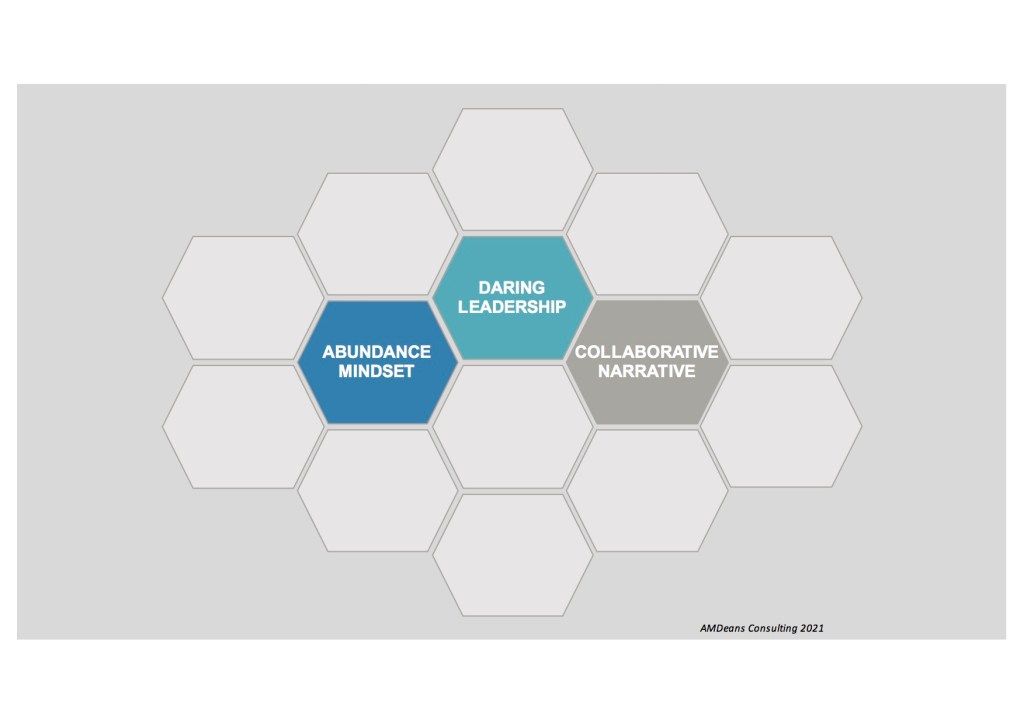
There are three important elements required to reimagine our systems and business models:

  1. Daring Leadership
  2. Abundance Mindset
  3. Collaborative Narrative

In this post I dig in to the term ‘Daring Leadership’ and why I believe it is important at the individual leader level, and also at a cultural level for our societies and organisations.

You are working on a project, your colleague has a great idea for an improvement that is mentioned over a coffee break. However, in the critical meeting no one speaks up. When they do speak up – you notice no genuine interest by those in the room to spend time to dig in to what this change would require. Most of the time in your organisation you seem to be reactively fixing issues, adding a new task force on top of another – rather than taking courageous decisions of stopping projects or blocking a chunk of time to really engage in meaningful dialogue with the experts and take hard decisions.

Time and time again in different organisations I witnessed and participated in similar situations and behaviour – yet I couldn’t quite put words to what was going on. I valued my colleagues individually, yet in our work interactions we seemed to stay in safe places that mid-term felt very dissatisfying regarding the business decisions taken.

Brené Brown opened my eyes and gave me language to explain what is going on in our societies and organisations. By interviewing CEOs and c-level executives Brené Brown collected all the answers to what is required in leaders. The answer she received most often was courage – “We need braver leaders and more courageous cultures”. Did they know how to act with courage and what skills this required? No – was the answer. But then the list, like mine above, started pouring out – behaviours that get in the way of a courageous work culture. This led to a large piece of research by Brené Brown and her group to look closely at the topic of courage and vulnerability in our work cultures.

‘Daring Leadership’ is based on this research by Dr. Brené Brown, Research Professor at the University of Houston, Texas. Other terms that for me relate to Daring Leadership and which are used elsewhere are ‘Servant Leadership’, ‘Courageous Leadership’, ‘The Purposeful Leader’.

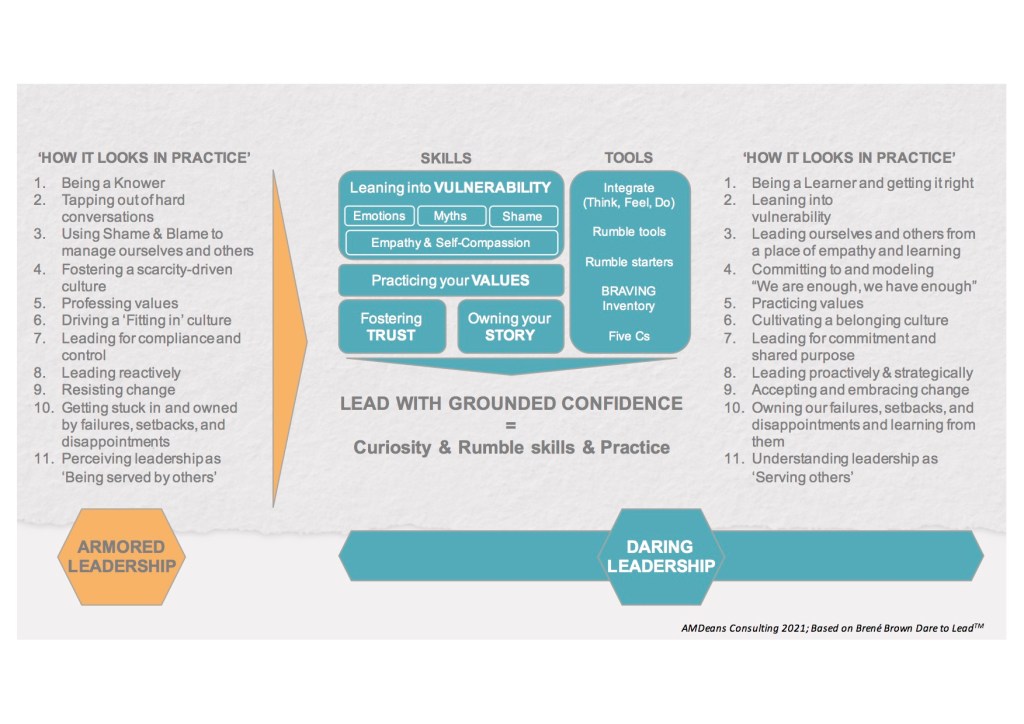
If you are a leader living by Daring Leadership principles then you are leaning into vulnerability and staying open to learning, you are caring for and connecting with your stakeholders, you are demonstrating curiosity and empathy and you have the courage to develop the potential in people and processes.

Brené Brown is not alone in her findings of the importance of courage and vulnerability. The best business schools and management consulting firms have started to put major highlight on the importance of trust, vulnerability, empathy and innovation in our workplaces. The recent publication by Hubert Joly “The Heart of Business” is receiving much positive attention for it’s focus on ‘unleashing the human magic’.

Yet, what is significantly harder to find are concrete methodologies that provide you with a way to strengthen your own skill set, provide you with tools and help you recognise when you are on the right path to being a leader and building an organisation with a culture of vulnerability, trust and empathy. Too often it is assumed we are naturally brave or trust is something you just have, or it is easy to come forward with these attributes.

Dare to Lead™ is an empirically based courage building program designed to be facilitated by organisational development professionals. It originated in the publication of Dr. Brené Brown’s research findings in the book Dare to Lead™.

Daring Leadership is unrelated to a companies organisational design. How you draw your organisational chart, whether you like the old-fashioned boxes with dotted and direct lines and classic project management, or you focus on agile methods and new ways of operating, whether you are set up in business and function units or are a process-driven organisation – it really does not matter (and I actually believe overall it does not really matter). Daring Leadership is the cultural and behavioural glue you require for HOW you, your leaders and employees operate within the organisational setting and interact with one another.

So why is Daring Leadership important? In a world that is transforming from shareholder-driven capitalism to a new form of stakeholder capitalism, from individual profit focus to sustainable solutions and with new technological advancements we have to be able to stay curious, foster an environment with diverse thinking, the ability to have tough conversations and dig into uncomfortable decisions. And with all of this we have to care better for each other and our planet.

On an individual level there are steps you can take on your path to Daring Leadership:

First, you become aware of what is happening around you – you observe carefully your own behaviour and that of others around you at the workplace. For example do people come up with and give voice to questions or suggestions, are there ‘meetings-after-the-meetings’ taking place where, what was agreed is altered again and do you feel you are constantly just fire-fighting issues rather than proactively taking the time for hard conversations early when issues start to appear?

Second, learn the skill sets for courage – by understanding vulnerability, identifying and discovering how to practice your values, understanding the elements required to foster trust and find out how to own and change the stories you develop. To build these skill sets you have amongst others the options depending on your learning preferences to read the book, work with a coach or take part in a Dare to LeadTM facilitated program. The facilitated program is also available to organisations.

Finally, you can develop your practice by integrating tools such as rumble starters into your daily way of working and keep developing the ability to lead with grounded confidence – that is by staying curious, using your rumble skills and practice, practice, practice.

On a societal and business model level we have to focus on building these skill sets in individuals, but also by generating interactions, time and space for meaningful dialogue around our values and also start operating from a notion of an abundance mindset and with new collaborative narratives that define how we measure success.

Summary of the Dare to LeadTM program to develop Daring Leadership, ie leading with Grounded Confidence. Dare to LeadTM is an empirically based courage building program developed by Dr. Brené Brown.
Image by AMDeans Consulting 2021.

Source: You can find more information on the work by Dr. Brené Brown and Dare to LeadTM here.