
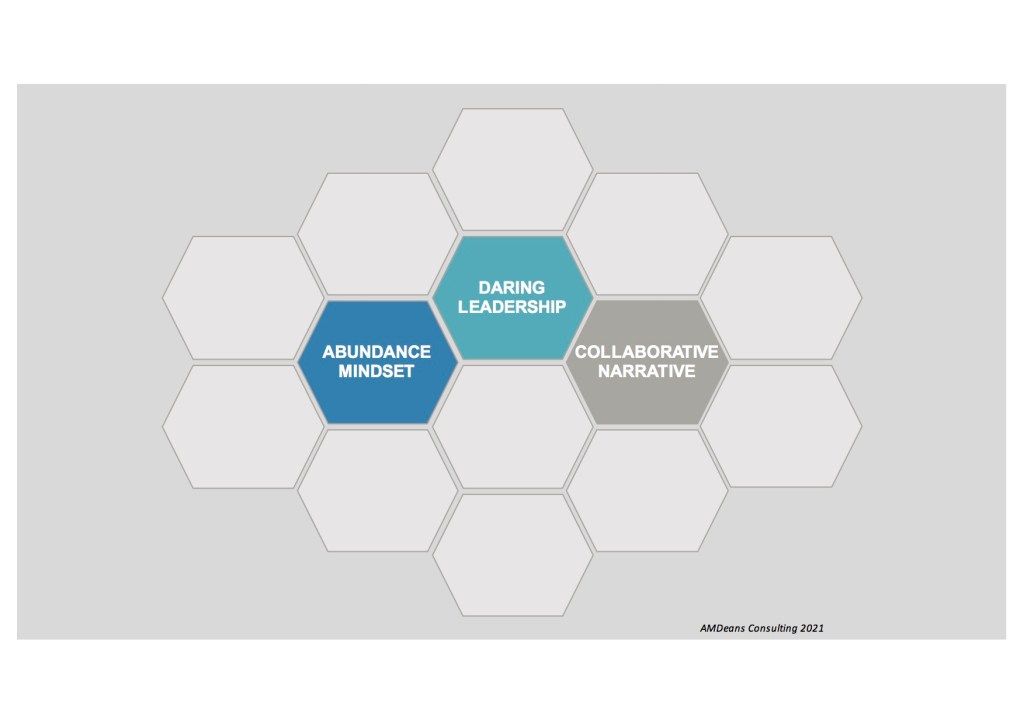
There are three important elements required to reimagine our systems and business models:
- Daring Leadership
- Abundance Mindset
- Collaborative Narrative
In this post I dig in to the term ‘Daring Leadership’ and why I believe it is important at the individual leader level, and also at a cultural level for our societies and organisations.
You are working on a project, your colleague has a great idea for an improvement that is mentioned over a coffee break. However, in the critical meeting no one speaks up. When they do speak up – you notice no genuine interest by those in the room to spend time to dig in to what this change would require. Most of the time in your organisation you seem to be reactively fixing issues, adding a new task force on top of another – rather than taking courageous decisions of stopping projects or blocking a chunk of time to really engage in meaningful dialogue with the experts and take hard decisions.
Time and time again in different organisations I witnessed and participated in similar situations and behaviour – yet I couldn’t quite put words to what was going on. I valued my colleagues individually, yet in our work interactions we seemed to stay in safe places that mid-term felt very dissatisfying regarding the business decisions taken.
Brené Brown opened my eyes and gave me language to explain what is going on in our societies and organisations. By interviewing CEOs and c-level executives Brené Brown collected all the answers to what is required in leaders. The answer she received most often was courage – “We need braver leaders and more courageous cultures”. Did they know how to act with courage and what skills this required? No – was the answer. But then the list, like mine above, started pouring out – behaviours that get in the way of a courageous work culture. This led to a large piece of research by Brené Brown and her group to look closely at the topic of courage and vulnerability in our work cultures.
‘Daring Leadership’ is based on this research by Dr. Brené Brown, Research Professor at the University of Houston, Texas. Other terms that for me relate to Daring Leadership and which are used elsewhere are ‘Servant Leadership’, ‘Courageous Leadership’, ‘The Purposeful Leader’.
If you are a leader living by Daring Leadership principles then you are leaning into vulnerability and staying open to learning, you are caring for and connecting with your stakeholders, you are demonstrating curiosity and empathy and you have the courage to develop the potential in people and processes.
Brené Brown is not alone in her findings of the importance of courage and vulnerability. The best business schools and management consulting firms have started to put major highlight on the importance of trust, vulnerability, empathy and innovation in our workplaces. The recent publication by Hubert Joly “The Heart of Business” is receiving much positive attention for it’s focus on ‘unleashing the human magic’.
Yet, what is significantly harder to find are concrete methodologies that provide you with a way to strengthen your own skill set, provide you with tools and help you recognise when you are on the right path to being a leader and building an organisation with a culture of vulnerability, trust and empathy. Too often it is assumed we are naturally brave or trust is something you just have, or it is easy to come forward with these attributes.
Dare to Lead™ is an empirically based courage building program designed to be facilitated by organisational development professionals. It originated in the publication of Dr. Brené Brown’s research findings in the book Dare to Lead™.
Daring Leadership is unrelated to a companies organisational design. How you draw your organisational chart, whether you like the old-fashioned boxes with dotted and direct lines and classic project management, or you focus on agile methods and new ways of operating, whether you are set up in business and function units or are a process-driven organisation – it really does not matter (and I actually believe overall it does not really matter). Daring Leadership is the cultural and behavioural glue you require for HOW you, your leaders and employees operate within the organisational setting and interact with one another.
So why is Daring Leadership important? In a world that is transforming from shareholder-driven capitalism to a new form of stakeholder capitalism, from individual profit focus to sustainable solutions and with new technological advancements we have to be able to stay curious, foster an environment with diverse thinking, the ability to have tough conversations and dig into uncomfortable decisions. And with all of this we have to care better for each other and our planet.
On an individual level there are steps you can take on your path to Daring Leadership:
First, you become aware of what is happening around you – you observe carefully your own behaviour and that of others around you at the workplace. For example do people come up with and give voice to questions or suggestions, are there ‘meetings-after-the-meetings’ taking place where, what was agreed is altered again and do you feel you are constantly just fire-fighting issues rather than proactively taking the time for hard conversations early when issues start to appear?
Second, learn the skill sets for courage – by understanding vulnerability, identifying and discovering how to practice your values, understanding the elements required to foster trust and find out how to own and change the stories you develop. To build these skill sets you have amongst others the options depending on your learning preferences to read the book, work with a coach or take part in a Dare to LeadTM facilitated program. The facilitated program is also available to organisations.
Finally, you can develop your practice by integrating tools such as rumble starters into your daily way of working and keep developing the ability to lead with grounded confidence – that is by staying curious, using your rumble skills and practice, practice, practice.
On a societal and business model level we have to focus on building these skill sets in individuals, but also by generating interactions, time and space for meaningful dialogue around our values and also start operating from a notion of an abundance mindset and with new collaborative narratives that define how we measure success.
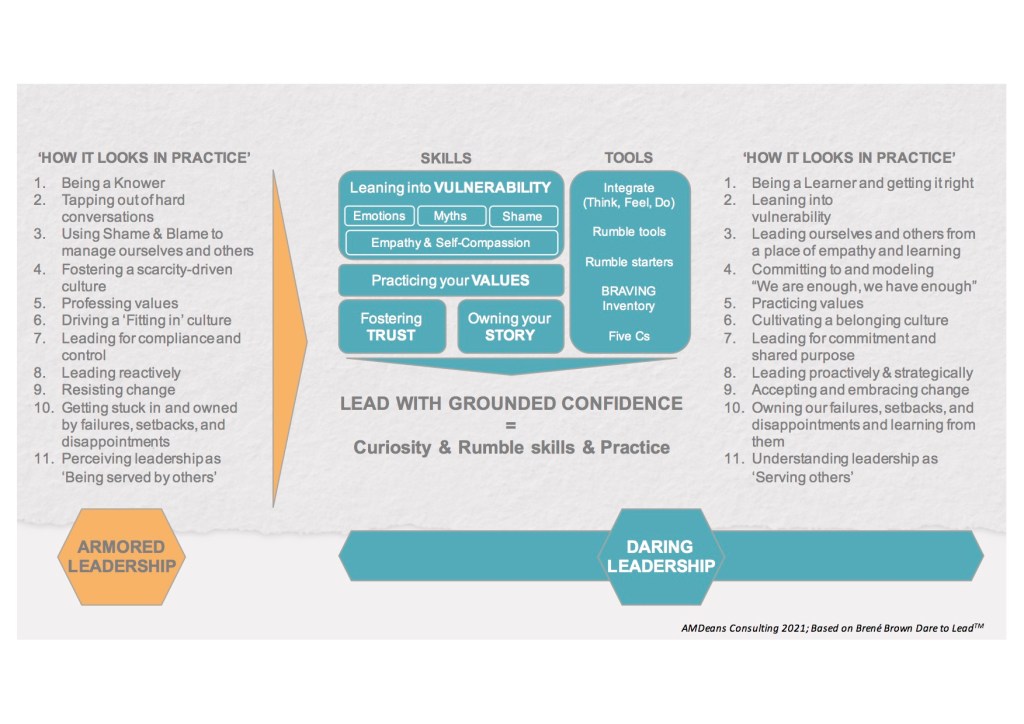
Image by AMDeans Consulting 2021.
Source: You can find more information on the work by Dr. Brené Brown and Dare to LeadTM here.
 amdeans-consulting.com