

Is it getting busier in here? Busyness, uncertainty and the courage to slow down

credit: pixabay

Is it getting busier in here? Busyness, uncertainty and the courage to slow down

Busy. The next meeting – online, offline, over coffee, with lunch, after dinner. Presentations, evaluations, process optimisations, digitalisation, implementations and reorganisations. Emails, instant messages, video calls, meetings. 

You may feel frazzled but isn’t fast a great advantage? In a recent survey McKinsey1 found that speed was associated with better outcomes – the positive effect was seen across all business dimensions, yet particularly in regards to operational resilience and innovation. Yet – here’s the thing – as separately reported McKinsey2 senior business leaders reported feeling busy and overwhelmed whilst getting nothing done and the quality of interactions decreasing.  I remember that feeling well from corporate settings – a constant stream of meetings, project revisions, KPI reporting – being busy with no tangible outcome for the business. 

What is it about the connection here with speed versus busyness with little value added.

When McKinsey talks about an advantage for speed, if you dig into their report, you will find that the barriers reported as getting in the way of speed are silos, slow decision-making and lack of strategic clarity. So, I would argue that the advantage of organisations being ‘faster’ is not about doing more, quicker, and spinning madly. I believe it is about being intentionally focused and calm with a clear strategy, and with a culture that enables employees to take bold business decisions at the right moment and right level,  with the right amount of information and with an appropriate amount of risk. This enables a felt speed – as the right activities and decisions get focused on and delivered upon.

The importance of strategic clarity as seen as one element required for speed – and increased operational resilience and innovation. The research by Leadership Expert Dorie Clark, who focuses on long-term strategic thinking, showed that business executives recognise the importance for long-term strategic thinking yet at the same time report to not have time to do so3. She took her research further to explore why they don’t have time, what is it with the busyness. Here’s the thing, as you will see in her concise Ted Talk4 the perceived busyness is often not about how much you have to do, but is associated with status, uncertainty and numbing (ie avoiding feeling our emotions). That means this busyness achieves the opposite to what would be desired, business leaders are staying busy to avoid decisions, or feeling discomfort and ambiguity. 

So if you want leaders and a corporate culture, where leaders are calm and focused, whilst making courageous decisions based on strategic clarity and collaborating across silos – you want to build the ability to handle discomfort, ambiguity, paradox challenges whilst staying true to agreed upon values and being accountable for mistakes. You want leaders who are able to feel comfortable slowing down in able to speed up.

There are three areas to focus on:

1) At the individual level: Train for skills in courage and handling uncertainty.  Start right at the top of the organisation with this.  You have to slow down to make space, learn about vulnerability, values, trust and resilience. Become brave and kind leaders who pay attention.

2) At the corporate culture level: Create a corporate culture where it is safe for courageous decision-making. And remember, clear is kind.  Culture is defined by a collection of norms, beliefs, values or artifacts. Take a close look at what you are rewarding and what people are held accountable for.

3) At the corporate strategy level: Really focus the corporate strategy to avoid noise, ensure there is alignment with your purpose and values. Understand your stakeholders.

In 2021, the consulting firm Kienbaum did a study5 investigating courage in the workplace – their research led them to define a leader as courageous as being both ‘determined’ and ‘value-driven’ (Entschlossenheit & Werteorientierung). Despite confirming the positive correlation of courage with business performance – they found that only 12% of participants in their study displayed courage as measured by their definition.

The good news is that courage and the ability to handle uncertainty can be developed as leadership skills.  I support leaders develop Daring Leadership, Abundance Mindset and Collaborative Narratives as the cornerstone for courageous and innovative organisations.

Sources: 

  1. https://www.mckinsey.com/business-functions/people-and-organizational-performance/our-insights/the-need-for-speed-in-the-post-covid-19-era-and-how-to-achieve-it
  2. https://www.mckinsey.com/business-functions/people-and-organizational-performance/our-insights/if-were-all-so-busy-why-isnt-anything-getting-done
  3. https://hbr.org/2018/06/if-strategy-is-so-important-why-dont-we-make-time-for-it
  4. https://www.ted.com/talks/dorie_clark_the_real_reason_you_feel_so_busy_and_what_to_do_about_it/transcript?language=en
  5. https://media.kienbaum.com/wp-content/uploads/sites/13/2021/09/Kienbaum_Die-MUTation-der-Arbeitswelt_2021_.pdf
  6. https://brenebrown.com/hubs/dare-to-lead/ 
Trust doesn’t need a strategy – it requires common values and skill development.

Up until recently I was responsible for corporate strategy, I remember a project not too long ago together with one of the large management consulting firms looking at best practices in corporate strategy development and strategic planning. We spent hours digging into the details of different models and recommendations. Clearly, I felt it had an important role and I am still convinced particularly by the relevance of strategic thinking.

I also believe in the importance of trust in business and society – today more than ever. Only midway in life, did I learn what trust entails and recognised the importance these skills can have in a business setting.

And at the same time – I do not want to see the two put together for CEOs to create an adaptive trust strategy(1). 

Why?

Strategies are about controlling uncertainty and decision-making, they are done for a business intention and to provide guidance for what to do and more importantly what not to do, to focus attention and priorities so a group of people are working towards common goals. They have been used by big management consultancies in business in relation to scarcity and competition for resources, to ‘speed up’ natural competition and evolution and involve trade-offs. 

Trust on the other hand is not about control. It is not about certainty. It is not a limited resource to be competed for. It is about letting go and being able to let go because of common values, acting reliably and in integrity with defined values, holding accountability, clarity of competencies and boundaries. That is not in an adaptive or planned way – but every time, in every interaction big or small. And when it goes wrong, you make amends and repair with integrity. 

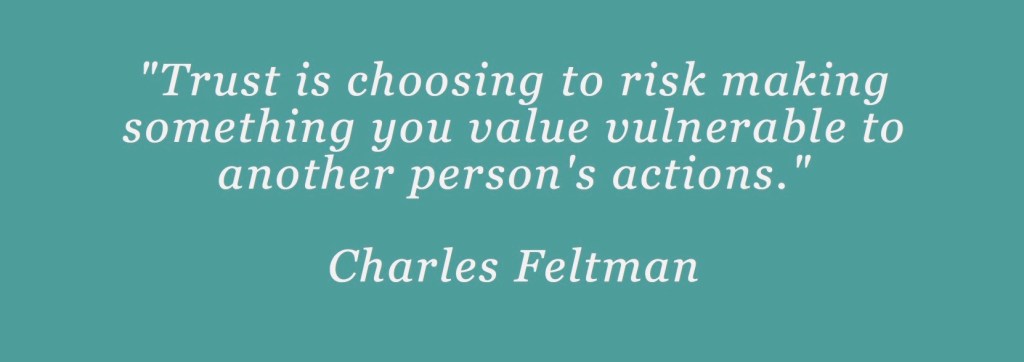
Trust is exactly the glue required to enable interactions when there is uncertainty and ambiguity, when you make something you value vulnerable to another person’s actions, which you have no control over. 

If I do not recommend a strategy, what do I recommend?

The starting point seems to be reminding ourselves of our humanity, our vulnerability and the common values we stand for. As Halla Tomasdottir said so well just the other day:

“Imagine common sense emerging as a governing philosophy. Humanity at the heart of leadership. A future built upon common values.

It’s on each and every one of us to make it so.”

Halla Tomasdottir, LinkedIn 31 May 2022

Further to that, we can move to include skills development around trust in our education systems, executive education and leadership trainings. There are frameworks on the elements of trust, which allow an understanding of what it requires to build and maintain trust.

And to be clear we have to be careful how we integrate product and service delivery within a trust measure as the report I wrote about here does – without reliably delivering a safe product, then even a great leadership team with common values and a great skill set around trust will not make up for the lack of delivery.

In conclusion. Trust is not a finite resource. Not one company has to win or beat others on a devised trustworthiness scale, it has to be inherent to our behaviours and choices as investors, CEOs, leaders and consumers.

(1) Source: The Evolving Role of Today’s CEO: BCG Weekly Brief, May 31 2022

Trust – it has a business value, yet is volatile. Can a new ‘Trust Index’ be the answer for leaders to navigate the topic?

Charles Feltman, The Thin Book of Trust

BCG, the strategy consulting firm, is going deep into the topic of Trust at this year’s WEF in Davos and have published a new report, in which they present a newly developed trust index. You can find the full report here.

Five immediate reflections below to the report, as I find there are interesting details hidden in this big scale research and at the same time it raises questions:

1. Good news for those of us who believe trust is important. They find a strong correlation of their way to assess trust with above-average total shareholder return, better post-crisis performance and higher ESGC scores – so investors will also be paying attention. But oops – a “significant portion of the largest companies received consistently low-trust scores” – plenty to do then! 

2. The overall finding confirms how fickle trust is – slow to build, quick to destroy. It is very variable which firms were in the top 100 list over a time span of 4 years. But those who do stay show strength in looking after their people, good governance, strength in collaboration and innovation. And unsurprisingly they deliver on their products and promises. I’d love to see the list of these 20 companies and look closer at how their leadership team looked within that time span. 

3. A whole report on trust without talking about care, integrity, values. These topics are hidden to a certain degree within BCG’s indicator of ‘Fairness’. Yet is still surprising given how these are weighted in other trust frameworks to not see them get more coverage. I disagree with this being purely ‘systemic trust’. Personally, I believe there needs to be more courage to include these more ambiguous and hard to measure aspects of trust and leadership.

4. Measuring topics has pro’s and con’s. The BRAVING Trust framework from Dare to LeadTM also comes with an assessment. So yes a Trust Index will draw attention to strengths/weaknesses and allow a degree of comparison. Yet if it is handled as primarily a KPI on a dashboard to ‘perform’ against, rather than truly integrate it into leadership behaviour, it may turn into exactly that – a performance. And I would not be surprised if that could send your trust-index score shooting right down.. 

5. Finally – did I miss it? What about looking a little closer at governance and the leaders. Did those with high scores have a stable consistent leadership team, that built and maintained trust by operating with clear values and integrity? How does it match with BCGs diversity score or their innovation rankings?

My work on the topic of ‘Trust’ is based on the research findings by Dr. Brené Brown and the work by Charles Feltman, and I continually integrate additional research and findings. For sure I will be following this ongoing work by BCG closely.

Most importantly – this research confirms the significance and value of investing in trust. Trust is a skill that can be learnt. It has to be maintained with continuous attention to the elements that define trust and addressing what gets in the way of trust in a safe manner. Trust will only be meaningful if leadership from the top truly stands behind their purpose, lives their values with empathy and with humility holds a true stakeholder focus which goes beyond ego, profit and financial returns.

My conclusion? Before adding a new KPI to the dashboard, I would take the money to invest in leadership skills such as those for Daring Leadership, ensure values have clear behaviours to operate by, and have the courage to move from a narrow profit-/performance-based dashboard to a wider collaborative, stakeholder and long-term perspective of success.

Source: What AI Reveals About Trust in the World’s Largest Companies, May 2022, BCG

Mutig voran – die Unternehmerin Antje von Dewitz zeigt auf, wie wir uns mit einer Vision und Vertrauen den Herausforderungen stellen können

In meinem Ansatz geht es um ein Führungsverständnis und eine Kultur, welche auf Mut, Empathie, Werten und Vertrauen basiert (Daring Leadership); mit einer Haltung, das wir genug haben, um die Offenheit für Innovation zu ermöglichen (Abundance Mindset); sowie über die Notwendigkeit von echter Kollaboration, um gemeinsam Lösungen zu ermöglichen (Collaborative Narratives).

Doch gibt es Beispiele, das es möglich ist in einem Unternehmen folgendes zu erreichen: Vertrauensorganisation als Kultur leben, Infrastruktur bereitstellen um Diversität zu fördern, Nachhaltigkeit im gesamten Unternehmen verankern trotz Widerstände, und langfristig zu wirtschaften anstatt kurzfristige Gewinne vorzuziehen? Ja! Und ich kann folgendes Buch sehr empfehlen: “Mut steht uns gut!” von Antje von Dewitz. Bei der Übernahme des Familienunternehmens hat sie nicht auf Trends und externen Druck gewartet, sondern ist als Unternehmerin und Mensch mutig ihrer Vision gefolgt und hat diese umgesetzt.

Ich folge dem gesunden Menschenverstand. Wir haben ein positives Menschenbild. Wir glauben daran, dass die Menschen, die hier arbeiten, gerne hier arbeiten und ihr Bestes einbringen wollen.

Antje von Dewitz, Interview im Manager Magazin 20.10.2020 hier

Bereits in den letzten Jahren wurde ich durch Artikel und Podcasts auf die Arbeit von Antje von Dewitz als Geschäftsführerin des Familienunternehmens Vaude aufmerksam. Doch erst jetzt kam ich dazu ihr Buch zu lesen. Es hat mich tiefst beeindruckt.

In dem Buch teilt Antje von Dewitz was sie als Unternehmerin bzgl. Vision, Vertrauen, Diversität und Nachhaltigkeit bei der Übernahme des von ihrem Vater gegründeten Unternehmen Vaude gemacht hat. Das wichtige dabei – sie hat es gemacht. Sie ist mit ihrem Team und den Mitarbeitern durch die Höhen und Tiefen der Umsetzung einer Vision und neuen Unternehmenskultur gegangen, um wirklich durchgehend nachhaltig zu werden. Im Buch teilt sie was sie auf diesem Weg gelernt hat und warum es sich rentiert. Rollenmodelle wie diese brauchen wir, um Mut und Hoffnung zu schöpfen für andere Unternehmen und die Zukunft.

Als Antje von Dewitz 2009 das Familienunternehmen übernommen hat, hatte sie eine klare Vision – mit Bezug auf starken Produkten, einer Werteorientierung und konsequenter Rücksicht auf Mensch und Natur. Sie hatte sich bereits vor der Übernahme in ihrer Forschung mit der Rolle von Vertrauen und der Motivation von Mitarbeitern auseinandergesetzt. Für mich beschreibt der folgende Auszug ihre Elementare Erkenntnis, die hinter allem steht, um ihre Vision zu erreichen.

Unser nachhaltiger Weg stellt uns (Vaude) immer wieder vor scheinbar unüberwindbare Hindernisse[…]Als Pioniere müssen wir immer wieder kreativ werden und miteinander eine machbare Lösung finden.

Diesen Einsatz, der viel Kraft und Erfindungsgeist erfordert und schwer messbar ist, kann ich nicht von Mitarbeitenden erwarten, die sich fremdbestimmt fühlen und ihr eigenes Leben dem Unternehmen unterordnen müssen. Für diesen Weg brauchen wir den ganzen Menschen mit Herz, Seele und Verstand und seiner ganzen Energie.

Antje von Dewitz, Mut steht uns gut!, 2020 Benevento Verlag

Ich teile diese Einsicht, und bin überzeugt, dass wir mit Blick auf den aktuellen Herausforderungen dringend an der Unternehmenskultur, Werten und Haltung arbeiten müssen, um Kreativität zu ermöglichen und mit kollaborativen Ansätzen Lösungen zu finden.

Antje von Dewitz hatte also eine Vision und wusste auch. “Unser Führungsverständnis und Unternehmenskultur sollte sehr bewusst und durchgängig auf Vertrauen und Wertschätzung aufbauen”. Später hat sie auch die Notwendigkeit, die Werte schriftlich festzuhalten, gesehen um damit die Position des Unternehmens klarzumachen. Für demokratische Werte einstehen, dabei auch die Stimme zu erheben und Haltung zu zeigen.

Sie hat viel investiert, um dieses Führungsverständnis und die Unternehmenskultur über viele Jahre gemeinsam mit den Führungskräften und Mitarbeitern aufzubauen. Das Buch beschreibt gut, nach welchen Ansätzen sie mit externer Unterstützung vorgeht und besonders wichtig, dass es eine Investition ist, welche kontinuierliche Weiterentwicklung und Zeit braucht. Nicht jede Führungsperson konnte/wollte sich mit entwickeln, so gab es auch Abgänge. Es gab zudem natürlich Rückschläge, kritische Meinungen, negative Erfahrungen.

[…]Genau das unvermeidliche Ringen mit Zielkonflikten, Authenzität und eine klare Wertehaltung eine Strahlkraft entwickeln, die anzieht, Hoffnung erzeugt und nicht zuletzt Vertrauen schafft.

Antje von Dewitz, Mut steht uns gut!, 2020 Benevento Verlag

Ein paar Beispiele zu den Änderungen, welche im Buch genannt sind: “Führungskräfte von Richtungsweiser und Entscheider… hinzu Rahmengeber, Vermittler und Begleiter”; “Leistung wird nicht nach Anwesenheit, sondern nach den Ergebnissen gemessen”; “Keine Besprechungen nach siebzehn Uhr angesetzt werden”; “weniger Belastung durch Überstunden” , “Schlichte Erkenntnis, dass wir mit möglichst gemischten Teams am Besten aufgestellt sind für die Zukunft”, “Verschiedene Hintergründe, Erfahrungen, desto unterschiedlichere Blickwinkel und nachhaltigere Lösungsansätze und Strategien”.

Wir lernten, dass schwarz-weisse Sichtweisen und Lösungen uns nicht voranbringen, sondern wir gemeinsam und abteilungsübergreifend um eine pragmatische Lösung ringen mussten.

Antje von Dewitz, Mut steht uns gut!, 2020 Benevento Verlag

Das Fundament des positiven Menschenbilds, die Vertrauensorganisation in der gelernt wird wie man mit Ungewissheit, unterschiedlichen Meinungen, Hindernissen umgeht, ist für mich ein Beispiel von ‘Daring Leadership’. Das heisst, es geht um Neugierde, Offenheit, Empathie und Abstand nehmen von defensivem Verhalten, also ‘Armored Leadership’. Diese Fähigkeiten zu lernen, stärken und kontinuierlich fortführen kann geübt werden, gelernt werden, und immer wieder mit Vision, Werte und Haltung in den Vordergrund gerufen werden.

“Statt in die Verteidigungshaltung zu gehen, wenn mich meine Führungskraft kritisiert, nachzufragen, was genau gemeint ist, oder statt Inhaltsschlachten zu führen, einfach mal zu fragen, was ist eigentlich los oder das Gegenüber gerade braucht”.

Antje von Dewitz, Mut steht uns gut!, 2020 Benevento Verlag

Was neben dem ‘WIE’ in ihrem Buch beeindruckt, ist ‘WAS’ sie damit konsequent angepackt hat:

  • die Unternehmenskultur kontinuierlich angepasst und gelebt mit Bezug auf Führungsverständnis, Vertrauensorganisation, Werten, Diversität
  • die Nachhaltigkeit in Produkten, dem Arbeitsstandort, der Kantine und sogar einem Mobilitätskonzept verankert
  • das Geschäftsmodell/Strategie und das klassische Wachstum in Frage gestellt, und den Mut gehabt, es neu zu denken, neues zu probieren und neu zu bewerten was Erfolg ist
  • das Stakeholder Management, so haben sie sich kollaborativ mit unterschiedlichsten Parteien an den Tisch gesetzt um Themen anzugehen, anstatt auf Grund von Wettbewerb defensiv in einem starren ‘Gegeneinander’ zu agieren
  • das gesellschaftliche Engagement, sie haben sich mit der Einbindung und Integration von Geflüchteten in den Arbeitsmarkt befasst und ermöglicht.

Ich bin überzeugt der ganzheitliche Ansatz bringt den Erfolg bei einer Transformation wie dieser. Und Erfolge haben sie gesehen.

Wir schaffen es, Lösungen zu finden, wo alles nach Scheitern aussieht. Für mich ist diese Haltung ein Schlüssel dafür, dass wir lösungsorientiert, gestaltungsfähig, und innovationsstark sind.

Antje von Dewitz, Mut steht uns gut!, 2020 Benevento Verlag

Und rentiert sich die Mühe der Vision und der Unternehmenskultur nachzugehen? Ein paar konkrete Gründe nennt Antje von Dewitz im Buch, welche erlebt wurden und werden:

  • Spürbare Leidenschaft, Loyalität und Energie für das Unternehmen und die gemeinsamen Ziele
  • Niedrige Krankheits- und Fluktuationsquote
  • Recht hohe interne Weiterentwicklungsmöglichkeiten
  • Selten Probleme Stellen zu besetzen, trotz der provinziellen Lage
  • Eine Vielzahl von Initiativbewerbungen, weil sich Menschen mit der Firmenphilosophie identifizieren
  • Eine selbstbestärkende Kultur: Viele Menschen mit starkem Urvertrauen angestellt, welche mit ihrer positiven und offenen Einstellung die Organisation und Kultur weiter von innen stärken
  • Nicht in alten Mustern verhaftet, sondern beweglich und kreativ
  • Begegnen einander unabhängig von Geschlecht oder Nationalität vertrauensvoll und auf Augenhöhe und lernen zunehmend, unsere Verschiedenartigkeit als Stärke zu schätzen.
  • Immer wieder in der Lage, gemeinsam zukunftsfähige Lösungen zu erarbeiten, und das macht viel spass

Mein Fazit: Es geht. Es lohnt sich. Es macht spass. Mit Mut, Vertrauen und Kollaboration gemeinsam die Hindernisse unserer Zeit anzugehen.

Für mich sind ‘Daring Leadership, Abundance Mindset und Collaborative Narratives’ der Schritt dahin. Ein Familienunternehmen hat die Unabhängigkeit langfristig einer Vision zu folgen, doch müssen wir dies auch in den grossen börsennotierten Unternehmen ermöglichen und als Investoren, Startups als Erfolg anerkennen.

Zum Schluss von Antje von Dewitz der Aufruf deiner Vision zu folgen:

Wenn viele Menschen am richtigen Platz sind, dann kann das die Welt ein Stück besser machen.

Dann lohnt es sich in meinen Augen erst recht, den Mut zu haben, sich einfach trotzdem auf den Weg zu machen, einfach mal einen ersten kleinen Schritt zu wagen. […]Den Blick nicht auf die Hindernisse, sondern auf das Machbare zu lenken.

Antje von Dewitz, Mut steht uns gut!, 2020 Benevento Verlag

Quelle: Antje von Dewitz, Mut steht uns gut!, 2020 Benevento Verlag (Keine Affiliation oder Sponsoring)