Trust – it has a business value, yet is volatile. Can a new ‘Trust Index’ be the answer for leaders to navigate the topic?

Charles Feltman, The Thin Book of Trust

BCG, the strategy consulting firm, is going deep into the topic of Trust at this year’s WEF in Davos and have published a new report, in which they present a newly developed trust index. You can find the full report here.

Five immediate reflections below to the report, as I find there are interesting details hidden in this big scale research and at the same time it raises questions:

1. Good news for those of us who believe trust is important. They find a strong correlation of their way to assess trust with above-average total shareholder return, better post-crisis performance and higher ESGC scores – so investors will also be paying attention. But oops – a “significant portion of the largest companies received consistently low-trust scores” – plenty to do then! 

2. The overall finding confirms how fickle trust is – slow to build, quick to destroy. It is very variable which firms were in the top 100 list over a time span of 4 years. But those who do stay show strength in looking after their people, good governance, strength in collaboration and innovation. And unsurprisingly they deliver on their products and promises. I’d love to see the list of these 20 companies and look closer at how their leadership team looked within that time span. 

3. A whole report on trust without talking about care, integrity, values. These topics are hidden to a certain degree within BCG’s indicator of ‘Fairness’. Yet is still surprising given how these are weighted in other trust frameworks to not see them get more coverage. I disagree with this being purely ‘systemic trust’. Personally, I believe there needs to be more courage to include these more ambiguous and hard to measure aspects of trust and leadership.

4. Measuring topics has pro’s and con’s. The BRAVING Trust framework from Dare to LeadTM also comes with an assessment. So yes a Trust Index will draw attention to strengths/weaknesses and allow a degree of comparison. Yet if it is handled as primarily a KPI on a dashboard to ‘perform’ against, rather than truly integrate it into leadership behaviour, it may turn into exactly that – a performance. And I would not be surprised if that could send your trust-index score shooting right down.. 

5. Finally – did I miss it? What about looking a little closer at governance and the leaders. Did those with high scores have a stable consistent leadership team, that built and maintained trust by operating with clear values and integrity? How does it match with BCGs diversity score or their innovation rankings?

My work on the topic of ‘Trust’ is based on the research findings by Dr. Brené Brown and the work by Charles Feltman, and I continually integrate additional research and findings. For sure I will be following this ongoing work by BCG closely.

Most importantly – this research confirms the significance and value of investing in trust. Trust is a skill that can be learnt. It has to be maintained with continuous attention to the elements that define trust and addressing what gets in the way of trust in a safe manner. Trust will only be meaningful if leadership from the top truly stands behind their purpose, lives their values with empathy and with humility holds a true stakeholder focus which goes beyond ego, profit and financial returns.

My conclusion? Before adding a new KPI to the dashboard, I would take the money to invest in leadership skills such as those for Daring Leadership, ensure values have clear behaviours to operate by, and have the courage to move from a narrow profit-/performance-based dashboard to a wider collaborative, stakeholder and long-term perspective of success.

Source: What AI Reveals About Trust in the World’s Largest Companies, May 2022, BCG

Mutig voran – die Unternehmerin Antje von Dewitz zeigt auf, wie wir uns mit einer Vision und Vertrauen den Herausforderungen stellen können

In meinem Ansatz geht es um ein Führungsverständnis und eine Kultur, welche auf Mut, Empathie, Werten und Vertrauen basiert (Daring Leadership); mit einer Haltung, das wir genug haben, um die Offenheit für Innovation zu ermöglichen (Abundance Mindset); sowie über die Notwendigkeit von echter Kollaboration, um gemeinsam Lösungen zu ermöglichen (Collaborative Narratives).

Doch gibt es Beispiele, das es möglich ist in einem Unternehmen folgendes zu erreichen: Vertrauensorganisation als Kultur leben, Infrastruktur bereitstellen um Diversität zu fördern, Nachhaltigkeit im gesamten Unternehmen verankern trotz Widerstände, und langfristig zu wirtschaften anstatt kurzfristige Gewinne vorzuziehen? Ja! Und ich kann folgendes Buch sehr empfehlen: “Mut steht uns gut!” von Antje von Dewitz. Bei der Übernahme des Familienunternehmens hat sie nicht auf Trends und externen Druck gewartet, sondern ist als Unternehmerin und Mensch mutig ihrer Vision gefolgt und hat diese umgesetzt.

Ich folge dem gesunden Menschenverstand. Wir haben ein positives Menschenbild. Wir glauben daran, dass die Menschen, die hier arbeiten, gerne hier arbeiten und ihr Bestes einbringen wollen.

Antje von Dewitz, Interview im Manager Magazin 20.10.2020 hier

Bereits in den letzten Jahren wurde ich durch Artikel und Podcasts auf die Arbeit von Antje von Dewitz als Geschäftsführerin des Familienunternehmens Vaude aufmerksam. Doch erst jetzt kam ich dazu ihr Buch zu lesen. Es hat mich tiefst beeindruckt.

In dem Buch teilt Antje von Dewitz was sie als Unternehmerin bzgl. Vision, Vertrauen, Diversität und Nachhaltigkeit bei der Übernahme des von ihrem Vater gegründeten Unternehmen Vaude gemacht hat. Das wichtige dabei – sie hat es gemacht. Sie ist mit ihrem Team und den Mitarbeitern durch die Höhen und Tiefen der Umsetzung einer Vision und neuen Unternehmenskultur gegangen, um wirklich durchgehend nachhaltig zu werden. Im Buch teilt sie was sie auf diesem Weg gelernt hat und warum es sich rentiert. Rollenmodelle wie diese brauchen wir, um Mut und Hoffnung zu schöpfen für andere Unternehmen und die Zukunft.

Als Antje von Dewitz 2009 das Familienunternehmen übernommen hat, hatte sie eine klare Vision – mit Bezug auf starken Produkten, einer Werteorientierung und konsequenter Rücksicht auf Mensch und Natur. Sie hatte sich bereits vor der Übernahme in ihrer Forschung mit der Rolle von Vertrauen und der Motivation von Mitarbeitern auseinandergesetzt. Für mich beschreibt der folgende Auszug ihre Elementare Erkenntnis, die hinter allem steht, um ihre Vision zu erreichen.

Unser nachhaltiger Weg stellt uns (Vaude) immer wieder vor scheinbar unüberwindbare Hindernisse[…]Als Pioniere müssen wir immer wieder kreativ werden und miteinander eine machbare Lösung finden.

Diesen Einsatz, der viel Kraft und Erfindungsgeist erfordert und schwer messbar ist, kann ich nicht von Mitarbeitenden erwarten, die sich fremdbestimmt fühlen und ihr eigenes Leben dem Unternehmen unterordnen müssen. Für diesen Weg brauchen wir den ganzen Menschen mit Herz, Seele und Verstand und seiner ganzen Energie.

Antje von Dewitz, Mut steht uns gut!, 2020 Benevento Verlag

Ich teile diese Einsicht, und bin überzeugt, dass wir mit Blick auf den aktuellen Herausforderungen dringend an der Unternehmenskultur, Werten und Haltung arbeiten müssen, um Kreativität zu ermöglichen und mit kollaborativen Ansätzen Lösungen zu finden.

Antje von Dewitz hatte also eine Vision und wusste auch. “Unser Führungsverständnis und Unternehmenskultur sollte sehr bewusst und durchgängig auf Vertrauen und Wertschätzung aufbauen”. Später hat sie auch die Notwendigkeit, die Werte schriftlich festzuhalten, gesehen um damit die Position des Unternehmens klarzumachen. Für demokratische Werte einstehen, dabei auch die Stimme zu erheben und Haltung zu zeigen.

Sie hat viel investiert, um dieses Führungsverständnis und die Unternehmenskultur über viele Jahre gemeinsam mit den Führungskräften und Mitarbeitern aufzubauen. Das Buch beschreibt gut, nach welchen Ansätzen sie mit externer Unterstützung vorgeht und besonders wichtig, dass es eine Investition ist, welche kontinuierliche Weiterentwicklung und Zeit braucht. Nicht jede Führungsperson konnte/wollte sich mit entwickeln, so gab es auch Abgänge. Es gab zudem natürlich Rückschläge, kritische Meinungen, negative Erfahrungen.

[…]Genau das unvermeidliche Ringen mit Zielkonflikten, Authenzität und eine klare Wertehaltung eine Strahlkraft entwickeln, die anzieht, Hoffnung erzeugt und nicht zuletzt Vertrauen schafft.

Antje von Dewitz, Mut steht uns gut!, 2020 Benevento Verlag

Ein paar Beispiele zu den Änderungen, welche im Buch genannt sind: “Führungskräfte von Richtungsweiser und Entscheider… hinzu Rahmengeber, Vermittler und Begleiter”; “Leistung wird nicht nach Anwesenheit, sondern nach den Ergebnissen gemessen”; “Keine Besprechungen nach siebzehn Uhr angesetzt werden”; “weniger Belastung durch Überstunden” , “Schlichte Erkenntnis, dass wir mit möglichst gemischten Teams am Besten aufgestellt sind für die Zukunft”, “Verschiedene Hintergründe, Erfahrungen, desto unterschiedlichere Blickwinkel und nachhaltigere Lösungsansätze und Strategien”.

Wir lernten, dass schwarz-weisse Sichtweisen und Lösungen uns nicht voranbringen, sondern wir gemeinsam und abteilungsübergreifend um eine pragmatische Lösung ringen mussten.

Antje von Dewitz, Mut steht uns gut!, 2020 Benevento Verlag

Das Fundament des positiven Menschenbilds, die Vertrauensorganisation in der gelernt wird wie man mit Ungewissheit, unterschiedlichen Meinungen, Hindernissen umgeht, ist für mich ein Beispiel von ‘Daring Leadership’. Das heisst, es geht um Neugierde, Offenheit, Empathie und Abstand nehmen von defensivem Verhalten, also ‘Armored Leadership’. Diese Fähigkeiten zu lernen, stärken und kontinuierlich fortführen kann geübt werden, gelernt werden, und immer wieder mit Vision, Werte und Haltung in den Vordergrund gerufen werden.

“Statt in die Verteidigungshaltung zu gehen, wenn mich meine Führungskraft kritisiert, nachzufragen, was genau gemeint ist, oder statt Inhaltsschlachten zu führen, einfach mal zu fragen, was ist eigentlich los oder das Gegenüber gerade braucht”.

Antje von Dewitz, Mut steht uns gut!, 2020 Benevento Verlag

Was neben dem ‘WIE’ in ihrem Buch beeindruckt, ist ‘WAS’ sie damit konsequent angepackt hat:

  • die Unternehmenskultur kontinuierlich angepasst und gelebt mit Bezug auf Führungsverständnis, Vertrauensorganisation, Werten, Diversität
  • die Nachhaltigkeit in Produkten, dem Arbeitsstandort, der Kantine und sogar einem Mobilitätskonzept verankert
  • das Geschäftsmodell/Strategie und das klassische Wachstum in Frage gestellt, und den Mut gehabt, es neu zu denken, neues zu probieren und neu zu bewerten was Erfolg ist
  • das Stakeholder Management, so haben sie sich kollaborativ mit unterschiedlichsten Parteien an den Tisch gesetzt um Themen anzugehen, anstatt auf Grund von Wettbewerb defensiv in einem starren ‘Gegeneinander’ zu agieren
  • das gesellschaftliche Engagement, sie haben sich mit der Einbindung und Integration von Geflüchteten in den Arbeitsmarkt befasst und ermöglicht.

Ich bin überzeugt der ganzheitliche Ansatz bringt den Erfolg bei einer Transformation wie dieser. Und Erfolge haben sie gesehen.

Wir schaffen es, Lösungen zu finden, wo alles nach Scheitern aussieht. Für mich ist diese Haltung ein Schlüssel dafür, dass wir lösungsorientiert, gestaltungsfähig, und innovationsstark sind.

Antje von Dewitz, Mut steht uns gut!, 2020 Benevento Verlag

Und rentiert sich die Mühe der Vision und der Unternehmenskultur nachzugehen? Ein paar konkrete Gründe nennt Antje von Dewitz im Buch, welche erlebt wurden und werden:

  • Spürbare Leidenschaft, Loyalität und Energie für das Unternehmen und die gemeinsamen Ziele
  • Niedrige Krankheits- und Fluktuationsquote
  • Recht hohe interne Weiterentwicklungsmöglichkeiten
  • Selten Probleme Stellen zu besetzen, trotz der provinziellen Lage
  • Eine Vielzahl von Initiativbewerbungen, weil sich Menschen mit der Firmenphilosophie identifizieren
  • Eine selbstbestärkende Kultur: Viele Menschen mit starkem Urvertrauen angestellt, welche mit ihrer positiven und offenen Einstellung die Organisation und Kultur weiter von innen stärken
  • Nicht in alten Mustern verhaftet, sondern beweglich und kreativ
  • Begegnen einander unabhängig von Geschlecht oder Nationalität vertrauensvoll und auf Augenhöhe und lernen zunehmend, unsere Verschiedenartigkeit als Stärke zu schätzen.
  • Immer wieder in der Lage, gemeinsam zukunftsfähige Lösungen zu erarbeiten, und das macht viel spass

Mein Fazit: Es geht. Es lohnt sich. Es macht spass. Mit Mut, Vertrauen und Kollaboration gemeinsam die Hindernisse unserer Zeit anzugehen.

Für mich sind ‘Daring Leadership, Abundance Mindset und Collaborative Narratives’ der Schritt dahin. Ein Familienunternehmen hat die Unabhängigkeit langfristig einer Vision zu folgen, doch müssen wir dies auch in den grossen börsennotierten Unternehmen ermöglichen und als Investoren, Startups als Erfolg anerkennen.

Zum Schluss von Antje von Dewitz der Aufruf deiner Vision zu folgen:

Wenn viele Menschen am richtigen Platz sind, dann kann das die Welt ein Stück besser machen.

Dann lohnt es sich in meinen Augen erst recht, den Mut zu haben, sich einfach trotzdem auf den Weg zu machen, einfach mal einen ersten kleinen Schritt zu wagen. […]Den Blick nicht auf die Hindernisse, sondern auf das Machbare zu lenken.

Antje von Dewitz, Mut steht uns gut!, 2020 Benevento Verlag

Quelle: Antje von Dewitz, Mut steht uns gut!, 2020 Benevento Verlag (Keine Affiliation oder Sponsoring)

Longing for divinity – what Bittersweet has to do with our workplaces and daring leadership

During this great resignation employees are leaving workplaces and listing ‘Uncaring leaders’ as their number one reason (source: McKinsey – Gone for now, or gone for good? ). People are desperate for meaning, values, purpose, kindness and leaders who care.

What if we have to go a step further, and consider that employees are desperately seeking both guidance as well as safe story stewardship for their longing for divinity and wholeness. And with no where else to go they are now searching for this in the workplace.

Let’s go a little back in time. Since I read the book “The Gifts of Imperfection” many years ago, I have had an ongoing quest in the back of my mind regarding ‘Faith’ – what is it to me, where do I find it, how do I cultivate it? This came as a result of one of Dr. Brené Brown’s findings in the book that the most wholehearted people cultivate faith in their lives, making her include guidepost #6: Cultivating Intuition and Trusting Faith. This has nothing to do with a religion and Brené Brown offers following definition for faith.

Faith is a place of mystery, where we find the courage to believe in what we cannot see and the strength to let go of our fear of uncertainty.

The Gifts of imperfection, Dr. Brené Brown.

More recently Dr. Jill Bolte Taylor talked in her book Whole Brain Living about how our ‘character 4’ on our right brain side already knows about the deep connection we all share. Also the work by Dr. Martha Beck explores how to let go of culturally-derived values, and follow the longing for warmth and yearnings to stay in our own integrity.

Now with Susan Cain just publishing her newest book “Bittersweet” (published April 2022), I have been provided a further addition to the thinking on our inherent longing for that more beautiful place.

I am an avid fan of the work by Glennon Doyle and how she has cut loose from culturally imposed rules of how things “should” be and writes about it so beautifully in her books (Carry on Warrior, Love Warrior, Untamed). So I was very excited to see that Susan Cain went into a conversation about the findings in her book Bittersweet with Glennon Doyle, Abby Wambach and Amanda Doyle on their podcast We can do hard Things.

It is a beautiful and stirring conversation – do listen to it yourselves – and it resulted in this post. They talk about how that longing or yearning that we feel in those moments of beauty and sadness remind us of the better world that could be, that it ideally makes us stretch together to build such a world even if we never fully reach it. It reminds us that this feeling of longing and bittersweet is a moment that connects us with each other. This really brought for me the point of faith or a longing for divinity together.

Ok – so that’s all great, but what about the workplace?

In the podcast, they also speak about relationships and refer to a finding from Esther Perel to which I went and found this reference in a another article: “In our modern world, we have the unrealistic expectation that our relationships will fill in for the divine, offering wholeness, transcendence and unconditional love”.

So let’s come back to the workplace – I wonder, did the time at home in the pandemic make us realise that we will not find divinity within our relationships? And so now we are off searching for it in our workplace? And that is why if we are not cared for, looked after, if we are made to feel morally compromised, constantly put in competitive situations to go against each other then employees are leaving or burnt-out or certainly not going to be in a best position for healthy striving.

Why is this important? Because we have to have conversations about it – and as it is even more ambiguous and wishy-washy and touchy-feely than even talking about emotions, I fear many organisations will avoid going there. And at the moment business schools are hardly building strong skills and competencies in this area.

For leaders ready to look at this a bit closer, we do have starting points.

The work by Dr. Brené Brown, published in her book Dare to Lead, showed that courageous, wholehearted leaders have in common that they truly care for and connect with their employees. In daring leadership I work to build courageous, wholehearted leaders and work cultures. And I continue to see this as an important first step for leaders – as it teaches what courage is, how to rumble with vulnerability, why values with behaviours are important, what the elements of trust are and how distancing from the stories our minds make up we can gain resilience. So it means skills to sit with uncertainty are built, there is space for the conversations and for being a learner, not a knower.

The Dare to LeadTM program includes how grief gets in the way of LivingBIG, that is the belief every person is doing the best they can, yet it handles the topic of grief with a lot of caution. And I see grief as part of sorrow and bittersweet, about something that is lost and what it may make us yearn for and stretch for with action.

This is where I believe we have to dig deeper and not shy away from conversations around the bittersweet, grief, nostalgia, beauty. These play a critical part of connecting us with our humanity, our longing, our faith and those emotions awe and wonder. It can put us in communion with each other. Taking from Brené Brown’s newest book Atlas of the Heart – we have to become more confident as story stewards to one another.

If you are looking for something concrete to do:

  • Develop your own thoughts, skills and awareness (you can start with books mentioned in this post)
  • Get leaders trained to enable safe workspaces, where vulnerability and uncertainty is allowed (eg. the Dare to LeadTM program)
  • Business schools – do include new programs so leaders come away with empathy and humility
  • Start incorporating and become aware of beauty in your life and workplaces

Although my thoughts here are around the workplace, I believe it is imperative that our education systems and our local governments step up in their responsibilities to engage and enable dialogue on our societies’ values, our moral compass, our desire for communion and connection with each other. As really I am not convinced we want these beautiful, soft issues of humanity to be cared for by large corporate conglomerates.

I leave you with some words from Susan Cain in her conversation with The House of Beautiful Business:

I think it’s possible to admit – not just admit, but embrace – all the bounty of what spiritual longing actually is. That’s completely consistent with deep agnosticism. But we’ve lost sight of that.

House of Beautiful Business. LONGING IS THE SOURCE OF ALL OUR MOONSHOTS, AND ALL OUR LOVE

And if you wonder where I am with my personal quest for faith. I continue to rumble with it, explore, learn and give myself grace whilst doing so. Currently it rests for me around my gratitude practice, the mantra Martha Beck offers “I deserve to live in peace”, my reading of the Tao Te Ching and it’s call to Non-Action, and the Buddhist high virtues of: loving-kindness, compassion, appreciative joy and equanimity.

(Clear is kind: I provide links so you can find my sources and find publications. I have no affiliation with any of these external sites or any return from doing so.)

Daring Leadership, heisst unserer Verletzlichkeit bewusst zu sein und warum das für Unternehmen wichtig ist

Was Verletzlichkeit mit Mut, Inklusion und Innovation zu tun hat, und warum das gerade in Unternehmen so wichtig ist.

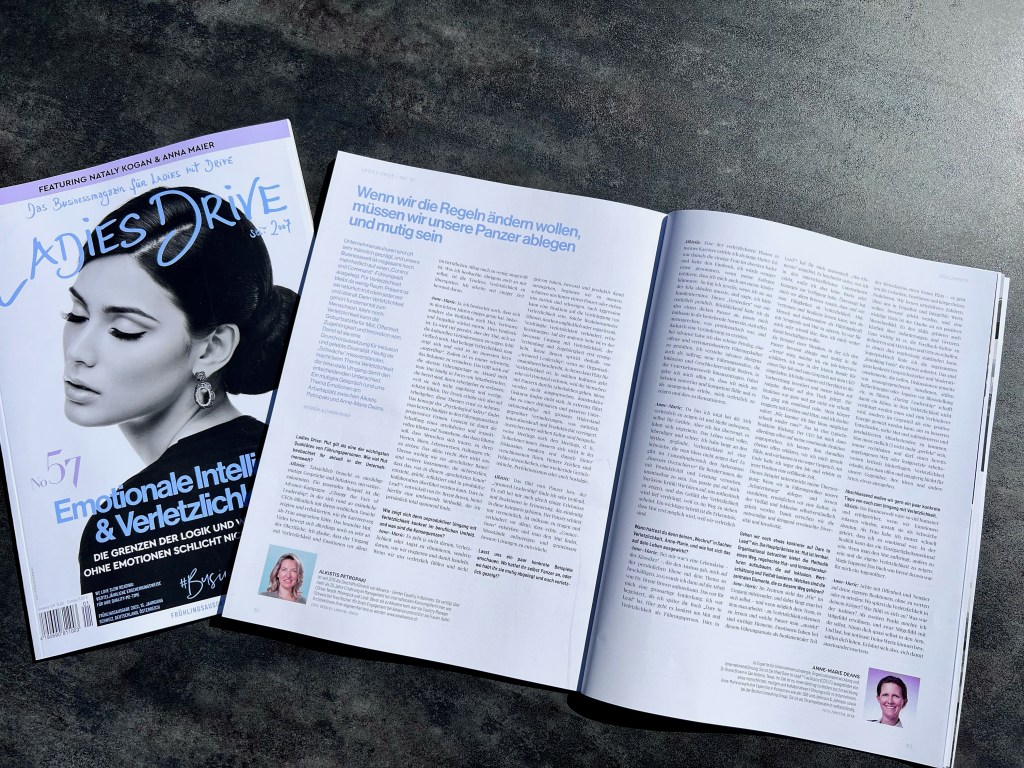
Dazu durfte ich meine Erfahrung in einem Gespräch mit Alkistis Petropaki teilen und dabei von ihr erfahren was Verletzlichkeit für sie und in ihrem Alltag mit Advance – Gender Equality in Business bedeutet. 

Diese Gelegenheit bedeutet mir sehr viel, denn Alkistis mit ihrer Organisation setzt sich mutig für neue Regeln in der Arbeitswelt ein, und ich bin der Meinung wir müssen in Unternehmenskulturen die Fähigkeiten zum Umgang mit Verletzlichkeit fördern, denn wir brauchen Mut. Ein grosses Dankeschön an Alexandra Rhiner für die Leitung des Gesprächs. 

Dazu kommt das ich den Eindruck habe, gerade im deutschen Sprachraum wird noch weniger über Verletzlichkeit (Vulnerability) gesprochen. Ist es der Begriff? Wäre Verwundbarkeit, oder ‘sich angreifbar machen’ oder ‘sich zeigen’ einfacher um das Gespräch aufzugreifen? Wir verstecken oft diese Verletzlichkeit, weil wir uns schämen nicht würdig /gut genug / geliebt zu sein. Ich finde schön wie in Deutschland der erste Artikel im Grundgesetz lautet “Die Würde des Menschen ist unantastbar” und in der Schweiz im Grundrecht “Die Würde des Menschen ist zu achten und zu schützen.”. Daran kann man sich orientieren und wir dürfen nicht Angst vor Fehlern haben, wir lernen alle – jedoch kann man Kompetenzen lernen, um im Alltag mit dieser Verletzlichkeit umzugehen und auf seine eigene Würde sowie die Anderer Acht zu geben.

Veröffentlicht ist unser Gespräch in der aktuellen Ausgabe der Business Zeitschrift Ladies Drive (Frühling 2022). Insgesamt hat die Herausgeberin Sandra-Stella Triebl spannende Beiträge von beeindruckenden Personen zum Thema Emotionale Intelligenz & Verletzlichkeit zusammengebracht. Und aktuell ist das Thema Verletzlichkeit ja sehr präsent um uns herum und betrifft uns alle. Eine Leseempfehlung.

Wer interessiert ist mehr zu erfahren darf gern mit mir unverbindlich Kontakt aufnehmen. Das Dare to LeadTM Programm von Dr. Brené Brown ist auf Deutsch verfügbar, ihr Buch dazu noch in der Übersetzung und nicht am deutschen Titel stören lassen.

#Verletzlichkeit #Mut #Startatthetop #ladiesdrive #businessisterhood

Abundance Mindset – let’s shift to a mindset that we are enough, know enough and have enough to serve the wellbeing of all

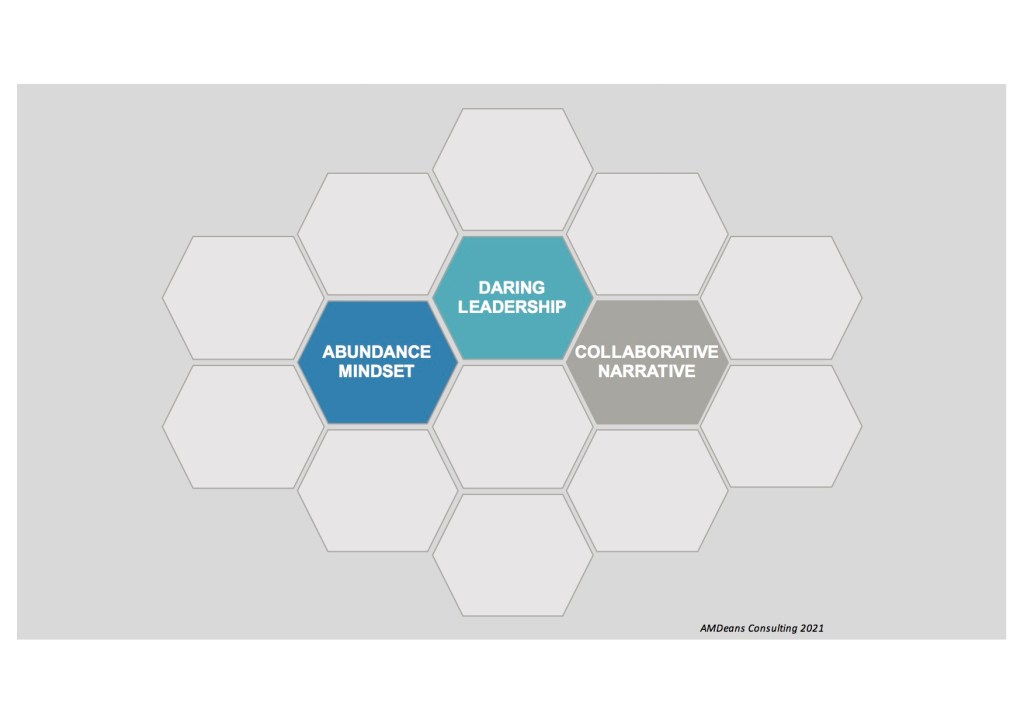
There are three important elements required to reimagine our systems and business models:

  1. Daring Leadership
  2. Abundance Mindset
  3. Collaborative Narrative

In this post I dig in to the term ‘Abundance Mindset’ and why I believe it is important at the individual leader level, and also at a cultural level for our societies and organisations.

“No problem has been more puzzling to thoughtful people than why, in a troubled world, we make such poor use of our affluence (Galbraith)” in J.Suzman. Work: A deep history.

Have you ever wondered why we believe time is scarce? Working long hours is seen as the way to create value? Material goods and money are the main indicators of our success? Competition and being the ‘winner’ is what counts?

Here’s the thing we live in a ‘scarcity-fuelled’ society. Scarcity meaning: “being in short supply or shortage”. We get taught from a young age onwards that we have to compete for the best grades and future jobs – this continues in adult life with performance rankings, material status symbols, the artificial desire for constant consumption. It has become our underlying mindset for our lives and the social and economic constructs. We are taught we are not enough, we don’t have enough and we don’t know enough.

I outline what living in scarcity does to our behaviour and creativity in the post on Daring Leadership. The work by Dr. Brené Brown shows that when we are in a scarcity-driven state of anxiety we are more likely to armour up and isolate ourselves further, rather than dig into vulnerability, creativity and courage to open up to new ways of operating. So being in a scarcity mindset is not going to be a great position to help us with the challenges around us and reimagining new systems.

An additional great piece in the puzzle as to where this ‘scarcity-fuelled’ way of operating may be rooted was provided in the recent publication “Work: A deep history, from the stone age to the age of robots” by James Suzman. As an anthropologist, James Suzman provides a view at a societal and economic level over our work history: from hunter-gatherers, via foraging, to farming, city-dwellers, the industrial revolution and finally our current times. I highly recommend reading the book to learn way more than I highlight in my summary and take-aways below. It provides a provoking insight. (Note: Direct quotes from this book are marked in italics)

James Suzman’s main conclusion is that we operate in a scarcity-driven system that originated in the agricultural period. Now, if we understand how our scarcity mindset originated it enables us to take a step back from our scarcity obsession and question if it is still a valid mindset for how we want to operate in our societies and businesses going forward. It allows us to recognise our own man-mind constructs, which means it is not fixed but up to us to change it.

If we move from a scarcity-driven mindset to an abundance mindset as the main notion underlying our activities, it will allow us to tap into creativity and curiosity. An abundance mindset is one where we focus on ensuring basic needs are met and beyond that the underlying notion is that we are enough, have enough and know enough. Of course we have to make sure basic economic needs are met globally and real scarcity is a thing of the past. Yet, I am convinced starting with an abundance mindset (plus daring leadership and a collaborative narrative) will play a key role on achieving more balanced distribution of the wealth and affluence we have.

As James Suzman highlights in his book, John Maynard Keynes called for an economics of abundance and that in such a scenario inequality would become irrelevant. Similarly, “Galbraith was of the view () individuals would relinquish the pursuit of wealth in favor of worthier work.”

So let’s dig into the case James Suzman builds around our work history and where scarcity originated:

James Suzman proposes that originally hunter-gatherers focused on meeting solely their immediate needs and established systems like ‘demand sharing’ with flat hierarchies. What they needed to cover their immediate needs was abundantly available and required limited amounts of their time to obtain, giving them time for leisure. In summary they had a form of affluence without material abundance as they had modest desires, which were easily met. In the consequent stage of foraging, foragers still enjoyed a form of affluence based on far greater material abundance. It is also the phase where people began to adopt a longer-term, more future-focused relationship with work.

The move to farming is really when the future-focused relationship with work and anxieties about scarcity developed and intensified. James Suzman summarises that climate changes led to a situation where the environment could not provide sufficient food year-round, so it changed the relationship with the land and work. Farmers had to focus on fewer but more prolific plants and also new farming techniques. Any gains in productivity were matched by growing populations. The situation led to an expansion into new spaces and to cultures based around anxieties about scarcity and productivity. “The sanctification of scarcity and the economic institutions and norms that emerged during this period still underwrite how we organize our economic life today.

It is also in the farming period that the concept around money starts. “The origins of money lies in the credit/debt arrangements that arose between farmers – who were, in effect, waiting for their land to pay them for the labor they invested in it and the people who depended on their surpluses

Later, when the industrial revolution changed farming productivity and with the continued population growth people started to aggregate in cities. Less people were occupied as farmers to work the land, and new specialist trades developed for organising how people lived in the larger populations and settlements. “This required bureaucrats, judges, soldiers, and those who specialized in keeping order and binding people together into urban communities with common values, beliefs, and goals.”

Furthermore, 20th century economic concepts and mindsets have contributed significantly to our scarcity and productivity focused systems: “Taylorism” – the focus to maximise efficiency with standardisation and assembly lines, it may have addressed a need for a while and certain industries, yet the issue here being “the right person for these industrial jobs was someone limited with imagination, boundless patience, and a willingness to obediently do the same repetitive tasks day in and day out.” “Consumerism” – producers and advertisers have been creating fears and artificial needs to keep consumption and growth up as well as “creating desires for material products would make people feel like they were moving upwards and worry less about inequality. “Talent” – a concept around a war for talent, has since been challenged for it’s issue that leads to “competitive narratives also amongst employees, overvaluing individuals, creating a corrosive culture and decreasing collaboration“.

Finally, yes wealth was created with this focus on scarcity and productivity – however this wealth has been highly concentrated amongst a few: “The richest 10 percent of people on earth own an estimated 85 percent of all global assets, and the richest 1 percent own 45 percent of all global assets”

So our relationship with scarcity are by-products of the transition from foraging to farming. James Suzman highlights how again and again it was observed by historians how people were losing their sense of belonging and purpose in these systems. For example, Durkheim was curious about the “malady of infinite aspiration” and he coined a term “anomie” as the feelings of intense dislocation, anxiety, and even anger in people due to their social isolation. We see today the concerns around growing isolation and it’s impact on mental and physical health. Already Durkheim recognised how creating safe working environments with strong relationships could potentially be a solution and when we today talk about daring leadership and purpose we are recognising the same. We are “A species whose evolutionary history has been shaped so profoundly by its need for purpose and meaning”. Besides the social cost, there is the environmental cost as we are aware and the mentioned wealth inequality cost.

No one can summarise how important this work is than James Suzman himself in the conclusion of his book:

“Recognizing that many of the core assumptions that underwrite our economic institutions (and notions of scarcity and a preoccupation with economic growth) are an artifact of the agricultural revolution, amplified by our migration into cities, frees us to imagine a whole range of new, more sustainable possible futures for ourselves, and rise to the challenge of harnessing our restless energy, purposefulness, and creativity to shaping our destiny”.

So are you ready to reimagine and start building our societies and economic models based on a notion of abundance? Start with this – you are enough, you have enough and you know enough to contribute to the change we want to see.

Source: Work – A deep history, from the stone age to the age of robots. James Suzman, Penguin Press 2021.

Daring Leadership – it is not about reckless daredevils, but about leaders who courageously show up open to vulnerability and empathy

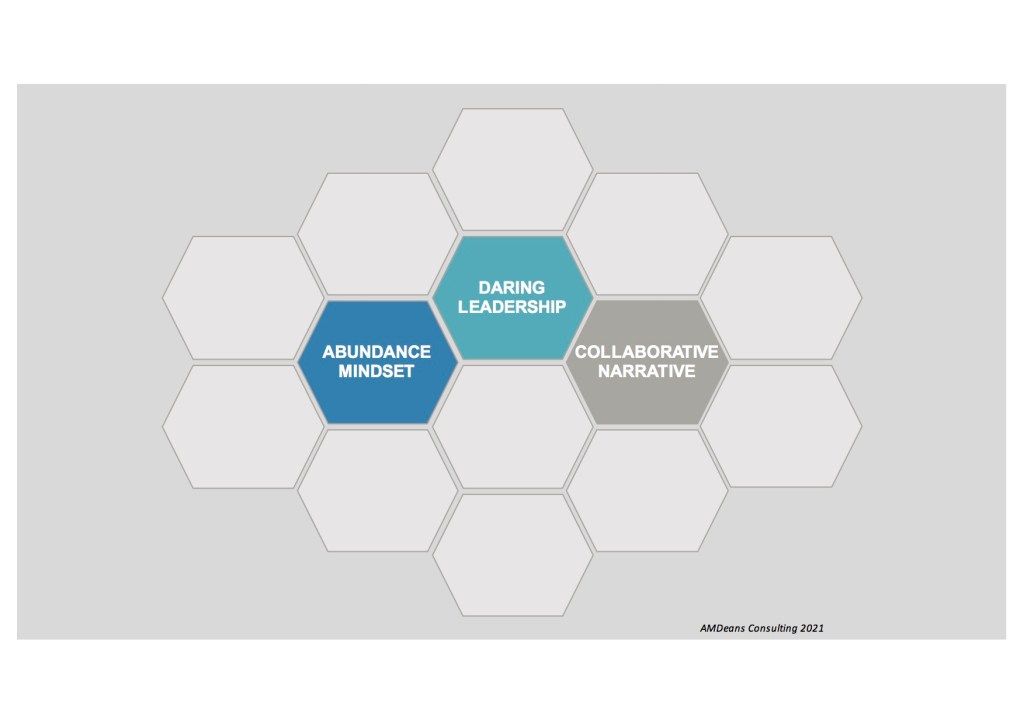
There are three important elements required to reimagine our systems and business models:

  1. Daring Leadership
  2. Abundance Mindset
  3. Collaborative Narrative

In this post I dig in to the term ‘Daring Leadership’ and why I believe it is important at the individual leader level, and also at a cultural level for our societies and organisations.

You are working on a project, your colleague has a great idea for an improvement that is mentioned over a coffee break. However, in the critical meeting no one speaks up. When they do speak up – you notice no genuine interest by those in the room to spend time to dig in to what this change would require. Most of the time in your organisation you seem to be reactively fixing issues, adding a new task force on top of another – rather than taking courageous decisions of stopping projects or blocking a chunk of time to really engage in meaningful dialogue with the experts and take hard decisions.

Time and time again in different organisations I witnessed and participated in similar situations and behaviour – yet I couldn’t quite put words to what was going on. I valued my colleagues individually, yet in our work interactions we seemed to stay in safe places that mid-term felt very dissatisfying regarding the business decisions taken.

Brené Brown opened my eyes and gave me language to explain what is going on in our societies and organisations. By interviewing CEOs and c-level executives Brené Brown collected all the answers to what is required in leaders. The answer she received most often was courage – “We need braver leaders and more courageous cultures”. Did they know how to act with courage and what skills this required? No – was the answer. But then the list, like mine above, started pouring out – behaviours that get in the way of a courageous work culture. This led to a large piece of research by Brené Brown and her group to look closely at the topic of courage and vulnerability in our work cultures.

‘Daring Leadership’ is based on this research by Dr. Brené Brown, Research Professor at the University of Houston, Texas. Other terms that for me relate to Daring Leadership and which are used elsewhere are ‘Servant Leadership’, ‘Courageous Leadership’, ‘The Purposeful Leader’.

If you are a leader living by Daring Leadership principles then you are leaning into vulnerability and staying open to learning, you are caring for and connecting with your stakeholders, you are demonstrating curiosity and empathy and you have the courage to develop the potential in people and processes.

Brené Brown is not alone in her findings of the importance of courage and vulnerability. The best business schools and management consulting firms have started to put major highlight on the importance of trust, vulnerability, empathy and innovation in our workplaces. The recent publication by Hubert Joly “The Heart of Business” is receiving much positive attention for it’s focus on ‘unleashing the human magic’.

Yet, what is significantly harder to find are concrete methodologies that provide you with a way to strengthen your own skill set, provide you with tools and help you recognise when you are on the right path to being a leader and building an organisation with a culture of vulnerability, trust and empathy. Too often it is assumed we are naturally brave or trust is something you just have, or it is easy to come forward with these attributes.

Dare to Lead™ is an empirically based courage building program designed to be facilitated by organisational development professionals. It originated in the publication of Dr. Brené Brown’s research findings in the book Dare to Lead™.

Daring Leadership is unrelated to a companies organisational design. How you draw your organisational chart, whether you like the old-fashioned boxes with dotted and direct lines and classic project management, or you focus on agile methods and new ways of operating, whether you are set up in business and function units or are a process-driven organisation – it really does not matter (and I actually believe overall it does not really matter). Daring Leadership is the cultural and behavioural glue you require for HOW you, your leaders and employees operate within the organisational setting and interact with one another.

So why is Daring Leadership important? In a world that is transforming from shareholder-driven capitalism to a new form of stakeholder capitalism, from individual profit focus to sustainable solutions and with new technological advancements we have to be able to stay curious, foster an environment with diverse thinking, the ability to have tough conversations and dig into uncomfortable decisions. And with all of this we have to care better for each other and our planet.

On an individual level there are steps you can take on your path to Daring Leadership:

First, you become aware of what is happening around you – you observe carefully your own behaviour and that of others around you at the workplace. For example do people come up with and give voice to questions or suggestions, are there ‘meetings-after-the-meetings’ taking place where, what was agreed is altered again and do you feel you are constantly just fire-fighting issues rather than proactively taking the time for hard conversations early when issues start to appear?

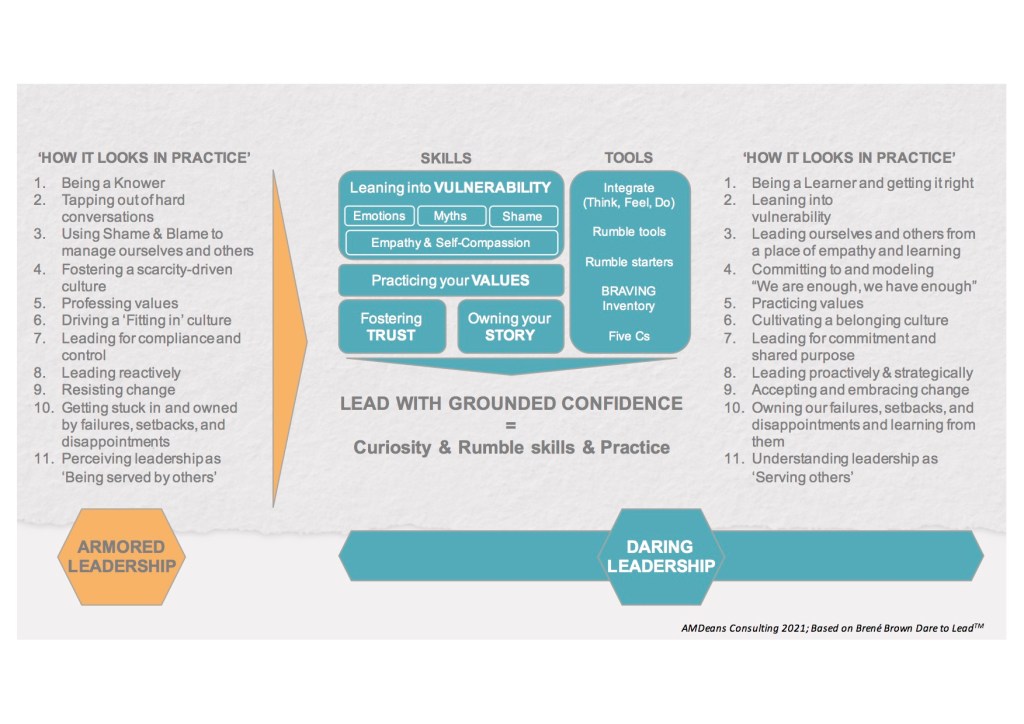
Second, learn the skill sets for courage – by understanding vulnerability, identifying and discovering how to practice your values, understanding the elements required to foster trust and find out how to own and change the stories you develop. To build these skill sets you have amongst others the options depending on your learning preferences to read the book, work with a coach or take part in a Dare to LeadTM facilitated program. The facilitated program is also available to organisations.

Finally, you can develop your practice by integrating tools such as rumble starters into your daily way of working and keep developing the ability to lead with grounded confidence – that is by staying curious, using your rumble skills and practice, practice, practice.

On a societal and business model level we have to focus on building these skill sets in individuals, but also by generating interactions, time and space for meaningful dialogue around our values and also start operating from a notion of an abundance mindset and with new collaborative narratives that define how we measure success.

Summary of the Dare to LeadTM program to develop Daring Leadership, ie leading with Grounded Confidence. Dare to LeadTM is an empirically based courage building program developed by Dr. Brené Brown.
Image by AMDeans Consulting 2021.

Source: You can find more information on the work by Dr. Brené Brown and Dare to LeadTM here.