Active engagement in our local communities – an unachieved priority

What if.. people want to be actively engaged in their community.. and yet are not achieving that?


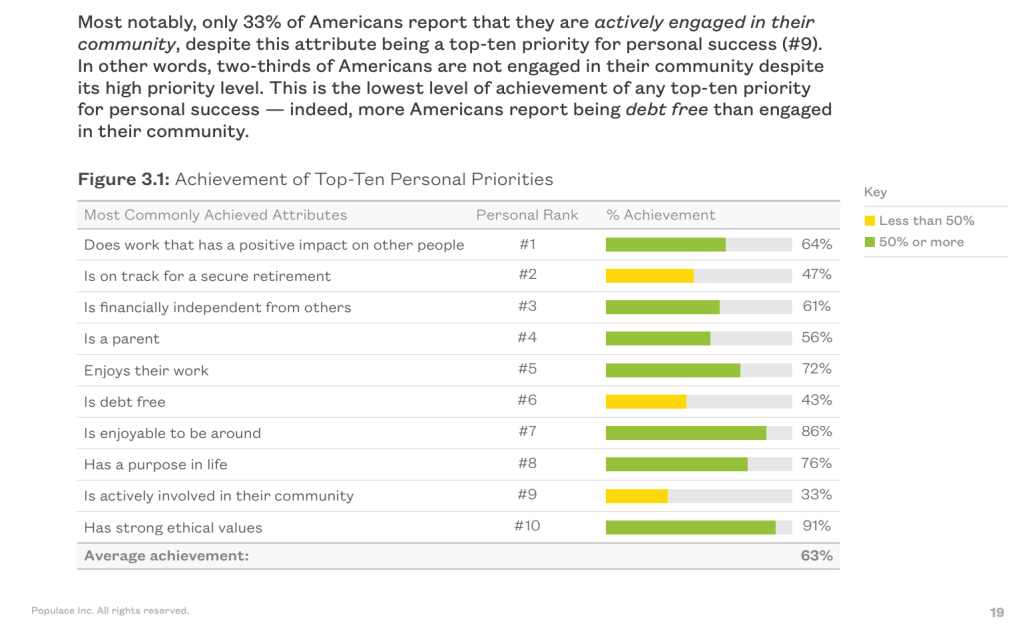
A study in the US that looked at what people privately share as their top personal priorities* and also to what degree do they subjectively feel they achieve against these. Below you see the top 10 results – source Populace, Success Index:
Misunderstanding the American Dream
:

.


Of the individuals reported top 10 priorities – active engagement in their community scores lowest in terms of their feeling if they are achieving it in their lives.

From my other research I know active engagement in our local communities is important for our wellbeing, for building peaceful connections across divides, and for engagement into looking after our local environment. It matters.

My personal experience with community engagement? My observation is for me getting involved in my local community requires space such as small regular chunks of time, free attention to look around myself, and consistency in being present. It’s about familiarity and micro-steps in building trust. It’s quiet, not loud. Sometimes it feels pointless and annoying. The rewards are not what mainstream culture rewards, they are connection, the satisfaction of living into your integrity and fulfilling that priority number 1 of having a positive impact on others in small, hardly noticeable ways.

And maybe it is simply knowing you matter because you feel part of a place. Your community. Where people know you and treat you as part of the community, irrespective of differences you may have.

A shoutout here. This makes me proud to be affiliated with the new initiative PIONIERQUARTIER – which is an amazing team of experts and initiative looking at how to create community spaces with a lower threshold for how to become and stay engaged. 💫

If anything these data are an invitation to question any judgement if people are not engaged because they do not care about their local community, and wonder what if rather there is something in the way of making it happen? What if..?

(*note: these top personal priorities are often not expressed publicly as we self-silence and follow what we believe are societal norms, there is more to this in this study – for example actively engaging in our community is ranked at nr26 for how important supposedly ‘others’ think it is)

Source: If you like reports and data and original sources as much as I do. This is all from the Populace research report on ‘Success index’ (2023) and the conversation by Todd Rose: Populace

Source: I also can highly recommend a listen to Todd Rose talk about his data and the findings in this episode of the Mel Robbins podcast. So much also on belonging, values, trust, and our personal agency.

Learnings on humanisation

“Start small. Start local. Circulate with unusual friends. Propagate better conversations.” John Paul Lederach


Did you know internationally renowned peace practitioner John Paul Lederach shared his reflections freely in a Pocket Guide on his experience across over four decades mediating and transforming conflicts around the globe?

I believe it is so relevant for current times that you go read the full ca 100 pages, I’ll add the link to his website where you can find the pocket guide as a source below.

I believe it is so relevant for current times that I am also sharing my own selection of key extracts in the attached document because I know many won’t feel there is time to read the full document. The extracts require some thinking – as tempted as I was to add the ‘key take-aways’ for you, I have not condensed it further. His wise words are clear.


Nothing he observed regarding how to shift away from violence and dehumanization is rocket science. His stories are about ordinary people. An improbable few – the critical yeast. With a whole load of curiosity, courage, and the willingness to persevere. It’s worth giving it a try right? To be the critical yeast.

There is a discussion guide provided to dig into the concepts and what they may mean for you, your life, your local area.

I will keep sharing different views on ways to stay in our integrity with hope, with curiosity, with courage. If you want to know more, please do get in touch for a chat.

Source: https://www.johnpaullederach.com/2024/07/pocket-guide/?utm_source=substack&utm_medium=email

“Denken ist handeln” – it’s time to examine our thinking

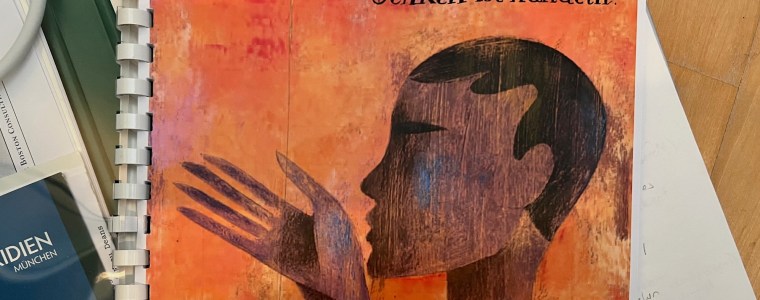
Image: Artist Olaf Hajek 2003. Personal material from the Move On Weekend, Munich 2005, by The Boston Consulting Group.

“Denken ist handeln” takes me back to my first interaction with the large management consultancy I joined after my malaria PhD. That line, “Thinking is for action,” spoke to me. I love ruminating, researching, putting complex bits of information into a digestible big picture, spotting the inconsistencies, the patterns, the messages. I tend to hang out a little longer on the side of thinking than on the side of action.

Yet – today I ask.

What if our thought itself was incorrect?

What if our thought adapted to a world around us and is driven by external messages of “you are not enough until _____” and you fill that blank with an external validation: your school grades, your university, your job titles, your products, your material wealth, your nose shape, your wittiness, your number of likes and followers. A world that we have created and our brains told us this is the only way of doing things.

If there’s one thing that such thought does it keeps us pretty distracted, busy and insecure as our basic desire for worthiness depends on external factors. It turns our opinions into self-identities, as David Bohm writes. It makes conversations into dangerous battle-grounds, as differing opinions are seen as attacks on our inherent internal worthiness and right to belong.

It makes us distracted and complacent.

As I write this, the world is watching atrocities unfold in the Middle East. It feels a little like the final straw on the camels back. I observe we are in pain. Yet, I also sense a discomfort in a sense of how could this happen (again). And a sense of grief for what we realise we are losing. There is also an unsettling silence to not say a wrong thing.

For me this article in the Guardian by Patrick Wintour sums up what I believe is a relevant viewpoint and speaks in a broader sense on other topics such as the loneliness, the anxiety, the questions on how to care for each other and our planet better. His title captures it: “The danger of leaving things be”.

Can we break the cycle of complacency?

Can we channel the regret of what got us here today, into where we put our energy into action tomorrow?

From all the research into the topics of wholehearted, courageous leadership, moving from discussion to dialogue and ways of rethinking strategy and business, I land at these three areas of focus for myself:

  1. Thought: Start with “you are enough”. Full stop. Then get really curious about a lot of other aspects of what we think of as normal and ‘has to be that way’. Ask yourself is it true?
  2. Feeling: Seek out & soak in awe. You can find this witnessing moral beauty in others, music, dance, nature, art. Read words from those that inspire you, watch concert videos, go to an exhibition, dance in the kitchen. Awe connects when the world polarises.
  3. Action: Shift from exploitation to exploration. I hold a deep desire to work with leaders and organisations (exploitation). That rarely allows real disruption and is slow, the logical consequence – it’s time to work with those leaders and organisations at the fringes (exploration).

Now here’s the thing – if we are feeling regret mixed in with all those feelings, according to Dan Pink we have three choices: Delusion, Despair or Action. Let’s choose action.

Sources:

  • David Bohm: On Dialogue.
  • Dan Pink: The power of regret
  • Dacher Keltner: Awe, The transformative power of everyday wonders

Investing in our aliveness matters

“The wheel is turning, the hamster is dead”

I have chosen a quote from 📚 Michael Bungay Stanier‘s fantastic and funny session on ‘how to work with (almost) everyone’, to sum up what I wish to share from my The_Dream business festival attendance: a quick win, a pay attention, a choice and a permission.

1) Less talking, more doing regarding our inner & outer ecology. It’s time to get the hamsters out of those wheels (alternatively we can use Philosopher Bayo Akomolafe’s reference to not be a Kafkan bug). Ie. how we want to work with each other, how we look after ourselves, how we build skills for wholehearted, courageous leadership. This can be a ‘quick win’ – it is known what can be done. Do it.

2) Speaking the truth – our planetary safety needs degrowth, our geopolitical safety needs growth. That means we have to really drill down into this paradox and align on a global scale to work on solutions. This is taken from Olivia Lazard‘s talk – the speaker who to me stood out most with her bravery, courage to look closely and her ability to grasp and look for solutions around energy transition and global situations. This is about paying attention – don’t look away from hard topics, chose where you want to invest your skill sets, your own behaviour.

3) Every time we invest in technology, we have to also invest in being human – our morality, our ethics, our communities. The messages were clear on how fast technology is moving, I took from it once more confirmation that we cannot expect to ‘teach’ technology ethics, morality if we are not investing similarly into these skills for ourselves and ensuring well grounded, alive human beings, relations and communities. To me this is a choice – let us link tech investment to human investments.

4) Do not mistake dreamers for not also being doers. I met the most amazing people – dreamers AND who have created businesses and institutes and art and graduate schools and new ideas. And who bring new ways of being to their leadership, teaching and interactions. Full of hope, curiosity, passion and desires to develop life-centered businesses. To me this is a permission – please dream, be full of aliveness, that is what our communities and work places need.

Back to that quote and stepping out from the busyness of a turning wheel – only with our aliveness can we tackle all these paradox questions around planetary wellbeing, shaping technological developments and doing so out of a deep care for ourselves and others.

Again, a thanks to the organisers and curators at House of Beautiful Business and all dreamers contributing.

Source: This post is reflecting my experience at The_Dream Business Festival, 2-5 June 2023, Sintra Portugal. Full details of the program is here: https://houseofbeautifulbusiness.com/thedream. I am happy to share more – get in touch.

Today’s strategic leaders require space more urgently than a neatly orchestrated strategy process

“There are leaders that always have time.
And then there are leaders that never have time.”

Does that ring true to you and your experience? This is what a senior leader recently observed to me and a group of their peers during a recent workshop. Since then, this comment has stuck in my mind. Because all around me I hear of the current busyness in organisations, and not in a ‘this is great there is so much happening’ way but rather in a ‘it’s too much we are all close to burnout’ way.

So what distinguishes those two groups of leaders mentioned above, if of course we all have the same hours in a day and a to-do list, which is never ending?

My hypothesis – we’re back to courage. Courage to make space, take time, be strategic and deliberate in our activities and interactions. Imagine the two groups:

  • A hustle and busyness culture: You stick with a command and control style of leadership, reactively fighting fires and resisting any change.
  • A strategic, deliberate culture: You make the space to invest in delegating power, allow for strategic thought and getting collaborative and curious in the face of change.

Does this mean if you lead with daring leadership everything will get real slow? I doubt it, even if I also believe it may not be the worst thing if there was more focus rather than worrying about speed. Anyway, if you look at it closely, removing the busyness may not be a contradiction to enabling speed. In the last years, McKinsey published work showing that speed can be a business advantage (McKinsey, The need for speed in the post-COVID-19 era—and how to achieve it), yet they also published that leaders report a lot of busyness with little effectiveness (McKinsey, If we’re all so busy why isn’t anything getting done? ).

I don’t have their underlying data, yet when McKinsey talks about an advantage for speed, if you dig into their report, you will find that the barriers reported as getting in the way of speed are silos, slow decision-making and lack of strategic clarity. So, this supports my hypothesis about being intentionally focused and calm with a clear strategy, and with a culture that enables employees to take bold business decisions at the right moment and right level, with the right amount of information and with an appropriate amount of risk. This enables the speed we are looking for – as the right activities and decisions get focused on and delivered upon – or as McKinsey says it themselves in an older 2018 article “Slowing down to speed up”.

What also backs this hypothesis up for me regarding busyness actually getting in the way of strategic work is the work by Business Professor Dorie Clark, who has written and spoken about the fact that busyness is often a mask to avoid facing uncertainty. You can go watch her TED Talk on the topic here.

So this busyness is asking us to have the courage to lean heavily into the discomfort of slowing down. That is making space. Space..

  • … for strategic, deliberate thinking, ideas and reflection, versus rushed firefighting and action bias.
  • … to take the time to align accountability and responsibilities for activities, versus blame and shaming over unclear responsibilities and deliverables.
  • … to allow for providing guidance on work that has been delegated with power to and power with models, versus a quicker ‘power over’ decision or solution,
  • … to respond with empathy to a situation going on with a colleague, versus brushing over it with a sympathetic gesture,
  • … to breath when you notice an emotional hook and get curious, versus letting our eager minds make up a false story.

And for many more examples of showing up with daring leadership behaviours.

As all of you reading this know, leaning into daring leadership is a tough choice, requiring persistence and practice. And yet we can build our courage skills to handle the vulnerability of making that space.

And this is where my activities tie to this work and you are welcome to get in touch with me about:

  1. Providing consulting and facilitation services to build those courage skills within your organisation that enable your leadership team to make and hold space
  2. As an open mindset facilitator certified by OMind support organisations in developing the mindset regarding collaboration
  3. Bringing the dialogue method to you and/or your organisation to create a wide space for strategic thinking and curiosity outside of structured processes and frameworks

I’d love to hear what you do to create and hold space as a leader so we can share and learn from each other around this.  

Image credit: Picture by Adam Thomas on Unsplash

Wholehearted courageous leaders – looking for reasons to invest in top leadership skills?

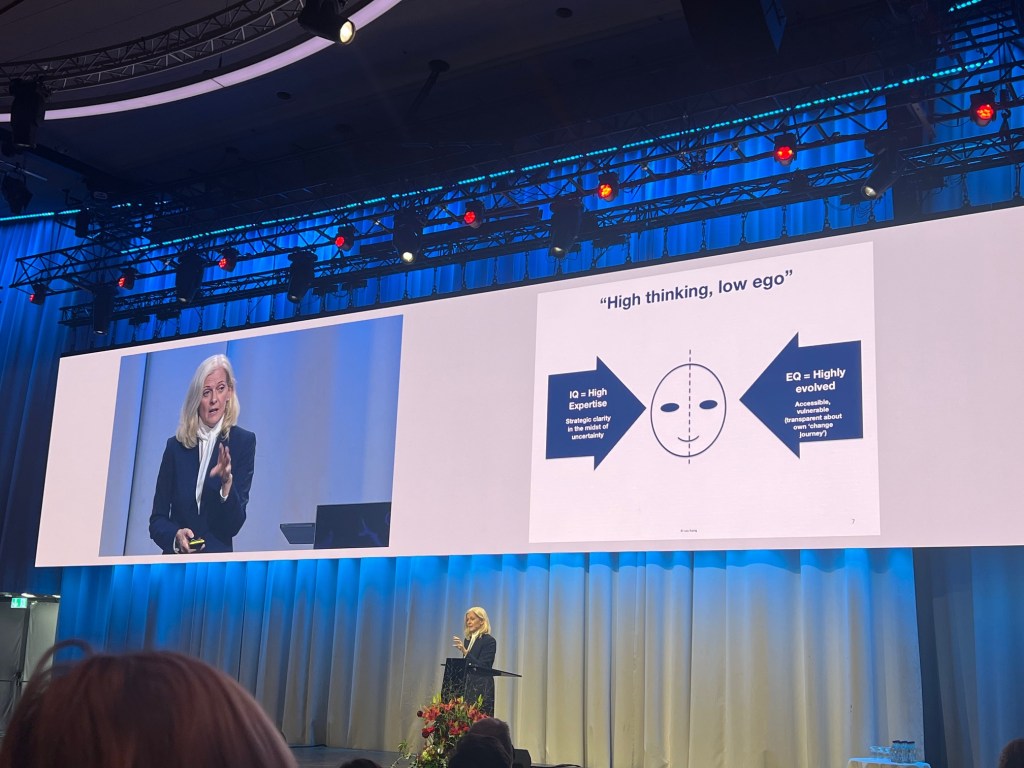
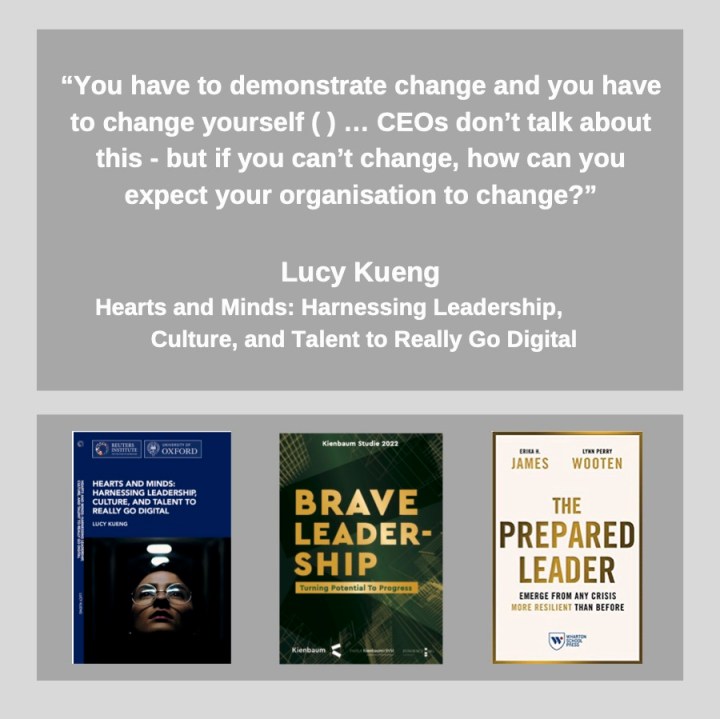
Lucy Kueng calls it ‘High Thinking, Low Ego’ and the consulting firm Kienbaum calls it ‘Brave Leadership’ —> for me it is the ability as a leader to focus on strategic priorities AND be a whole-hearted courageous leader. 

Lucy Kueng presenting at the Swiss Board Day 2022, Kursaal Bern, picture by Anne-Marie Deans

A new Kienbaum report confirms once more this leadership style is associated with…

.. improved business performance

.. building courageous cultures

.. integrating paradox, ambiguous demands (eg people and business needs)

.. retaining and attracting talent

.. boosting transformation success

In addition, the work by Erika James and Lynne Perry Wooten shows ego is the quintessential problem getting in the way of crisis preparedness by top leadership in organisations.  

Where to start? With yourself to do your inner work and your leadership team. Build courage skills – that is handling vulnerability, operating by your values, understanding the elements of trust and examine the stories you make up. 

Here the sources of the referenced work:  

  • Lucy Kueng’s book she published as open access: Hearts and Minds: Harnessing Leadership, Culture, and Talent to Really Go Digital. (2020)
  • Kienbaum’s new report: BRAVE LEADERSHIP – Turning Potential To Progress (2022) (note: in German)
  • Erika James & Lynne Perry Wooten new book: The Prepared Leader. (2022)

Generosity, Care and Curiosity – can we start there?

I had the real pleasure to give a keynote on the topic of “Speak Up & Psychological Safety” at an internal company event.

Preparing for this really made me distill down what this topic meant to me in its essence. What it meant in terms of the stories I have experienced. What it meant in combination with the experience I have from working in corporate cultures and my learnings around building courage and courageous cultures.

This is what I got to – forget for a moment all the fancy language, statistics and KPIs. Stop pointing the finger in all directions in terms of who is responsible to start generating this safe environment. And simply do this – start your interactions with others from a place of generosity, care and curiosity. Be the courageous listener so those around you can be heard with their ideas, opinions and feelings.

Courage is what it takes to stand up and speak; courage is also what takes to sit down and listen”

Winston Churchill

Because here’s the thing – I am confident we all are doing our best, carry our individual struggles and have a uniqueness that makes us shine. That includes ourselves. If we can keep that in mind and interact from a place of generosity, care and curiosity, this forms the starting point for us to be able to be Courageous.Enough.Together. And that is what we need in our businesses and our societies today.

Give it a try. See what happens and please do let me know if you feel inclined to share feedback.

Capturing my moment of vulnerability during the German version of the keynote (spot the numbering). Picture is used with permission and courtesy of the host Syngenta Stein R&D and the photographer Stephan Graf.

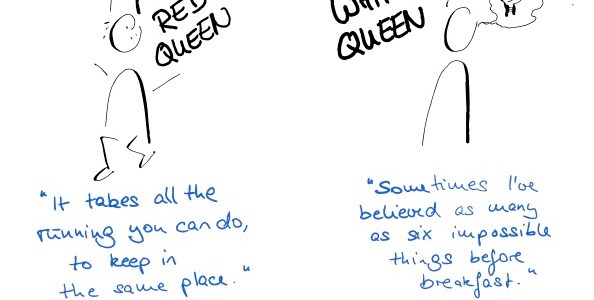
What a Red Queen and a White Queen might tell us about about business

Are you creating the space in your organisation for creativity and anticipation of the future – imagining as many possible scenarios as you can to build a bold new future? Listening to those idealists, visionaries, dreamers, thinkers who share how trends are developing?

“Now, here, you see, it takes all the running you can do, to keep in the same place. If you want to get somewhere else, you must run at least twice as fast as that!”

Red Queen, Through the Looking-Glass, Lewis Carroll 1871

I remember in my molecular genetics in biotechnology degree many years ago learning about the “Red Queen Hypothesis”. This is used in evolutionary biology to describe how organisms interact in a continuous “arms race” of defence and counter-defence mechanisms. It was called “Red Queen” based on the above quote from the red queen in Lewis Carroll’s book. Now that I have spent 15+ years in business after leaving academic science both on the management consulting side and in the industry – it is very much how business likes to behave. Constant competition both within the organisation (employees, projects, business units, etc) and also outside against other companies (competitors, substitutes, supplier, customers, etc). A lot of running fast to get more efficient and performing in what they already do well, that is known ways of doing business.

Here is the thing though. Today more than ever, we have a good understanding that all this competition against each other is not really going to solve the problems we jointly share – around inequality, climate change, human and planetary wellbeing. Those Dennis Meadows named “Difficult, global problems”. Similarly it leads to a very narrow perspective – the busyness of running to keep still is distracting from real disruptive change. So is it time to shift away from running fast only to keep in the same place?

Sometimes I’ve believed as many as six impossible things before breakfast

White Queen, Through the Looking-Glass, Lewis Carroll 1871

Inspired by the proposition from Eric Muraille in his paper “Diversity Generator Mechanisms Are Essential Components of Biological Systems: The Two Queen Hypothesis” (2018) I would like to extend his thinking around the other queen, the White Queen, towards businesses as a concept.

My reasons for this?

  1. We have difficult, global problems to solve – it requires bold (impossible) thinking
  2. It is time to anticipate how our future can look – have the courage to imagine outside of what we already do
  3. The White Queen is described as child-like – it will require playfulness, curiosity, the right brain

We jointly have one planet. Let us anticipate (at least) six impossible futures that involve courageous, compassionate and collaborative ways of doing business and living.

How to start? Stop running like a Red Queen – make space for long-term thinking, playing, curiosity and reimagining. It might be a little scary to stop running – as there are multiple factors why we tend to stay on that treadmill as I wrote about here – yet there are skills you can learn so you land softly when you bounce of that treadmill and into being.

Sources:

  1. Muraille E (2018) Diversity Generator Mechanisms Are Essential Components of Biological Systems: The Two Queen Hypothesis. Front. Microbiol. 9:223. doi: 10.3389/fmicb.2018.00223
  2. Escaping the Red Queen Effect in Competitive Strategy: Sense-testing Business Models. European Management Journal Vol. 23, No. 1, pp. 37–49, February 2005

Is it getting busier in here? Busyness, uncertainty and the courage to slow down

credit: pixabay

Is it getting busier in here? Busyness, uncertainty and the courage to slow down

Busy. The next meeting – online, offline, over coffee, with lunch, after dinner. Presentations, evaluations, process optimisations, digitalisation, implementations and reorganisations. Emails, instant messages, video calls, meetings. 

You may feel frazzled but isn’t fast a great advantage? In a recent survey McKinsey1 found that speed was associated with better outcomes – the positive effect was seen across all business dimensions, yet particularly in regards to operational resilience and innovation. Yet – here’s the thing – as separately reported McKinsey2 senior business leaders reported feeling busy and overwhelmed whilst getting nothing done and the quality of interactions decreasing.  I remember that feeling well from corporate settings – a constant stream of meetings, project revisions, KPI reporting – being busy with no tangible outcome for the business. 

What is it about the connection here with speed versus busyness with little value added.

When McKinsey talks about an advantage for speed, if you dig into their report, you will find that the barriers reported as getting in the way of speed are silos, slow decision-making and lack of strategic clarity. So, I would argue that the advantage of organisations being ‘faster’ is not about doing more, quicker, and spinning madly. I believe it is about being intentionally focused and calm with a clear strategy, and with a culture that enables employees to take bold business decisions at the right moment and right level,  with the right amount of information and with an appropriate amount of risk. This enables a felt speed – as the right activities and decisions get focused on and delivered upon.

The importance of strategic clarity as seen as one element required for speed – and increased operational resilience and innovation. The research by Leadership Expert Dorie Clark, who focuses on long-term strategic thinking, showed that business executives recognise the importance for long-term strategic thinking yet at the same time report to not have time to do so3. She took her research further to explore why they don’t have time, what is it with the busyness. Here’s the thing, as you will see in her concise Ted Talk4 the perceived busyness is often not about how much you have to do, but is associated with status, uncertainty and numbing (ie avoiding feeling our emotions). That means this busyness achieves the opposite to what would be desired, business leaders are staying busy to avoid decisions, or feeling discomfort and ambiguity. 

So if you want leaders and a corporate culture, where leaders are calm and focused, whilst making courageous decisions based on strategic clarity and collaborating across silos – you want to build the ability to handle discomfort, ambiguity, paradox challenges whilst staying true to agreed upon values and being accountable for mistakes. You want leaders who are able to feel comfortable slowing down in able to speed up.

There are three areas to focus on:

1) At the individual level: Train for skills in courage and handling uncertainty.  Start right at the top of the organisation with this.  You have to slow down to make space, learn about vulnerability, values, trust and resilience. Become brave and kind leaders who pay attention.

2) At the corporate culture level: Create a corporate culture where it is safe for courageous decision-making. And remember, clear is kind.  Culture is defined by a collection of norms, beliefs, values or artifacts. Take a close look at what you are rewarding and what people are held accountable for.

3) At the corporate strategy level: Really focus the corporate strategy to avoid noise, ensure there is alignment with your purpose and values. Understand your stakeholders.

In 2021, the consulting firm Kienbaum did a study5 investigating courage in the workplace – their research led them to define a leader as courageous as being both ‘determined’ and ‘value-driven’ (Entschlossenheit & Werteorientierung). Despite confirming the positive correlation of courage with business performance – they found that only 12% of participants in their study displayed courage as measured by their definition.

The good news is that courage and the ability to handle uncertainty can be developed as leadership skills.  I support leaders develop Daring Leadership, Abundance Mindset and Collaborative Narratives as the cornerstone for courageous and innovative organisations.

Sources: 

  1. https://www.mckinsey.com/business-functions/people-and-organizational-performance/our-insights/the-need-for-speed-in-the-post-covid-19-era-and-how-to-achieve-it
  2. https://www.mckinsey.com/business-functions/people-and-organizational-performance/our-insights/if-were-all-so-busy-why-isnt-anything-getting-done
  3. https://hbr.org/2018/06/if-strategy-is-so-important-why-dont-we-make-time-for-it
  4. https://www.ted.com/talks/dorie_clark_the_real_reason_you_feel_so_busy_and_what_to_do_about_it/transcript?language=en
  5. https://media.kienbaum.com/wp-content/uploads/sites/13/2021/09/Kienbaum_Die-MUTation-der-Arbeitswelt_2021_.pdf
  6. https://brenebrown.com/hubs/dare-to-lead/ 

Reflections on 50 years ‘The limits of growth’ – let’s invest in the skill sets and mindset to be ‘Courageous. Enough. Together’

I am convinced we require courage and caring; we require the ability to recognise what we have versus being driven by external wants; and we have to seek true collaboration based on our common vulnerability and a common goal to build “The Mature Society” – a term coined by Dennis Meadows.

Professor Dennis Meadows is not a name I was familiar with up until very recently. Also his work was not something I was aware of. That is the “Limits of Growth” research and work published now 50 years ago.

That is although I worked in management consulting advising business leaders on structuring their businesses. The job was not to be concerned with a full view and long-term thinking on people, planet, profit. It was a view on competitive advantage, profit and total shareholder return – that is excluding the occasional non-profit engagements. Dominant topics requested by industry to management consultancies were to cut FTE, benchmark and optimise sales numbers, find reasons to raise prices, perfect patient funnels or customer journeys, and outsource to somewhere (still) cheaper (globalised) where possible. More sales at higher prices, cheaper costs of resources, and consistent growth of the financials was the goal.

So back to Dennis Meadows and the original work in 1972. At the time an international team of researchers at the Massachusetts Institute of Technology began a study looking at the implications of continued worldwide growth. The findings: The earth’s interlocking resources – the global system of nature in which we all live – probably cannot support present rates of economic and population growth much beyond the year 2100, if that long, even with advanced technology. A strong message – that got completely belittled and ignored.

It was the work published by anthropologist James Suzman that brought my attention to this report, as well as how it was received back then. So as my attention on the topic was raised, I grabbed the opportunity on the 7th June 2022, to watch a live transmission of Dennis Meadows presenting to The New Institute Hamburg titled “Reflections on The Limits to Growth at 50 & 80”. ’50’ being the years since his original presentation of The Limits of Growth in 1972 at the Smithsonian Institution and ’80’ being his age in 2022.

I took away three key messages and learnings shared by Dennis Meadows to reflect on:

  1. Ignore your doubts and be persistent with your contributions
  2. The findings of the model were accurate, yet were not addressed as they are “difficult, global problems”
  3. Create a positive alternative and a goal to drive hope

1. Ignore your doubts and be persistent with your contributions. Dennis Meadows shared one of his main thoughts before going on stage back then in 1972. And it was this: “This is completely obvious“. His research and finding seemed to him to be obvious, and that it was not worth him telling the collected group of scientists and journalists. And yet it was not obvious. It was ignored. Did that make him give up on the work? No, he continued and 50 years later is still hopeful for our ability to take action.

2. The findings of the model were accurate, yet were not addressed. Dennis Meadows shared how simple the model was focusing on just five aspects: population increase, agricultural production, nonrenewable resource depletion, industrial output, and pollution generation. Yet from the scenarios the ‘standard run’ represents real-life happenings leading to where we are today 50 years later. He reflects openly on failure “We completely failed to achieve our purpose“. He then linked this failure to our (politics, business, societies) lack of ability to tackle “difficult, global problems” – that is problems, which generate returns in the long-term (vs. short-term) (that is ‘difficult’) and which require global solutions, so cannot be solved with local actions (that is ‘global’).

3. Create a positive alternative and a goal to drive hope. Finally, he talked about what is required for us to work together and find solutions, rather than moving in the direction of “less liberty, in exchange for less chaos” – based on the basic social law. In his perspective it links to first what is required for hope: “It requires a sense of humanity (collective ethics and values) plus tools to give hope“. And second Dennis Meadow explained what he would change “If I were to go back.. we need to offer a positive alternative“. His finish is a proposal for that alternative scenario to stimulate discussion and activity around this: “The mature society”.

I attended a further event on the “50 Years of The Limits of Growth” hosted by the Club of Rome on the 14th June 2022. Prof. Dennis Meadows shared the above learnings once more in his keynote and a panel discussion took place moderated by Sandrine Dixson-Declève, Co-President of the Club of Rome. I noted in particular following thoughts to pursue (I attempt to attribute these to the panel speakers, wording may not be accurate):

  • People are currently affected by the 3 Cs – Covid. Climate. Conflict. (Sandrine Dixson-Declève)
  • GDP is not measuring what is worthwhile measuring. (Tim Jackson)
  • A new business school is required. (Tim Jackson / Sandrine Dixson-Declève)
  • Care for place. Care for community. (Kate Raworth)
  • Have courage of our convictions. (Sandrine Dixson-Declève)
  • Look at positions of power: those who it suits well and do well in it will not change it. (?)

With Sandrine Dixson-Declève wrapping the overall discussion up well – saying let’s make Jane Goodall proud and use our intellect wisely.

Jane Goodall in a book written with Douglas Abrams lays out her reasons for hope: the amazing human intellect, the resilience of nature, the power of young people, the indomitable human spirit. “Let us use the gift of our lives to make this a better world.”

Hope itself is not an emotion – it is a way of thinking and is based on having three things: realistic goals, pathways to get there (not one but multiple) and agency – we believe in ourselves. “Hope is a function of struggle – we develop hope not during the easy or comfortable times, but through adversity and discomfort”.

How can the work on reimaging systems and culture towards the concepts of Daring Leadership, Abundance Mindset and Collaborative Narratives play a part in creating this “The Mature Society”?

These are the opportunities and contributions I see and will continue to work on:

Daring Leadership: Courageous leaders can handle their vulnerability, can lead from the head and heart. They can stay curious and generous, stick with the messy middle of problem identification and solving, and listen with the same passion with which we want to be heard. These are skills to be teaching at school, in business schools and the further development of current leaders.

Abundance Mindset: To slow down our consumption and increase our well-being, we have to move from scarcity-fuelled fears and externally-created wants to recognising what we have (and yes this may not be material wealth and rather go back to the roots of our mental, spiritual, physical wellbeing) as well as understand that we have enough to make a change, that is to give us that sense of agency.

Collaborative Narratives: It is imperative to move from competitive to collaborative thinking to address current challenges and particularly to address the ‘global problems’ described by Dennis Meadow. No one can ‘win’ alone, as then we all lose. An aspect of this is the ability to address paradox challenges and recognise the vulnerability we all have in common with each other and the planet.

In short it is about being Courageous. Enough. Together.

  • Sources:
  • Professor Dennis Meadows, Online Presentation, hosted by: The New Institute, date: Hamburg 7th June 2022.
  • Professor Dennis Meadows, Online Presentation, hosted by: The Club of Rome, date: 14th June 2022.
  • Book: The Book of Hope: A Survival Guide for Trying Times, by Jane Goodall and Douglas Abrams, with Gail Hudson
  • Book: Atlas of the Heart, Brené Brown, 2022
  • Book: Dare to Lead, Brené Brown, 2019.