
Are you creating the space in your organisation for creativity and anticipation of the future – imagining as many possible scenarios as you can to build a bold new future? Listening to those idealists, visionaries, dreamers, thinkers who share how trends are developing?
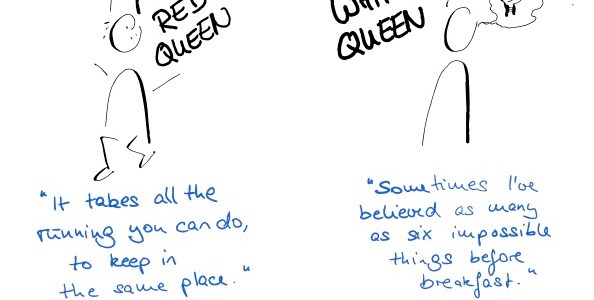
“Now, here, you see, it takes all the running you can do, to keep in the same place. If you want to get somewhere else, you must run at least twice as fast as that!”
Red Queen, Through the Looking-Glass, Lewis Carroll 1871
I remember in my molecular genetics in biotechnology degree many years ago learning about the “Red Queen Hypothesis”. This is used in evolutionary biology to describe how organisms interact in a continuous “arms race” of defence and counter-defence mechanisms. It was called “Red Queen” based on the above quote from the red queen in Lewis Carroll’s book. Now that I have spent 15+ years in business after leaving academic science both on the management consulting side and in the industry – it is very much how business likes to behave. Constant competition both within the organisation (employees, projects, business units, etc) and also outside against other companies (competitors, substitutes, supplier, customers, etc). A lot of running fast to get more efficient and performing in what they already do well, that is known ways of doing business.
Here is the thing though. Today more than ever, we have a good understanding that all this competition against each other is not really going to solve the problems we jointly share – around inequality, climate change, human and planetary wellbeing. Those Dennis Meadows named “Difficult, global problems”. Similarly it leads to a very narrow perspective – the busyness of running to keep still is distracting from real disruptive change. So is it time to shift away from running fast only to keep in the same place?
“Sometimes I’ve believed as many as six impossible things before breakfast”
White Queen, Through the Looking-Glass, Lewis Carroll 1871
Inspired by the proposition from Eric Muraille in his paper “Diversity Generator Mechanisms Are Essential Components of Biological Systems: The Two Queen Hypothesis” (2018) I would like to extend his thinking around the other queen, the White Queen, towards businesses as a concept.
My reasons for this?
- We have difficult, global problems to solve – it requires bold (impossible) thinking
- It is time to anticipate how our future can look – have the courage to imagine outside of what we already do
- The White Queen is described as child-like – it will require playfulness, curiosity, the right brain
We jointly have one planet. Let us anticipate (at least) six impossible futures that involve courageous, compassionate and collaborative ways of doing business and living.
How to start? Stop running like a Red Queen – make space for long-term thinking, playing, curiosity and reimagining. It might be a little scary to stop running – as there are multiple factors why we tend to stay on that treadmill as I wrote about here – yet there are skills you can learn so you land softly when you bounce of that treadmill and into being.
Sources:
- Muraille E (2018) Diversity Generator Mechanisms Are Essential Components of Biological Systems: The Two Queen Hypothesis. Front. Microbiol. 9:223. doi: 10.3389/fmicb.2018.00223
- Escaping the Red Queen Effect in Competitive Strategy: Sense-testing Business Models. European Management Journal Vol. 23, No. 1, pp. 37–49, February 2005

 amdeans-consulting.com