Was Verletzlichkeit mit Mut, Inklusion und Innovation zu tun hat, und warum das gerade in Unternehmen so wichtig ist.
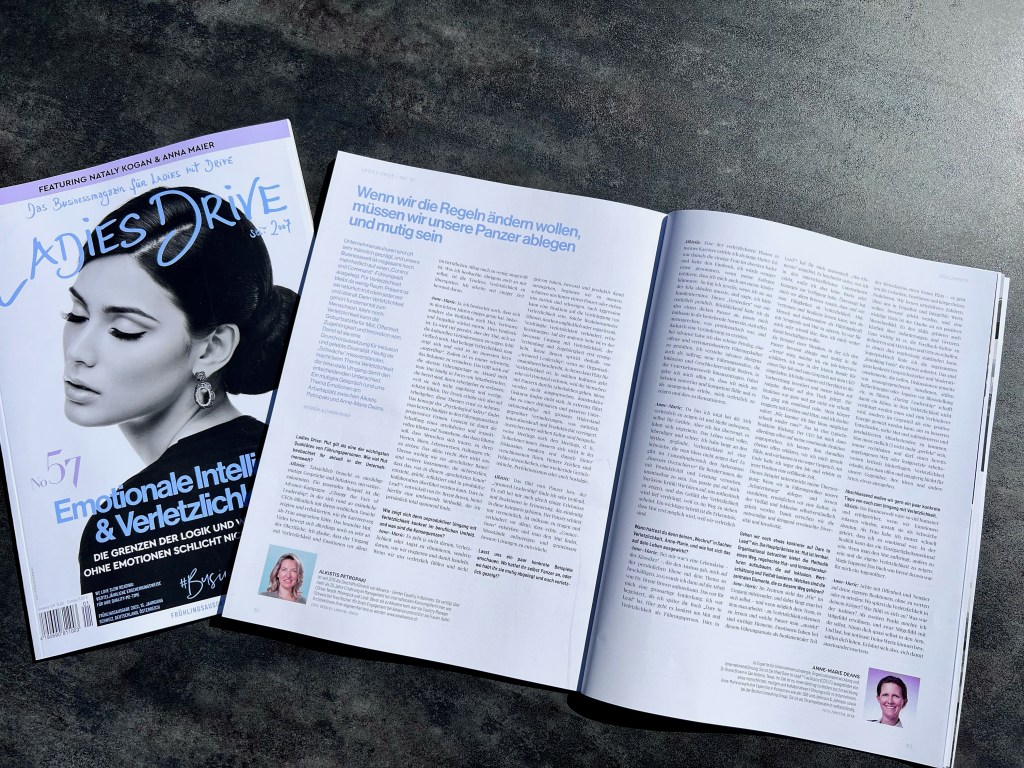
Dazu durfte ich meine Erfahrung in einem Gespräch mit Alkistis Petropaki teilen und dabei von ihr erfahren was Verletzlichkeit für sie und in ihrem Alltag mit Advance – Gender Equality in Business bedeutet.
Diese Gelegenheit bedeutet mir sehr viel, denn Alkistis mit ihrer Organisation setzt sich mutig für neue Regeln in der Arbeitswelt ein, und ich bin der Meinung wir müssen in Unternehmenskulturen die Fähigkeiten zum Umgang mit Verletzlichkeit fördern, denn wir brauchen Mut. Ein grosses Dankeschön an Alexandra Rhiner für die Leitung des Gesprächs.
Dazu kommt das ich den Eindruck habe, gerade im deutschen Sprachraum wird noch weniger über Verletzlichkeit (Vulnerability) gesprochen. Ist es der Begriff? Wäre Verwundbarkeit, oder ‘sich angreifbar machen’ oder ‘sich zeigen’ einfacher um das Gespräch aufzugreifen? Wir verstecken oft diese Verletzlichkeit, weil wir uns schämen nicht würdig /gut genug / geliebt zu sein. Ich finde schön wie in Deutschland der erste Artikel im Grundgesetz lautet “Die Würde des Menschen ist unantastbar” und in der Schweiz im Grundrecht “Die Würde des Menschen ist zu achten und zu schützen.”. Daran kann man sich orientieren und wir dürfen nicht Angst vor Fehlern haben, wir lernen alle – jedoch kann man Kompetenzen lernen, um im Alltag mit dieser Verletzlichkeit umzugehen und auf seine eigene Würde sowie die Anderer Acht zu geben.
Veröffentlicht ist unser Gespräch in der aktuellen Ausgabe der Business Zeitschrift Ladies Drive (Frühling 2022). Insgesamt hat die Herausgeberin Sandra-Stella Triebl spannende Beiträge von beeindruckenden Personen zum Thema Emotionale Intelligenz & Verletzlichkeit zusammengebracht. Und aktuell ist das Thema Verletzlichkeit ja sehr präsent um uns herum und betrifft uns alle. Eine Leseempfehlung.
Wer interessiert ist mehr zu erfahren darf gern mit mir unverbindlich Kontakt aufnehmen. Das Dare to LeadTM Programm von Dr. Brené Brown ist auf Deutsch verfügbar, ihr Buch dazu noch in der Übersetzung und nicht am deutschen Titel stören lassen.
The Great Attrition triggered surely by our collective recognition of our vulnerability and the finity of our lives has gained significant traction in the US and now in Europe. McKinsey ran a big study and recently shared these numbers, which caught my attention in the blog here.
“More than half of employees who left their job in the past six months did not feel valued by their organization (54 percent) or manager (52 percent), or they lacked a sense of belonging (51 percent). Additionally, 46 percent cited the desire to work with people who trust and care for each other as another reason to quit. Employees want stronger relationships, a sense of connection, and to be seen.”
It’s not about the office, it’s about belonging. McKinsey.com, 13th January 2022. Accessed 19th Jan 2022.
It is good to see our human need for belonging and it’s role in the Great Re-Evaluation, as Arianna Huffington calls it, get the deserved attention.
Small fixes as suggested in this post by McK are a good immediate step.
Yet if we mean the change seriously, I believe this calls for a real re-think of our societal and organisational cultures. Including slowing down, lots of self-awareness work to be able to show up as a courageous and vulnerable leader, and reframing our mindset towards one of abundance and collaboration.
That would include in organisations having to question our productivity and performance measures, including which behaviors and deliverables those measures really create and measure. Or questioning being so occupied with competition, profit, busyness and creating more wealth for the few beneficiaries right at the top of the current structures?
It’s a bumpy path and vulnerability is uncomfortable, we might have to admit some management choices we were part of for example to drive up productivity and consumerism weren’t so great. We have to look at our individual choices – how do we show up towards ourselves and others, what and from whom do we make purchases, what do we have to let go off.
It can also be pretty lonely if you are ready to start down this track, with various shareholders resisting any change and pulling you back when they can.
I am convinced those leading the way with courage will create spaces for people sharing their values in purpose, authenticity and belonging to join them and at some point that magic tipping point for others to follow will happen. In the same way I prefer to believe people are doing their best, I prefer to be part of reimaging a great place that our world is developing towards.
In this post I dig in to the term ‘Collaborative Narrative’ and why I believe it is important at the individual leader level, and also at a cultural level for our societies and organisations.
I had the pleasure to participate in a Story DoJo session hosted by Mary Alice Arthur, in which she explored the topic of story and power with the author Annette Simmons. Annette Simmons has a new book coming out this October, which is on my ‘to-read’ list and I am looking forward to. In the Story DoJo session Annette Simmons shared her theory around ‘competitive narrative’ and a ‘collaborative narrative’.
In our societies and businesses we have been operating in an environment with armored leadership, scarcity-fuelled anxieties and predominantly competitive narratives. Competitive narratives mean the messages and stories we are sent are “you always have to be better than others”, “it’s all about winning”, “perfectionism, exhaustion are signs your are committed”. For example one of the latest McKinsey Email Newsletters in my inbox headlined “Can your company stay competitive if it focuses only on what it’s good at today?” – Source McKinsey Daily Read Newsletter 24 July 2021.
If we are looking to shift to new systems and business models with daring leadership and a mindset of abundance, than we require new stories of success. And new stories of success have to support new ways to measure success, it cannot be about profit alone and it cannot be with a singular view on the organisation. It has to be a wholistic view with benefit to the organisation and within the external environment. This would mean the organisation is successful if it is contributing to better wellbeing and a healthier planet for us all. We need system thinkers and ecologists to work with the economists on building these narratives.
With the current ongoing focus on ‘Purpose’ – I am convinced that what people are looking for is how their organisation belongs within the ecosystem of our society and planet. It is our right-brains inherent understanding of the interconnectedness of everything and an increasing demand for this belonging to be made very explicit. This is a key part of a Collaborative Narrative – what is our organisation’s (and thus our employee’s) role within our system to create wellbeing for all?
Some questions to ponder on:
The famous ‘Hero’s Journey’ – how do we make one that is collaborative?
What stories do you read and see in your go to sites for information? Are they competitive or collaborative in nature?
How do we change and agree upon what we measure as success?
Here I talk about a ‘Collaborative Narrative’ – it is about collaboration and cooperation, right?
Source: You can find more information on the work about the power of stories by Annette Simmons here.
In this post I dig in to the term ‘Abundance Mindset’ and why I believe it is important at the individual leader level, and also at a cultural level for our societies and organisations.
“No problem has been more puzzling to thoughtful people than why, in a troubled world, we make such poor use of our affluence (Galbraith)” in J.Suzman. Work: A deep history.
Have you ever wondered why we believe time is scarce? Working long hours is seen as the way to create value? Material goods and money are the main indicators of our success? Competition and being the ‘winner’ is what counts?
Here’s the thing we live in a ‘scarcity-fuelled’ society. Scarcity meaning: “being in short supply or shortage”. We get taught from a young age onwards that we have to compete for the best grades and future jobs – this continues in adult life with performance rankings, material status symbols, the artificial desire for constant consumption. It has become our underlying mindset for our lives and the social and economic constructs. We are taught we are not enough, we don’t have enough and we don’t know enough.
I outline what living in scarcity does to our behaviour and creativity in the post on Daring Leadership. The work by Dr. Brené Brown shows that when we are in a scarcity-driven state of anxiety we are more likely to armour up and isolate ourselves further, rather than dig into vulnerability, creativity and courage to open up to new ways of operating. So being in a scarcity mindset is not going to be a great position to help us with the challenges around us and reimagining new systems.
An additional great piece in the puzzle as to where this ‘scarcity-fuelled’ way of operating may be rooted was provided in the recent publication “Work: A deep history, from the stone age to the age of robots” by James Suzman. As an anthropologist, James Suzman provides a view at a societal and economic level over our work history: from hunter-gatherers, via foraging, to farming, city-dwellers, the industrial revolution and finally our current times. I highly recommend reading the book to learn way more than I highlight in my summary and take-aways below. It provides a provoking insight. (Note: Direct quotes from this book are marked in italics)
James Suzman’s main conclusion is that we operate in a scarcity-driven system that originated in the agricultural period. Now, if we understand how our scarcity mindset originated it enables us to take a step back from our scarcity obsession and question if it is still a valid mindset for how we want to operate in our societies and businesses going forward. It allows us to recognise our own man-mind constructs, which means it is not fixed but up to us to change it.
If we move from a scarcity-driven mindset to an abundance mindset as the main notion underlying our activities, it will allow us to tap into creativity and curiosity. An abundance mindset is one where we focus on ensuring basic needs are met and beyond that the underlying notion is that we are enough, have enough and know enough. Of course we have to make sure basic economic needs are met globally and real scarcity is a thing of the past. Yet, I am convinced starting with an abundance mindset (plus daring leadership and a collaborative narrative) will play a key role on achieving more balanced distribution of the wealth and affluence we have.
As James Suzman highlights in his book, John Maynard Keynes called for an economics of abundance and that in such a scenario inequality would become irrelevant. Similarly, “Galbraith was of the view () individuals would relinquish the pursuit of wealth in favor of worthier work.”
So let’s dig into the case James Suzman builds around our work history and where scarcity originated:
James Suzman proposes that originally hunter-gatherers focused on meeting solely their immediate needs and established systems like ‘demand sharing’ with flat hierarchies. What they needed to cover their immediate needs was abundantly available and required limited amounts of their time to obtain, giving them time for leisure. In summary they had a form of affluence without material abundance as they had modest desires, which were easily met. In the consequent stage of foraging, foragers still enjoyed a form of affluence based on far greater material abundance. It is also the phase where people began to adopt a longer-term, more future-focused relationship with work.
The move to farming is really when the future-focused relationship with work and anxieties about scarcity developed and intensified. James Suzman summarises that climate changes led to a situation where the environment could not provide sufficient food year-round, so it changed the relationship with the land and work. Farmers had to focus on fewer but more prolific plants and also new farming techniques. Any gains in productivity were matched by growing populations. The situation led to an expansion into new spaces and to cultures based around anxieties about scarcity and productivity. “The sanctification of scarcity and the economic institutions and norms that emerged during this period still underwrite how we organize our economic life today“.
It is also in the farming period that the concept around money starts. “The origins of money lies in the credit/debt arrangements that arose between farmers – who were, in effect, waiting for their land to pay them for the labor they invested in it and the people who depended on their surpluses”
Later, when the industrial revolution changed farming productivity and with the continued population growth people started to aggregate in cities. Less people were occupied as farmers to work the land, and new specialist trades developed for organising how people lived in the larger populations and settlements. “This required bureaucrats, judges, soldiers, and those who specialized in keeping order and binding people together into urban communities with common values, beliefs, and goals.”
Furthermore, 20th century economic concepts and mindsets have contributed significantly to our scarcity and productivity focused systems: “Taylorism” – the focus to maximise efficiency with standardisation and assembly lines, it may have addressed a need for a while and certain industries, yet the issue here being “the right person for these industrial jobs was someone limited with imagination, boundless patience, and a willingness to obediently do the same repetitive tasks day in and day out.” “Consumerism” – producers and advertisers have been creating fears and artificial needs to keep consumption and growth up as well as “creating desires for material products would make people feel like they were moving upwards and worry less about inequality. “Talent” – a concept around a war for talent, has since been challenged for it’s issue that leads to “competitive narratives also amongst employees, overvaluing individuals, creating a corrosive culture and decreasing collaboration“.
Finally, yes wealth was created with this focus on scarcity and productivity – however this wealth has been highly concentrated amongst a few: “The richest 10 percent of people on earth own an estimated 85 percent of all global assets, and the richest 1 percent own 45 percent of all global assets”
So our relationship with scarcity are by-products of the transition from foraging to farming. James Suzman highlights how again and again it was observed by historians how people were losing their sense of belonging and purpose in these systems. For example, Durkheim was curious about the “malady of infinite aspiration” and he coined a term “anomie” as the feelings of intense dislocation, anxiety, and even anger in people due to their social isolation. We see today the concerns around growing isolation and it’s impact on mental and physical health. Already Durkheim recognised how creating safe working environments with strong relationships could potentially be a solution and when we today talk about daring leadership and purpose we are recognising the same. We are “A species whose evolutionary history has been shaped so profoundly by its need for purpose and meaning”. Besides the social cost, there is the environmental cost as we are aware and the mentioned wealth inequality cost.
No one can summarise how important this work is than James Suzman himself in the conclusion of his book:
“Recognizing that many of the core assumptions that underwrite our economic institutions (and notions of scarcity and a preoccupation with economic growth) are an artifact of the agricultural revolution, amplified by our migration into cities, frees us to imagine a whole range of new, more sustainable possible futures for ourselves, and rise to the challenge of harnessing our restless energy, purposefulness, and creativity to shaping our destiny”.
So are you ready to reimagine and start building our societies and economic models based on a notion of abundance? Start with this – you are enough, you have enough and you know enough to contribute to the change we want to see.
Source: Work – A deep history, from the stone age to the age of robots. James Suzman, Penguin Press 2021.
In this post I dig in to the term ‘Daring Leadership’ and why I believe it is important at the individual leader level, and also at a cultural level for our societies and organisations.
You are working on a project, your colleague has a great idea for an improvement that is mentioned over a coffee break. However, in the critical meeting no one speaks up. When they do speak up – you notice no genuine interest by those in the room to spend time to dig in to what this change would require. Most of the time in your organisation you seem to be reactively fixing issues, adding a new task force on top of another – rather than taking courageous decisions of stopping projects or blocking a chunk of time to really engage in meaningful dialogue with the experts and take hard decisions.
Time and time again in different organisations I witnessed and participated in similar situations and behaviour – yet I couldn’t quite put words to what was going on. I valued my colleagues individually, yet in our work interactions we seemed to stay in safe places that mid-term felt very dissatisfying regarding the business decisions taken.
Brené Brown opened my eyes and gave me language to explain what is going on in our societies and organisations. By interviewing CEOs and c-level executives Brené Brown collected all the answers to what is required in leaders. The answer she received most often was courage – “We need braver leaders and more courageous cultures”. Did they know how to act with courage and what skills this required? No – was the answer. But then the list, like mine above, started pouring out – behaviours that get in the way of a courageous work culture. This led to a large piece of research by Brené Brown and her group to look closely at the topic of courage and vulnerability in our work cultures.
‘Daring Leadership’ is based on this research by Dr. Brené Brown, Research Professor at the University of Houston, Texas. Other terms that for me relate to Daring Leadership and which are used elsewhere are ‘Servant Leadership’, ‘Courageous Leadership’, ‘The Purposeful Leader’.
If you are a leader living by Daring Leadership principles then you are leaning into vulnerability and staying open to learning, you are caring for and connecting with your stakeholders, you are demonstrating curiosity and empathy and you have the courage to develop the potential in people and processes.
Brené Brown is not alone in her findings of the importance of courage and vulnerability. The best business schools and management consulting firms have started to put major highlight on the importance of trust, vulnerability, empathy and innovation in our workplaces. The recent publication by Hubert Joly “The Heart of Business” is receiving much positive attention for it’s focus on ‘unleashing the human magic’.
Yet, what is significantly harder to find are concrete methodologies that provide you with a way to strengthen your own skill set, provide you with tools and help you recognise when you are on the right path to being a leader and building an organisation with a culture of vulnerability, trust and empathy. Too often it is assumed we are naturally brave or trust is something you just have, or it is easy to come forward with these attributes.
Dare to Lead™ is an empirically based courage building program designed to be facilitated by organisational development professionals. It originated in the publication of Dr. Brené Brown’s research findings in the book Dare to Lead™.
Daring Leadership is unrelated to a companies organisational design. How you draw your organisational chart, whether you like the old-fashioned boxes with dotted and direct lines and classic project management, or you focus on agile methods and new ways of operating, whether you are set up in business and function units or are a process-driven organisation – it really does not matter (and I actually believe overall it does not really matter). Daring Leadership is the cultural and behavioural glue you require for HOW you, your leaders and employees operate within the organisational setting and interact with one another.
So why is Daring Leadership important? In a world that is transforming from shareholder-driven capitalism to a new form of stakeholder capitalism, from individual profit focus to sustainable solutions and with new technological advancements we have to be able to stay curious, foster an environment with diverse thinking, the ability to have tough conversations and dig into uncomfortable decisions. And with all of this we have to care better for each other and our planet.
On an individual level there are steps you can take on your path to Daring Leadership:
First, you become aware of what is happening around you – you observe carefully your own behaviour and that of others around you at the workplace. For example do people come up with and give voice to questions or suggestions, are there ‘meetings-after-the-meetings’ taking place where, what was agreed is altered again and do you feel you are constantly just fire-fighting issues rather than proactively taking the time for hard conversations early when issues start to appear?
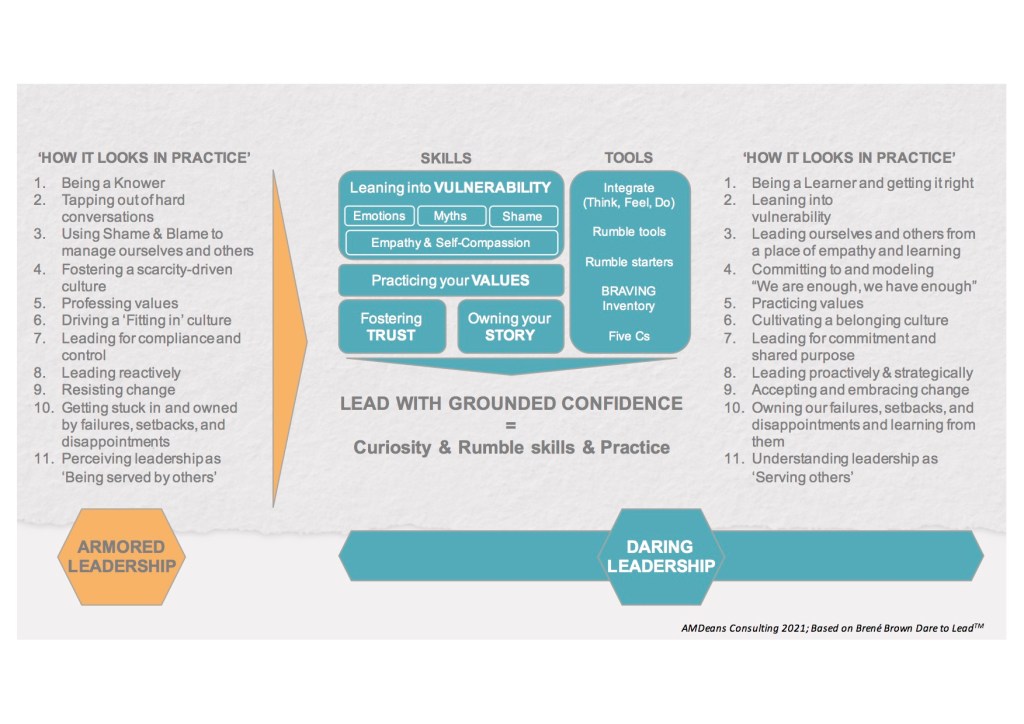
Second, learn the skill sets for courage – by understanding vulnerability, identifying and discovering how to practice your values, understanding the elements required to foster trust and find out how to own and change the stories you develop. To build these skill sets you have amongst others the options depending on your learning preferences to read the book, work with a coach or take part in a Dare to LeadTM facilitated program. The facilitated program is also available to organisations.
Finally, you can develop your practice by integrating tools such as rumble starters into your daily way of working and keep developing the ability to lead with grounded confidence – that is by staying curious, using your rumble skills and practice, practice, practice.
On a societal and business model level we have to focus on building these skill sets in individuals, but also by generating interactions, time and space for meaningful dialogue around our values and also start operating from a notion of an abundance mindset and with new collaborative narratives that define how we measure success.
Summary of the Dare to LeadTM program to develop Daring Leadership, ie leading with Grounded Confidence. Dare to LeadTM is an empirically based courage building program developed by Dr. Brené Brown. Image by AMDeans Consulting 2021.
Source: You can find more information on the work by Dr. Brené Brown and Dare to LeadTMhere.
“Their economic life was organized around the presumption of abundance rather than a preoccupation with scarcity”
Work: A deep history, from the stone age to the age of robots. James Suzman, 2020.
A sentence that in one moment brought different elements of what I have been studying and observing over the last years together. For me it was a major moment to “ReThink” – the term nicely coined by Adam Grant.
What do I mean?
First of all let’s start where we are today. It is obvious that our existing economic and societal models are not working as they should. If we look at the wellbeing of our societies and planet that becomes crystal clear – growing wealth inequalities, crazy levels of illness and burnout, loneliness becoming a leading cause of death, a climate crisis looming and the financial system we operate by being close to it’s end just pumping money into the system. I believe our systems have most recently been scarcity-driven to manage and control behavior, foster consumerism and hence drive the required economic growth.
Second, let’s talk about the work by Brené Brown, which I have now been studying for many years. Her evidence-based findings is targeted at individuals and relationships between individuals – it all started looking at the importance of connection and belonging. The research has identified that our current armored leadership style is linked with scarcity and a fear of not being good enough, not belonging and deep-rooted shame. She also identifies the skill sets for daring leadership – so a methodology for how we can move to a place of courage, vulnerability and curiosity.
Finally, the book by James Suzman allows us to take a different perspective on the system we operate in today. He leads us through history and shares how we have in the past lived by a concept of abundance. His hypothesis links this to a much better state of wellbeing.
So what?
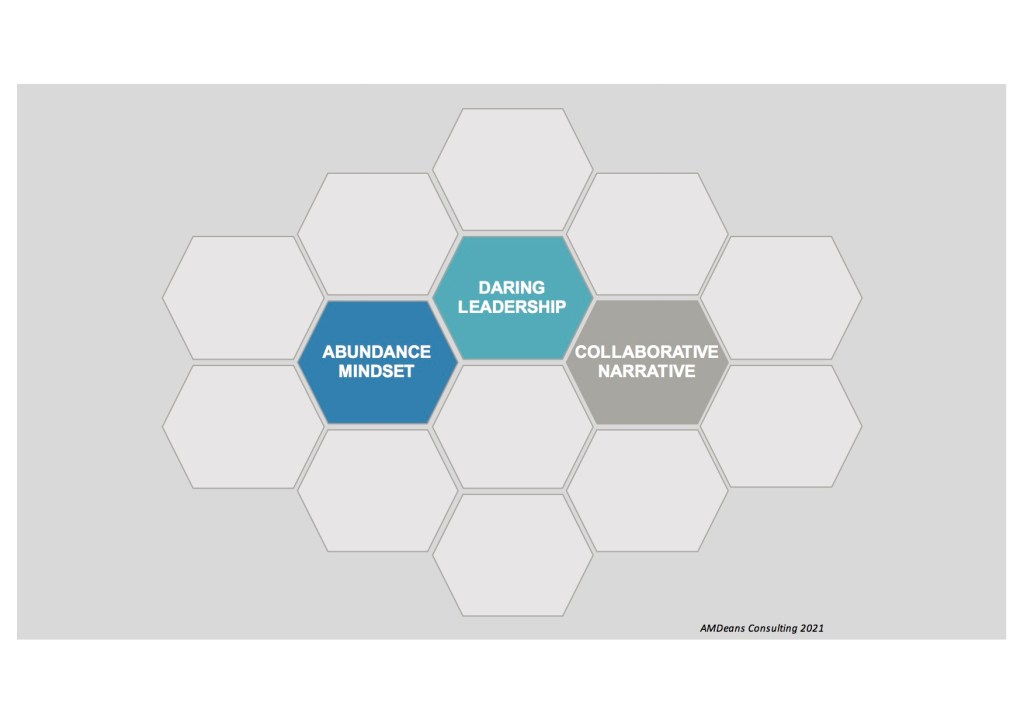
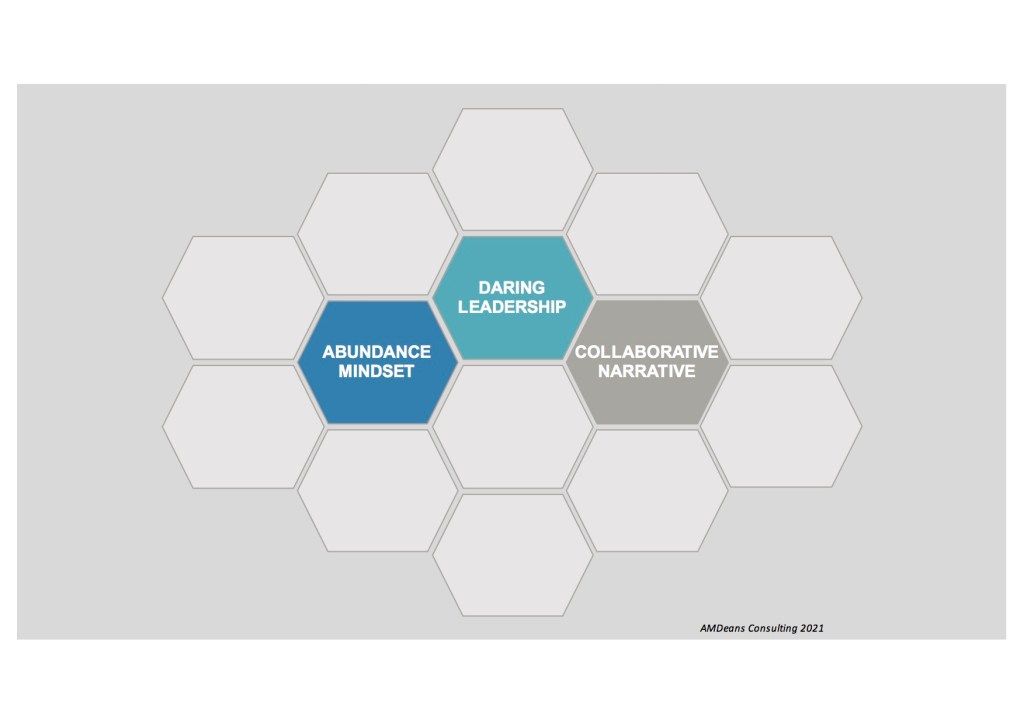
Let’s reimagine our world to build new values, societal systems and business models around the following concepts:
1) daring leadership – so a truly human way of operating with each other, caring for and connecting with ourselves, each other and the planet stands above short-term financial returns.
2) abundance mindset – we have to move from trying to drive human behavior by instilling scarcity-driven fears to a notion of building trust that together we have enough.
3) collaborative narrative – as a last piece of this puzzle I believe we need to generate new stories around power and how we will measure success.
I will diving more into all these elements and additional research plus resources that supports how we can do this in following posts.



 amdeans-consulting.com