
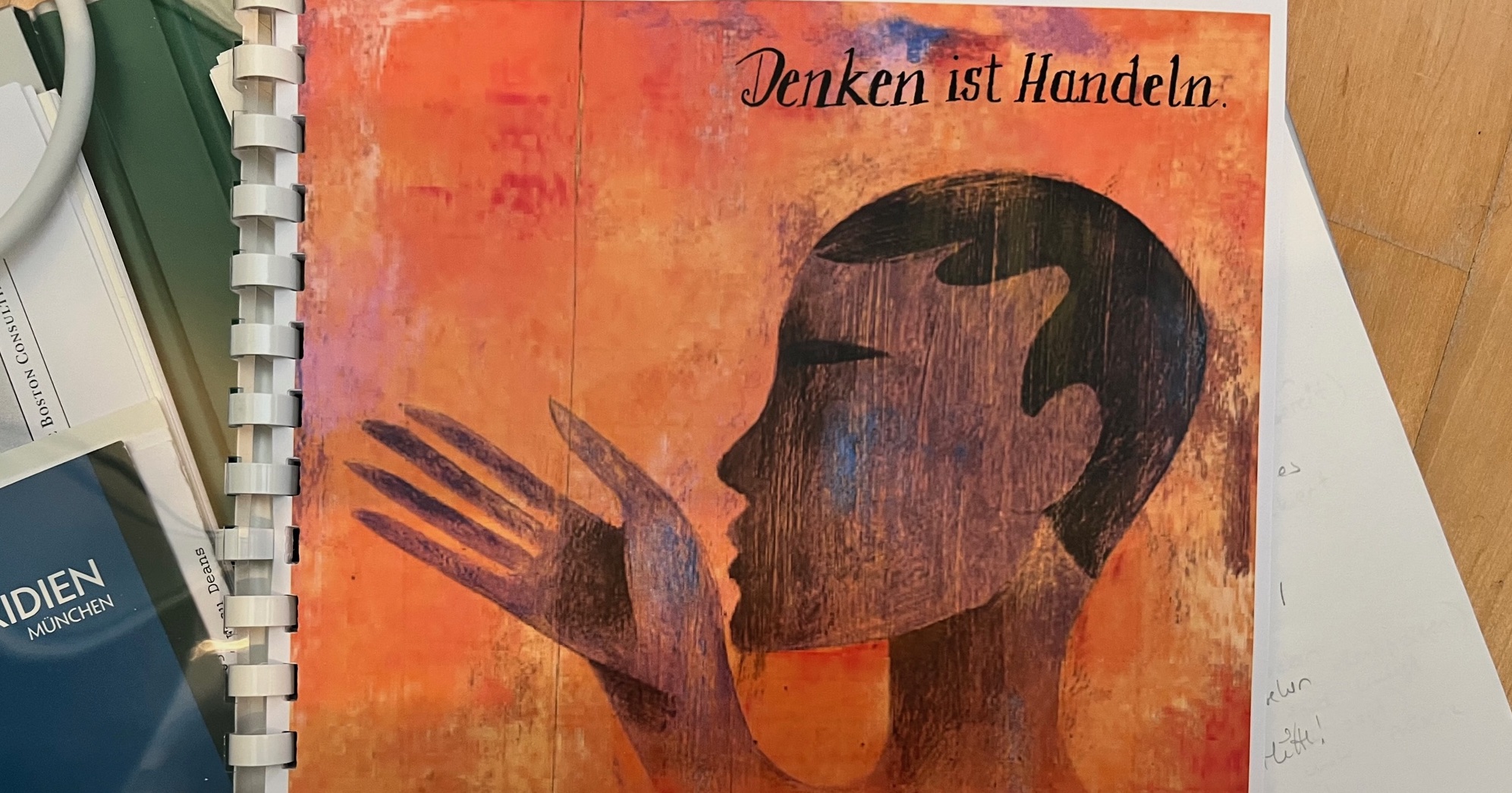
Image: Artist Olaf Hajek 2003. Personal material from the Move On Weekend, Munich 2005, by The Boston Consulting Group.
“Denken ist handeln” takes me back to my first interaction with the large management consultancy I joined after my malaria PhD. That line, “Thinking is for action,” spoke to me. I love ruminating, researching, putting complex bits of information into a digestible big picture, spotting the inconsistencies, the patterns, the messages. I tend to hang out a little longer on the side of thinking than on the side of action.
Yet – today I ask.
What if our thought itself was incorrect?
What if our thought adapted to a world around us and is driven by external messages of “you are not enough until _____” and you fill that blank with an external validation: your school grades, your university, your job titles, your products, your material wealth, your nose shape, your wittiness, your number of likes and followers. A world that we have created and our brains told us this is the only way of doing things.
If there’s one thing that such thought does it keeps us pretty distracted, busy and insecure as our basic desire for worthiness depends on external factors. It turns our opinions into self-identities, as David Bohm writes. It makes conversations into dangerous battle-grounds, as differing opinions are seen as attacks on our inherent internal worthiness and right to belong.
It makes us distracted and complacent.
As I write this, the world is watching atrocities unfold in the Middle East. It feels a little like the final straw on the camels back. I observe we are in pain. Yet, I also sense a discomfort in a sense of how could this happen (again). And a sense of grief for what we realise we are losing. There is also an unsettling silence to not say a wrong thing.
For me this article in the Guardian by Patrick Wintour sums up what I believe is a relevant viewpoint and speaks in a broader sense on other topics such as the loneliness, the anxiety, the questions on how to care for each other and our planet better. His title captures it: “The danger of leaving things be”.
Can we break the cycle of complacency?
Can we channel the regret of what got us here today, into where we put our energy into action tomorrow?
From all the research into the topics of wholehearted, courageous leadership, moving from discussion to dialogue and ways of rethinking strategy and business, I land at these three areas of focus for myself:
- Thought: Start with “you are enough”. Full stop. Then get really curious about a lot of other aspects of what we think of as normal and ‘has to be that way’. Ask yourself is it true?
- Feeling: Seek out & soak in awe. You can find this witnessing moral beauty in others, music, dance, nature, art. Read words from those that inspire you, watch concert videos, go to an exhibition, dance in the kitchen. Awe connects when the world polarises.
- Action: Shift from exploitation to exploration. I hold a deep desire to work with leaders and organisations (exploitation). That rarely allows real disruption and is slow, the logical consequence – it’s time to work with those leaders and organisations at the fringes (exploration).
Now here’s the thing – if we are feeling regret mixed in with all those feelings, according to Dan Pink we have three choices: Delusion, Despair or Action. Let’s choose action.
Sources:
- David Bohm: On Dialogue.
- Dan Pink: The power of regret
- Dacher Keltner: Awe, The transformative power of everyday wonders
 amdeans-consulting.com